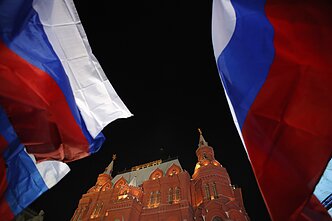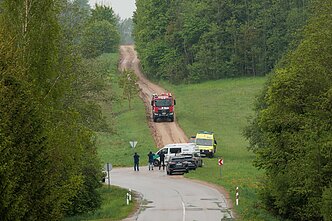
















Russian troops traversing Belarus could be an “early warning” of Moscow’s military aggression against the Baltics, according to a report by Chatham House analyst commissioned by Vilnius Policy Analysis Institute.
In the report on Belarus and Russia, presented in Vilnius on June 23, Anais Marin from Chatham House analysed the prevailing myths on the two countries’ integration – including the military union envisioned by the Union State treaty signed in 1999.
Since 2019, the two countries have been engaged in controversial discussions over the implementations of the treaty. Moscow pushed Minsk to hand over “95 percent” of Belarusian sovereignty, which would have meant “sheer capitulation”, the Belarusian ambassador to Russia, Vladimir Semashko, told the state news agency BelTa on July 1.
Even though Russia has been trying to project “an image of a functioning military alliance”, according to Marin, Belarus declared neutrality during Russia’s war against Georgia in 2008 and Ukraine in 2014.
Belarusian leader Alexander Lukashenko said in 2019 he was unwilling to be trapped “in someone else’s wars”, according to the report.

If an “unlikely scenario” of Russia preparing a large-scale attack on the Baltics and Poland, Minsk “could well assert its desire for neutrality, by withholding diplomatic support or delaying efforts to enhance interoperability or provide Russia with supporting forces”, the report said.
This would be an “an early warning to NATO” as “any invasion of Lithuania or Poland would [have to] see Russian forces traverse Belarusian territory”, according to Alexander Lanoszka, a professor at University of Waterloo, quoted in the report.
“Rather than considering Belarus as a mere extension of Russia’s Western military district”, the country could be a buffer for the Baltics and Poland “against a conventional Russian attack”, wrote Marin.
Read more: Poland and Lithuania to plan joint Suwalki Gap defence
Therefore, to counter Russia’s attempts to use Belarus for military needs, a regional security approach should “encourage NATO to intensify contacts and cooperation with Belarus – something which Turkey and Lithuania allegedly opposed up until now”.
According to a 2019 report by Jamestown, a think tank in the US, Lithuania has been blocking ratification of NATO’s cooperation agreement with Belarus over the Astravyets nuclear power plant.
The Belarusian facility is being built just 50 kilometres from the Lithuanian capital, which Vilnius says is unsafe and a tool for the Kremlin to apply pressure on the Baltic states and Poland. Minsk denies all allegations.
Read more: Worried of Belarus nuclear plant, Lithuania ups monitoring measures

Newsletter
Every Friday morning.