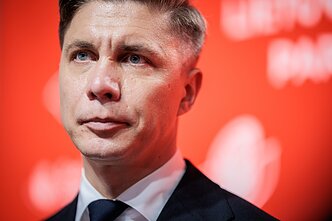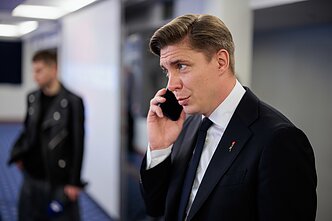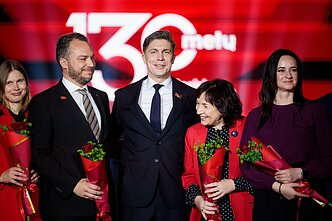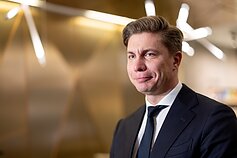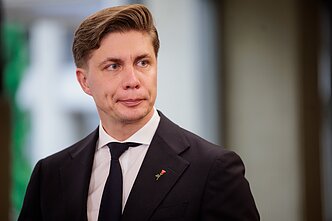
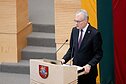
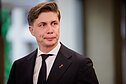



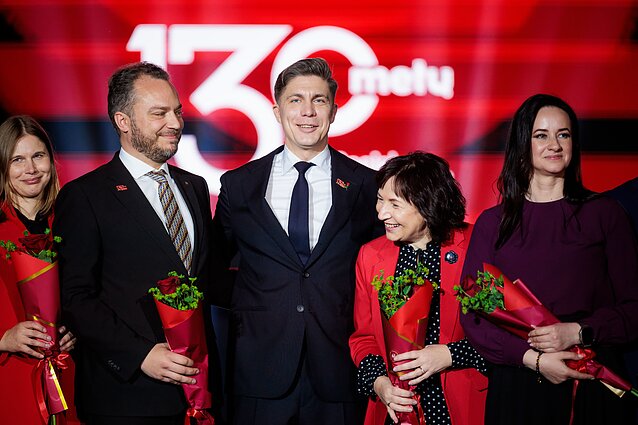
Lithuania will have a new prime minister – Mindaugas Sinkevičius, leader of the Lithuanian Social Democratic Party (LSDP).
His career trajectory in recent years reads like a political drama series – from bright prospects, to the courts, and back up to the heights of Lithuanian politics.
Though most people know Sinkevičius, who turns 42 on June 20, as the mayor of Jonava district, his political journey had previously taken him all the way to national government.
Rooted in Jonava
Almost the entirety of Sinkevičius' political career has been spent in local government – specifically in Jonava, a district in the middle of Lithuania. Born there, he established himself in the district's administration as early as 2007, when he was elected to the municipal council.
After a year on the council, he became deputy mayor of Jonava district in 2008, and by 2011 had taken the mayor's chair himself.
He only agreed to leave Jonava in 2016, when the Social Democrats formed a coalition with the Lithuanian Farmers and Greens Union, which had won the parliamentary elections, and he was appointed economy minister.
That stint in national politics was short-lived, however. Within a year, the then Social Democrat leader Gintautas Paluckas encouraged the party to withdraw from the coalition with the Farmers. While some Social Democrats chose to remain in the coalition, and consequently had to leave the party, Sinkevičius did not follow that path and resigned as minister.

He recently spoke on Edmundas Jakilaitis' podcast Politika (Politics) about how he had been pressed to stay in post at the time, including by Ramūnas Karbauskis, who then led the Farmers.
"I was serving as economics minister, things were going well, Saulius Skvernelis asked me to stay, Ramūnas Karbauskis spent an hour and a half trying to convince me, but I said no. The decision to step back was political, not the result of any mistakes," the Social Democrat leader said on the podcast.
After his brief ministerial career, Sinkevičius did not return immediately to local politics, instead spending 18 months as director of Jonavos Vandenys (Jonava Water Utilities). He was re-elected mayor in 2019, though that term proved to be full of difficulties.
A swift and painful fall from grace
The political landscape in Lithuania might look rather different were it not for the expenses scandal.
Sinkevičius had been a rising political star. Having become president of the Association of Lithuanian Municipalities in 2019, he was among the most prominent mayors in the country. His standing within the Social Democratic Party was also growing, with some already tipping him for the premiership.
Then came the expenses affair. Activist Andrius Tapinas and his outlet Laisvės TV began scrutinising expense receipts submitted by municipal councillors for reimbursement.
In 2023, Sinkevičius was charged with allegedly causing financial damage worth 1,487 euros to the Jonava district municipal administration between 2019 and 2023.
Laisvės TV found that, while serving as mayor, he had used funds allocated for council members' activities to purchase two television sets and other communications services.
That November, following the charges, he suspended his Social Democratic Party membership, and the Association of Lithuanian Municipalities suspended his powers as association president.
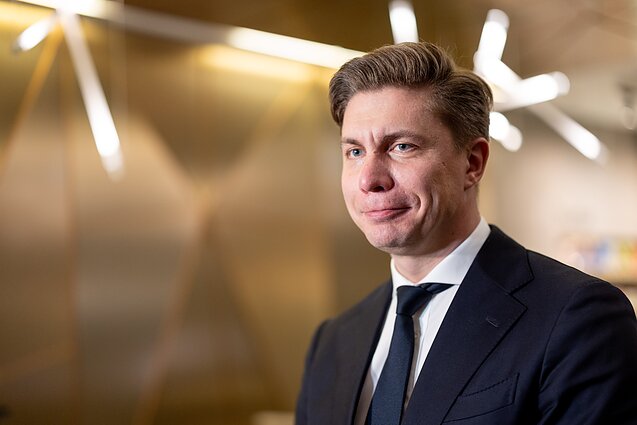
Sinkevičius himself maintained he had done nothing wrong.
"I do not feel I have committed any offence or crime. For now, there is no obstacle to carrying out the duties of mayor. Of course, we live in a state governed by the rule of law, and in this case only the courts, or several levels of courts, will have the final say, since legal processes in Lithuania tend to move rather slowly," he said as the case reached trial.
Nonetheless, he was compelled to leave the mayoral post after the Court of Appeals dismissed his plea and upheld the Kaunas Regional Court ruling finding him guilty of abuse of office, document forgery and misappropriation of property.
The court imposed a fine of 12,500 euros and banned him for three years from running for election or being appointed to positions in state and municipal institutions. He was therefore barred from continuing as mayor.
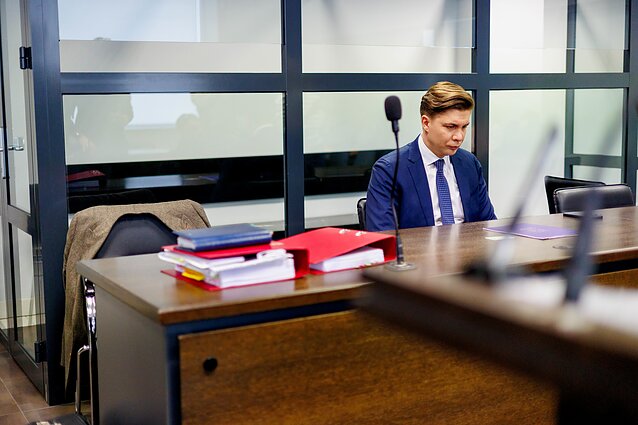
Sinkevičius did not give up, however, and pressed his case before the Lithuanian Supreme Court – with success.
In early March 2025, the Supreme Court terminated the expenses case against him and quashed the guilty verdicts handed down by the lower courts.
Sinkevičius immediately returned to the post of Jonava mayor and, a year later, was elected leader of the Social Democratic Party.
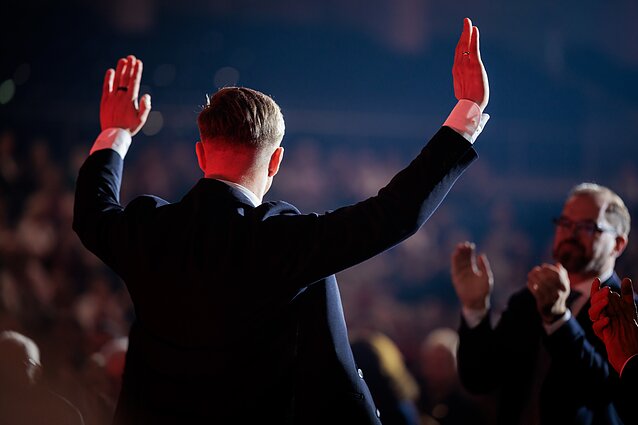
However, the Chief Official Ethics Commission previously found that Sinkevičius had conflated personal and public interests. In June 2025, the commission voted unanimously that a conflict of interest had occurred. However, there was in practice "no real liability" for him, the commission said.
"In this specific case, the only applicable sanction is that, for one year, the individual may not be promoted, elected, or appointed to a higher position within the institution where he serves or within its subordinate organisations – meaning the municipality and its affiliated bodies," commission chairman Gediminas Sakalauskas told journalists.
He was already in the highest position at the municipality and, therefore, could not be penalised by having potential promotions frozen or blocked.
Sinkevičius and Fegda
A company called Fegda began attracting considerable attention last year, after it emerged that a road the firm had built to the Rūdninkai training ground was defective. Despite the faults, the Defence Ministry had not demanded that the company rebuild the road.
At the time, the ministry was led by Social Democrat Dovilė Šakalienė. The news portal Delfi then reported that Sinkevičius, by then serving as acting Social Democrat leader, had been employed by Fegda.
According to Delfi, Sinkevičius held the position of commercial director at Fegda from November 19, 2024 to March 7, 2025 – the period following the Court of Appeal ruling in the receipt case, after which the Central Electoral Commission had stripped him of his mayoral mandate.
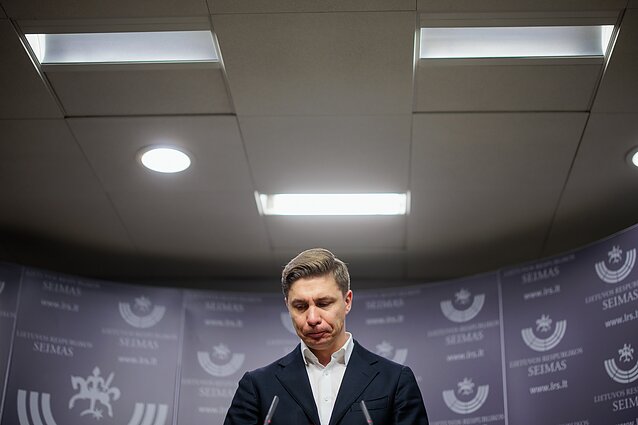
According to the Register of Legal Entities, Fegda is headed by Jonas Jablonskis, with Arvydas Gribulis holding a 33.44% stake and sitting on the board alongside Gintaras Kazakevičius, Rimvydas Šėrys and Mantas Makulavičius.
Delfi also reported that Sinkevičius' father, Rimantas Sinkevičius, then chairman of the Seimas Economics Committee, had in 2020 taken part in a hunting trip with Fegda shareholder Gribulis. Mindaugas Sinkevičius and Gribulis are also said to be members of the same hunting club, Tauras.
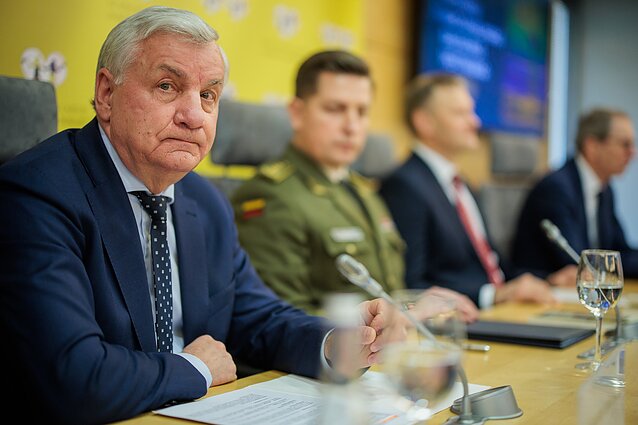
Former defence minister Šakalienė indicated that when she summoned Fegda representatives for a meeting about the matter, she received a sharp reaction from Sinkevičius. Lithuania's anti-corruption watchdog, the Special Investigation Service (STT), also sought clarification regarding Fegda, though no pre-trial investigation was launched.
Sinkevičius himself insisted that he had never acted on the company's behalf before central government institutions.
"I have never – personally, directly, or through third parties – represented Fegda's interests before any central government institution," the politician stated.
The agreement to form a governing coalition between the Social Democrats, the Democrats "For Lithuania" and the Lithuanian Farmers and Greens Union is due to be signed this week.

Newsletter
Every Friday morning.