













Lithuania suffered greatly during the late-2000s financial crash. With turmoil following the US-Israeli war against Iran, could current global disruptions lead to a similar crisis?
The author of the 2007 book A Demon of Our Own Design, Richard Bookstaber, who anticipated the approaching crisis at the time, argues that the greatest danger now lies not in so-called “financial engineering”, but in the financial system’s links to the physical world.
“Our models for detecting risk look at prices, volatility and correlations. They have no instruments for reading a grid failure, a drought or a severed supply chain. By the time warning signs show up in market data, the damage will already have been done,” he wrote in an opinion piece for The New York Times.
Our current financial system fails not because any one thing goes wrong. It fails because different shocks propagate through the same structure and in ways that are hard to anticipate,” he warned.
Bookstaber identified artificial intelligence, the nearly $2tn private credit market, stock markets, Taiwan and now Iran as areas under the greatest strain.
These risks are analyzed one by one, news article by news article. We understand them in isolation. Yet they are different entry points into the same underlying structure ,” he said.
Heading towards recession
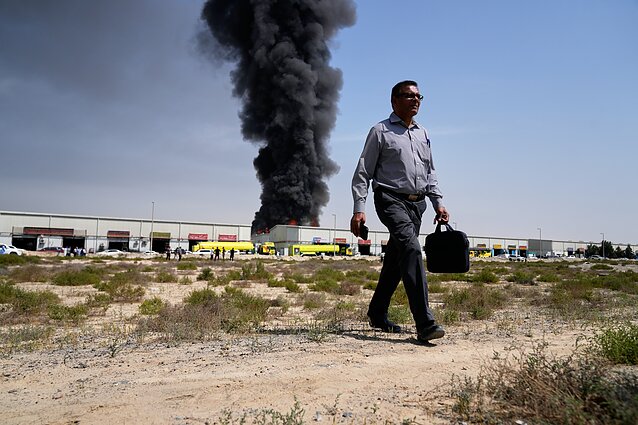
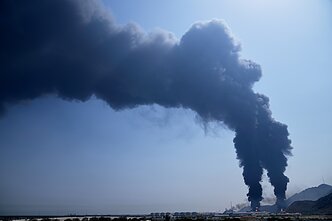
Swedbank investment strategist Vytenis Šimkus told LRT.lt that the outlook for the global economy and financial markets has deteriorated significantly due to war in the Middle East.
“Stock markets are approaching correction territory – a 10% fall. Many asset classes are declining, and a surge in inflation is raising fears that central banks will increase interest rates, further slowing the economy and weighing on asset prices.
“The current situation echoes several historical examples – the oil crisis of the 1970s, the conflicts in Iraq in 1990 and 2003, and even the 2022 invasion of Ukraine. Energy shocks often not only push up prices but also slow growth, as less income is left for other goods and services. For now, markets are pricing in a relatively quick end to the conflict, but the damage is growing daily,” he said.
So far, most attention has focused on oil, but Šimkus said disruptions to natural gas, fertiliser, aluminium and helium supply chains should also be closely monitored, as they could have even greater consequences.
“Even after accounting for mitigating measures, about a tenth of oil demand is currently unmet, while supply of some products has fallen by as much as a third.
“In 2022, the energy shock hit when demand was at record highs and labour markets were tight, with governments still actively stimulating post-pandemic recovery. Weaker demand now should mean a more limited impact on inflation – prices may rise by 1–2 percentage points faster, but double-digit inflation is likely to be avoided. On the other hand, the impact on growth could be greater,” he said.
Could it happen again?
In reference to the 2008 crash, Šimkus said risks are also emerging from the financial sector.
“Before 2008, we also saw very high asset prices, active lending and expensive energy. That combination produced one of the largest financial crises in a century, raising fears that it could happen again. While there are similarities, the differences are also clear,” he said.
He stressed that 2008 was so severe because the financial system effectively stopped functioning – the circulation of money, the lifeblood of the economy, was disrupted.
“Banks are now far better capitalised and more liquid than they were then, with a much greater capacity to absorb losses. Risks have accumulated outside the traditional financial system.
At that time, the bubble was driven by rapid private-sector borrowing; now, debt indicators are far more sustainable. Financial crises rarely occur without a preceding borrowing boom. Private debt has grown quickly, but it remains a relatively small part of the financial sector,” he said.
However, this doesn’t make the current crisis any less dangerous.
“Unless a solution is found to reopen the Strait of Hormuz, resources will continue to become more expensive until demand falls. That will affect both growth and financial asset prices. In a typical recession, equities may correct by 20–30%,” he said.
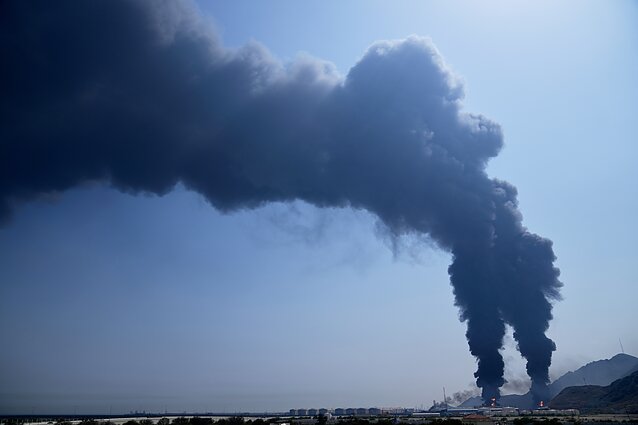
‘The US is not suicidal’
Lithuania’s Finance Ministry forecasts economic growth of 3.1% this year, inflation of 3.7% and unemployment of 6.8%. The International Monetary Fund expects global growth of 3.3% in 2026.
However, the war on Iran has led economists to question such optimistic projections.
Vilnius University economist Algirdas Bartkus said this is now a time for scenarios rather than forecasts.
“The catastrophe scenario would be this: we run out of oil, hyperinflation wipes out savings, the economy falls into decline and we end up with a real-life version of Mad Max. I do not think that will happen. Someone will simply tell Donald Trump that the party is over – and that will be that,” he told LRT.lt.
Bartkus said he is not yet abandoning baseline forecasts, but advised considering less favourable scenarios.
“We understand that the US is not suicidal. What is happening is unhealthy for both the US economy and politics. Its aim is not to halt global economic development. I believe this conflict will be resolved one way or another, and not in a catastrophic way. There is no need to paint doomsday scenarios,” he said.
In his view, several lessons should be learned.
“First, it is risky to have an energy-imbalanced economy, as it creates excessive dependence on a single resource. Another lesson is diversification. Lithuania once had a completely undiversified oil supply, largely dependent on Russia. Now it is much more diversified – with roughly half coming from Saudi Arabia and the rest from Algeria, Norway, the UK and sometimes the US. However, the share from Saudi Arabia is still too large, and further diversification would be prudent,” he said.

Newsletter
Every Friday morning.