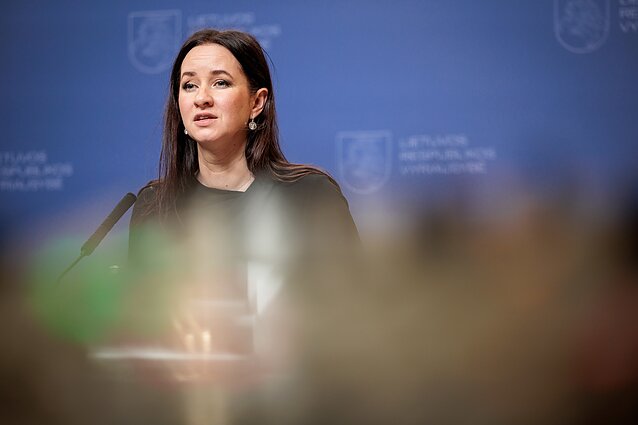







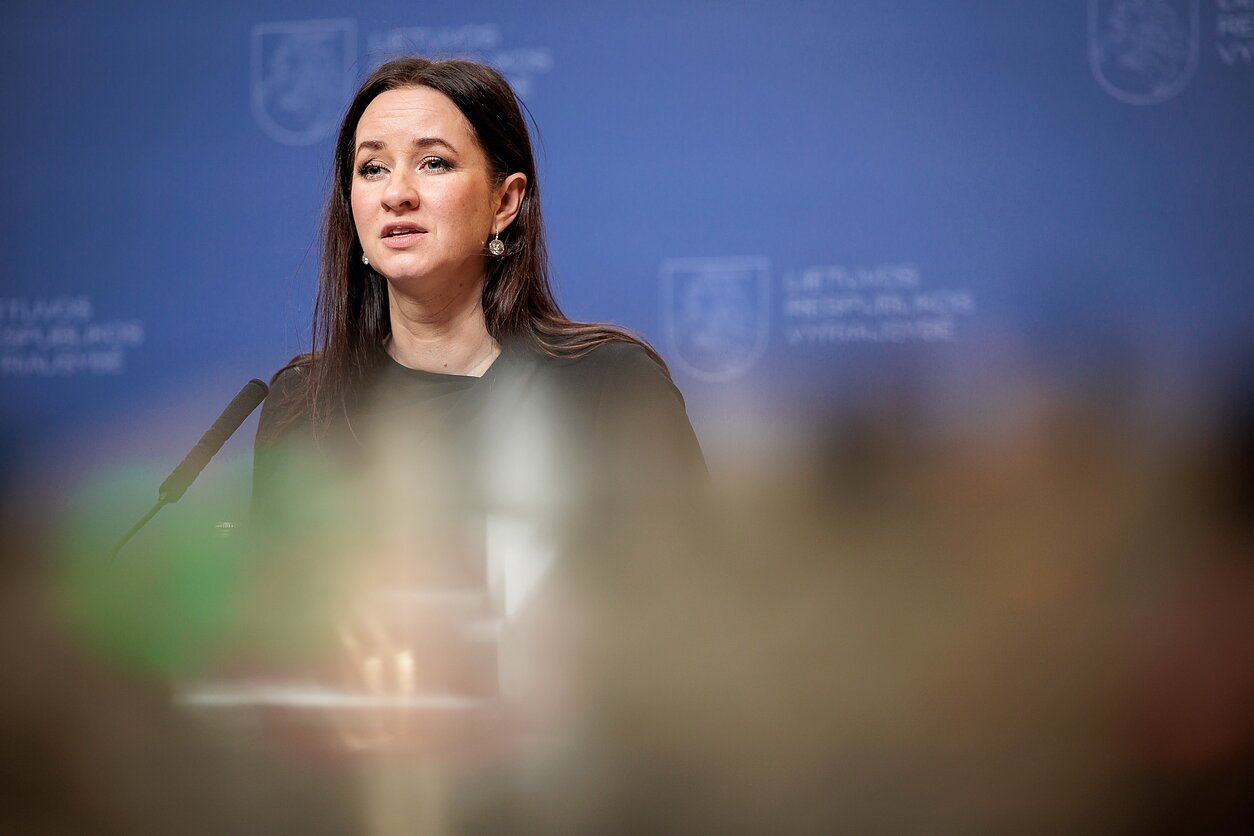
Prime Minister Inga Ruginienė said on Friday that Lithuania would consider a proposal by US envoy on Belarus John Coale to hold a meeting with Minsk at the deputy minister level, adding that certain conditions would need to be met.
“We discussed balloons, the release of lorries, illegal migration – these are indeed the issues we raised, as they are our conditions for meeting Belarus at the deputy minister level,” Ruginienė told LRT.
In an interview with LRT published on Friday, Coale proposed that Lithuania organise a bilateral political meeting with Belarus, which he said could take place at the deputy minister level. He also noted that restoring fertiliser transit through Lithuania would be beneficial to Washington.
Ruginienė said the resumption of fertiliser transit had not been discussed with Coale. “At no level has fertiliser transit through Lithuania ever been discussed with the US envoy,” she said.
“We cannot consider anything regarding fertilisers, as European Union sanctions are currently in force,” the prime minister added.
According to Ruginienė, Lithuania has set the following conditions for Belarus: first, meteorological balloons used for smuggling must stop crossing the border; second, all detained lorries must be returned without additional charges or financial penalties; and third, Belarus must prevent irregular migrants from crossing into Lithuania.
“We are talking only about a technical meeting to exchange positions. Such a meeting could take place once the conditions are met,” she said.
Ruginienė stressed that while the number of balloons crossing the border had declined somewhat, this was also due to Lithuania’s active anti-smuggling efforts. Meanwhile, Vilnius airport was again shut down for an hour on Thursday evening.
She added that, beyond smuggling, some balloons launched from Belarus appear to be deliberately directed towards Vilnius airport, which she described as a sign of targeted hybrid activity.
Belarus has also released some of the detained lorries, but is demanding that hauliers pay parking fees.

Fertiliser issue
There has been informal political discussion for some time that the United States may in future seek some easing of sanctions on Belarusian fertilisers, though any such move would require agreement across the European Union.
The export of fertilisers is considered one of the main sources of income for the regime of Alexander Lukashenko.
Lithuania's Foreign Ministry declined to comment on Coale's calls for deputy minister-level talks with Minsk to restore fertiliser transit, saying European Union sanctions on such shipments remain in force.
"Lithuania consistently adheres to the positions agreed at the EU level regarding political relations with Belarus and the sanctions imposed on it, which are confirmed in the conclusions of the European Council and the EU Council," the ministry said.
It noted that on February 26, the bloc extended sanctions against Belarus, including those on Belarusian fertilizers, for another year.
"None of the reasons for which the EU began applying sanctions to Belarus in the summer of 2020 have disappeared. Lithuania appreciates US efforts to stop the Belarusian regime's hybrid attacks against Lithuania and the economic pressure measures applied against our country and EU companies, which, unfortunately, are still ongoing," the ministry added.
This sentiment was echoed by Remigijus Motuzas, chairman of the Seimas Committee on Foreign Affairs, who told reporters on Friday that "even if Lithuania wanted to ease or thaw sanctions at this stage, it could not," adding that "there can be no unilateral decision. The United States knows this."
Motuzas emphasised that the common position of European Union member states remains key.
"We are maintaining our consistent position because we still have unresolved issues with Belarus," he added.
Technical-level talks possible?
Meanwhile, speaker of the Seimas Juozas Olekas took a more nuanced approach saying that technical-level contacts with Minsk were possible, while higher-level engagement would depend on progress in talks.
“It seems that there will be various technical and working-level discussions, because if we want to resolve issues, we will inevitably need contacts – there is no other way. But first, there must be mutual understanding, not one-sided concessions, especially while the other side maintains an aggressive stance. Technical talks, in my view, should take place,” he told reporters on Friday.
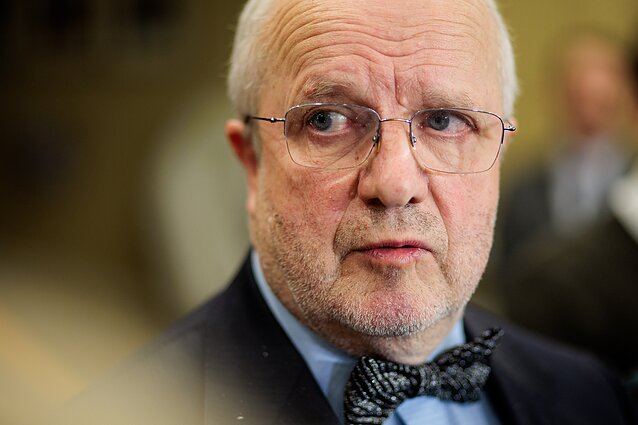
Asked whether meetings could also be held at a higher level, such as deputy ministers, as suggested by Coale, Olekas said this would depend on how discussions with Minsk develop.
“If further progress is achieved, then perhaps other steps will follow. We are not so rigid as to say nothing will happen. We need progress, we have very clear objectives, and that is what we are pursuing,” he said.
According to Olekas, Lithuania aims to maintain good neighbourly relations, but only if certain conditions are met.
“We are talking about an end to Russia’s aggression, an end to Belarus’s support for that aggression, and the release of all political prisoners. These conditions remain. As for how to persuade the regime to meet them, we are also using the American channel,” he said.
Olekas noted that although some political prisoners had been released following Coale’s visits to Minsk, this was not sufficient for higher-level contacts with Belarus.
“However, continuing this work is certainly necessary. We may also need greater activity on our part, including possibly lower-level contacts at the embassy in Minsk, so that we have the information we need. These relations matter to us, as does security,” he said.
He added that Lithuania had previously focused significant attention on the safety of the Astravets nuclear power plant but was now effectively cut off again, making lower-level engagement in Minsk important.
Olekas said there were no plans to return Lithuania’s ambassador to Minsk, but that non-political staff could be deployed to maintain situational awareness.
Following the 2020 presidential election in Belarus – widely regarded by Lithuania and other Western countries as illegitimate – Vilnius withdrew its diplomats from Minsk. After the ambassador’s term ended in 2021, no replacement was appointed, and representation was downgraded to a chargé d’affaires and a special envoy.
Last week, Coale visited Lithuania and met President Gitanas Nausėda and Prime Minister Ruginienė to discuss what Vilnius describes as hybrid attacks by Minsk.
Nausėda said he had warned the US representative to treat the regime’s statements with caution.

Nausėda: Belarus dialogue possible if Minsk shows goodwill
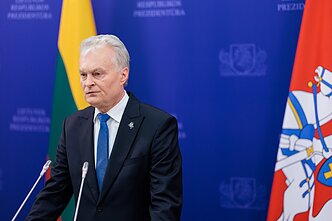
Lithuanian President Gitanas Nausėda said later on Friday that dialogue with Belarus is only possible if Minsk shows genuine goodwill.
"So far, we see no goodwill from the Belarusian side. I would say that opportunities for dialogue arise when the other side demonstrates a desire to foster neighbourly relations as much as possible," Nausėda said.
"If we see a stable situation over a certain period and the Belarusian regime poses no direct threats to Lithuania, then contacts and dialogue at a certain level are possible," he added.
Nauseda said that the issue of fertiliser sanctions is decided at the European Union level. The EU extended sanctions against Belarus, including those on fertilisers, for another year on February 26.
"These were introduced much earlier and are linked not so much to current hybrid attacks, but to human rights violations, the illegal 2020 presidential elections, and, undoubtedly, the de facto participation of Belarus in Russia's war of aggression against Ukraine," he said.
The president added that Belarus’s decision to release detained Lithuanian trucks could hardly be seen as a sign of goodwill, as they were initially detained illegally by Minsk.
"It is as if we should be thankful for the return of an illegally seized item," Nausėda said.
Belarus has already released some of the detained trucks. Lithuania’s State Border Guard Service (VSAT) said on Friday that 153 trucks had returned to Lithuania via the Medininkai and Šalčininkai checkpoints, though Minsk is still demanding parking fees from carriers.
Meanwhile, balloons carrying contraband continue to enter Lithuanian airspace, albeit less frequently.
"Unfortunately, the balloon problem has not been solved. I would say it is being demonstrated in a provocative manner just after the special envoy left Belarusian territory," Nausėda said.
"Under such a regime, one would have to be very bold to carry out this kind of activity if the authorities were categorically opposed to it. If it continues regardless, it means there are enough signals that the authorities not only do not object but even encourage it in some way," he added.
Tsikhanouskaya aide urges Lithuania not to make political concessions
Dzianis Kuchynski, an aide to Belarusian opposition leader Sviatlana Tsikhanouskaya, said on Friday that now is not the time for Lithuania to offer political concessions to Minsk.
"In our view, now is not the time for Lithuania to offer Lukashenko any political or economic concessions, such as political dialogue or the transit of potash fertilisers," Kuchynski said.
"In my opinion, such steps will lead nowhere because Lukashenko's goal is not cooperation with Lithuania – he seeks to weaken and humiliate Lithuania and the wider democratic community, to gain advantages and continue to undermine Lithuania's national security.
Today, Prime Minister Inga Ruginienė clearly stated that no negotiations on fertiliser transit are taking place. We are personally grateful to her and her government for their firm position on this and other issues," he added.
Kuchynski said repressions in Belarus continue, and although some political prisoners are being released, they are immediately replaced by new ones.
"This is a cycle designed to create an illusion of change. Lukashenko is not changing course – on the contrary, he is increasingly becoming an accomplice in Russia's full-scale war against Ukraine. He acts as Putin's subcontractor and vassal, and will continue hybrid attacks against our neighbours, including Lithuania and Poland, in one way or another," he said.
"We see no systemic changes. This is a regime trying to trade an illusion of change for real concessions – as if it wanted to buy a Lamborghini for 1,000 euros: give very little but expect great benefits," he added.
He urged European partners, including Lithuania, to remain firm and principled.
"More sanctions, constant pressure, continued non-recognition, and clear accountability for Lukashenko. [...] It is precisely this pressure – the deteriorating economic situation and fear of prosecution in The Hague – that forces Lukashenko to make limited concessions, including the release of political prisoners," Kuchynski said.
He also expressed hope that the US would not exert institutional influence on Lithuania or the EU to make concessions to the regime.
Previously, other prominent members of the Belarusian opposition called for dialogue with Lukashenko in an effort to free political prisoners.
Further reading
Updated: included Lithuania's Foreign Ministry's and Remigijus Motuzas' stances, added comments by Nausėda and Kuchynski.

Newsletter
Every Friday morning.