













Police in Vilnius have launched a pilot project to respond to certain incidents by deploying drones instead of sending patrol officers to the scene.
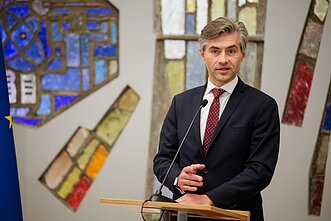
Police Commissioner General Arūnas Paulauskas said Monday that the project is being tested in cooperation with the city municipality.
“A pilot project has started in Vilnius. Together with the municipality, we are looking at the possibility of responding to certain incidents with drones. A drone flies to the scene, officers see a live view and the real situation, and often patrols do not even need to go,” Paulauskas told a news conference.
Four drones are currently being tested under the system, he said.

The commissioner general said the system could be expanded, noting that in many cases the physical arrival of officers is not necessary. For example, in minor traffic accidents where no one is injured, a drone can record the position of vehicles, allowing drivers to complete accident declarations without waiting for police.
Drones could also be used to respond to other incidents, such as blocked driveways, obstructed vehicles and similar situations, he said.
Equipped with thermal imaging cameras, drones may also be effective in catching thieves who steal car catalytic converters at night, Paulauskas added.
Staffing pressures have also shaped police planning. According to Paulauskas, Lithuania’s police force shrank by 31 officers last year, the smallest decrease in the past decade.
The Police Department said 37 officers have left or been dismissed so far this year, while 13 new officers have joined. In previous years, an average of 45 officers left the service per month.

Last autumn, Paulauskas warned that hundreds of officers could leave if promised salary increases were not implemented, but a compromise was later reached. Amendments to the Internal Service Statute adopted at the end of the year introduced a monthly 300-euro compensation payment for officers eligible for retirement, which he said helped retain some personnel.
“Based on one or two months of data, we cannot draw conclusions,” he said, adding that police salaries should be significantly higher.
Women now make up 45% of Lithuania’s police force, according to Paulauskas. He said the gender balance has both advantages and drawbacks. While physical strength can matter in certain situations, research shows resistance against female officers tends to be lower than against male officers.
Officers are also trained to use so-called compensatory measures, such as electric shock devices and gas, which can offset differences in physical strength, he said.
Commenting on crime trends, Paulauskas said overall crime in Lithuania is declining, with two notable exceptions: drug-related offenses are increasing and the amounts lost to fraud are rising.
Crime numbers had been increasing since 2021 but began to decline last year. In 2024, 44,531 criminal offenses were registered in Lithuania, compared with 40,490 last year.
The most common crimes are theft, domestic violence, telephone fraud, driving with a blood alcohol level above 1.5 per mille and possession of narcotics, he said.
Serious and very serious crimes most frequently involve drug possession, fraud, sexual assault, severe bodily harm and rape.
Many fraud call centres operate abroad, complicating investigations, Paulauskas said, adding that about one-quarter of fraud cases are solved.
The number of homicides has fallen significantly. Seventy-three people were killed in Lithuania last year, compared with roughly three times as many a decade ago.
“We have not recorded contract killings for many years. Most homicides are domestic,” the commissioner general said.