















A parliamentary working group reviewing the governance of Lithuania’s national broadcaster LRT on Thursday agreed on a new definition of the broadcaster’s mission and proposed establishing a board starting in 2028.
The group, formed in the Seimas, Lithuania’s parliament, is examining possible amendments to the law governing Lithuanian National Radio and Television, LRT.
Meeting without most opposition members and several media representatives, the group approved a proposed mission statement that LRT should “ensure the public’s right to reliable, objective and diverse information and a variety of opinions, create conditions for free public debate and contribute to the preservation and development of the Lithuanian language and national culture, making content accessible in all regions and to various social groups”.
The draft also states that the mission must be carried out independently and impartially, without political or other external influence on content or editorial decisions.
The group previously agreed to establish a new governing body – a board – for the national broadcaster. On Thursday, members proposed that the board begin operating on January 1, 2028.
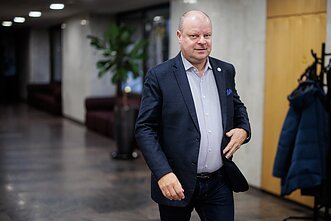
Working group chairman Juozas Olekas said board members should be appointed by July 1, 2027, allowing a six-month preparatory period before the body formally begins its work.
The group also agreed to expand the LRT Council from 12 to 15 members. Starting January 1, 2027, representatives would be delegated by organisations representing people with disabilities, the Lithuanian Local Communities Organisations Union and the Tripartite Council.
Under the proposal, the number of council members delegated by non-governmental organisations would increase, although a majority would still be appointed by politicians – the president and the Seimas.
For the first time, the group proposes setting specific requirements for council members. Candidates would need at least five years of professional experience in management and administration, academia, media or culture.
The working group also agreed to limit the participation of representatives of other media outlets in creating LRT content. The draft amendments would stipulate that individuals who own or publicly represent other media organisations could take part in LRT programs only under editorial policy conditions approved by the LRT Council, after declaring conflicts of interest and without using the LRT platform to promote their own outlets, shift audiences or strengthen their influence.
Donatas Večerskis, a board member of the Internet Media Association and deputy director of the 15min Group, said the proposed wording could create uncertainty.
“It will be unclear to us whether, for example, our editor’s participation in a program could be treated as advertising,” he said. “It is normal for such matters to be regulated by the council. But whether the law itself should define issues like audience shifting or influence strengthening is debatable. In our view, this amendment creates uncertainty.”
However, the working group decided to keep the wording unchanged for now, with Olekas saying amendments could still be introduced during parliamentary debate.
The group also agreed that the LRT director general could be dismissed before the end of their term for improper performance of duties, violations of the public interest, gross misconduct or failure to meet standards of impeccable reputation.
At the same time, the current requirement of a two-thirds majority of the council to dismiss the director general for lack of confidence would remain in place. The group also proposed limiting the director general to two consecutive terms.
Two members of the opposition Homeland Union–Lithuanian Christian Democrats faction withdrew from the working group at the start of Thursday’s meeting, leaving 12 members instead of the 17 originally envisaged. The Liberal Movement and representatives of the Association of Professional Journalists and an LRT initiative group had earlier declined to participate, saying organisations proposed by the Media Council were not included.
The working group is expected to finalise draft amendments to the LRT law by February 24.
The group was formed after the ruling majority in the Seimas failed to fast-track earlier amendments that would have allowed easier dismissal of the LRT director general.
Under the current law, the LRT director general can be dismissed in an open vote with at least eight of 12 council members in favour, and the dismissal must be based on the public interest.
In December, several protests drawing more than 10,000 people each were held outside the Seimas over concerns about threats to freedom of speech.

Newsletter
Every Friday morning.