












Lithuania has staked its security on the United States and its military presence in the region as well as the unity of NATO. But if that fails – is there a plan B?
“The old order is not coming back. We should not mourn it. Nostalgia is not a strategy,” Canadian Prime Minister Mark Carney said at the World Leaders Forum in Davos last week.
“The power of the less powerful begins with honesty” that the US-led world order has finished, the Canadian leader said in a speech that some observers have called historic.
Yet Lithuanian leaders are trying to simply endure this global transformation – even as discussions about “spheres of influence” and their potentially tragic consequences for the Baltic states are already taking place in the Vilnius political bubble.
“TS-LKD is now in an apocalyptic mood,” said one conservative politician. “Everyone is worried,” a senior Social Democrat politician added.
In an effort to understand the discussions taking place behind closed doors, LRT interviewed five former and serving senior officials, as well as prominent members of the country’s main political parties. They spoke on the condition of anonymity due to the sensitive nature of the topics.

What's next?
Lithuanian officials say no one is closely informed about the developments in Washington, adding that a similar mood is felt in other European capitals, too.
Some officials in Vilnius are also worried about the content of the American-Russian talks, as they are in the dark about whether the US military presence in Eastern Europe is also on the table.
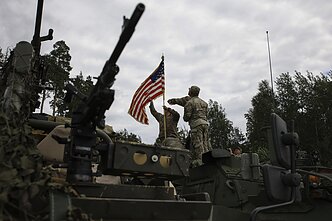
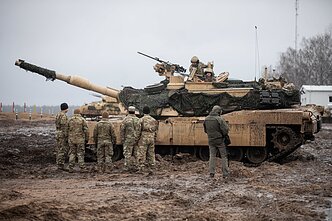
Lithuania’s relationship with Washington is based on the main security question – the presence of the hundreds of American troops and dozens of tanks stationed on Lithuania’s border with Belarus, an ally of Russia.
If they are gone, it’s an open invitation for Russia to test Lithuania and NATO, according to several Vilnius officials.
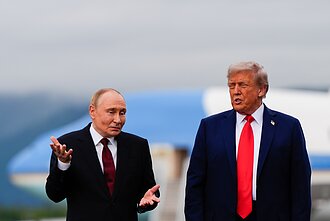
Some describe America’s approach as strategic ambiguity – where you don’t telegraph your actions to your adversaries. “Trump is the only one who can cause strategic dilemmas for Russia, [Former US president Joe] Biden failed in that,” a Lithuanian official said.
But this ambiguity is now being directed at friends and foes alike.
“We read the US National Security Strategy, and we see: ‘healthy nations of Central, Eastern, and Southern Europe’. Then we think – maybe they mean us?” said an official.
That uncertainty also encompasses NATO, once considered an immovable defence pillar, which would be hollow without the US presence, officials say.
“Now the US general in Europe has been given more powers, but he still has to call Washington. And what will he hear on the other end of the line? That’s where the uncertainty lies,” said another former senior official.
Meanwhile, one Lithuanian politician said they were told by their counterparts in the US that everything is much more straightforward than Europeans imagine – “Trump and a few people simply make a decision.”
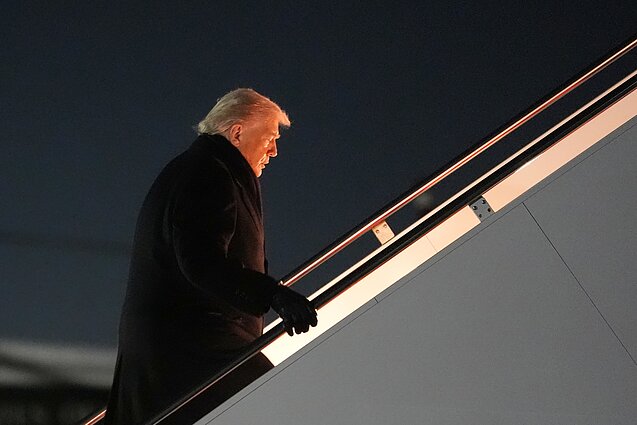
“With the Trump administration, one thing has to be kept in mind – decisions are not made by a small circle of people, decisions are made by one person,” a former official added.
However, much of the Vilnius political bubble considers that Trump’s rhetoric is just that – rhetoric. Others, critics say, are simply keeping their heads in the snow.
“The Social Democrats almost have no people for whom foreign policy really matters or who really understand it,” said a TS-LKD politician, echoing a similar sentiment expressed by other, non-conservative MPs as well.

Almost all interviewed Lithuanian officials said there was too much attention on Trump’s words and “too much panicking”.
“Creating the impression for Trump through actions or rhetoric that Lithuania sees an alternative or that we are clashing with US interests would be suicidal,” said one former official.
“The main rule is not to have illusions about our ability to influence that one person’s decision,” the politician added. “But we can ruin our position in his eyes in an instant, so we must be very careful. We can screw up very quickly.”
In an interview published by DELFI last week, Lithuanian Prime Minister Inga Ruginienė claimed that the country had “plan B and plan C” in case NATO collapsed.
“Just yesterday we had mobilisation plans, we discussed what is happening. [...] We must always have a plan B, with the possibility that we suddenly remain alone in the world. [...] We see a changing environment. There is no mythical [security] dome – we have to build it ourselves,” she said, adding that “Europe has begun taking good steps”.
Her comments received immediate criticism from the political opposition, saying it was irresponsible to speak about this publicly.
At least three politicians interviewed by LRT also said that all comments about the US are closely monitored, therefore, it was better to not criticise Washington publicly.
Some also ridiculed the prime minister’s assertion that there really is a plan B.
“Having a plan B is good. But what are the next actions? Nobody knows,” said one former official.
“Within the government, there are more people who understand that without America it is impossible to defend ourselves – as NATO Secretary General Mark Rutte told the European Parliament just yesterday,” another former official said.
“But there are also voices saying that Europe should build alternative capabilities and somehow think about what we would do without America. We must strengthen our capabilities in any case, but in the next few years, we cannot do without the US, so giving in to emotions is irrational,” he added.
For now, no European power is able to provide an alternative in defending against Russia – or to replace America’s role in NATO.

“Without the US, there is nothing to talk about. There simply isn’t – and I know this at the technical level: intelligence, satellites, troop numbers. It just doesn’t exist,” said a former official, repeating comments made privately and publicly by other Lithuanian leaders.
“Carney spoke well, and that’s it. The country’s north is guarded by 500 soldiers; they don’t even reach the 2 percent NATO defence spending threshold. Talking is good, but what comes after that?” the politician added.
The logic of relying on alliance-wide defence is also evident in Lithuania’s expensive military purchases, such as a limited number of tanks and helicopters.
“There are NATO defence plans, and for each country it is defined which capabilities it should develop,” a former official said.
The defence approach would be different if the military and political leadership prepared for a plan B – one where the country would have to defend itself without NATO’s help, at least for a while. But raising such questions, like defending without NATO, has previously received an immediate political backlash.
“I asked the military: if NATO did not exist, would you buy what you are buying now? They said no,” the source said.
This was disputed by another former official.
“There is no alternative whereby if we were to defend ourselves without the US, we would do something differently. We are still carrying out comprehensive growth of the armed forces, and Europe’s role in our defence plan, and that of countries like Germany, is already huge – larger than that of the US,” the source said.

Keeping up the sign
In his speech, Carney criticised the conformist mindset. He quoted Czech dissident and later president Václav Havel on how the communist system had sustained itself for so long.
“His answer began with a greengrocer. Every morning, this shopkeeper places a sign in his window: “Workers of the world, unite!” He does not believe it. No one believes it. But he places the sign anyway – to avoid trouble, to signal compliance, to get along,” Carney said.
Western countries did the same, he added, enjoying the US security and economic umbrella even while knowing that the “rules-based world order” was partly a fiction.
“When the greengrocer removes his sign, the illusion begins to crack. It is time for companies and countries to take their signs down,” he said, adding that “we are in the midst of a rupture, not a transition”. Following his speech, Trump pulled Carney’s invitation to join his so-called Board of Peace.
Yet, Vilnius is keeping the sign in the window, with officials saying they have no other choice but to suck up to Washington – there is nothing that can replace America’s military presence in the region and deter Russia.
According to one official, “the main thing now is to have as many friends as possible”. But the ultimate goal, the source said, was still “to remain under America’s sphere-of-influence umbrella”.
“That’s why we have to act cautiously when talking about China, about Taiwan, not make any changes or unexpected decisions, because we might then fail to keep up with his sudden decisions and suddenly find ourselves on the other side of the ditch,” said a former official.

Newsletter
Every Friday morning.