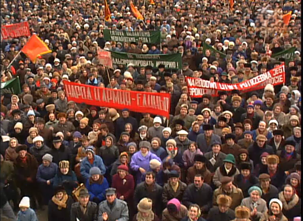



After the January 13 events, when Soviet forces killed 14 people, Lithuania entered a 222-day period of tension and instability leading up to the attempted coup in Moscow that marked the end of the USSR. Here’s what happened in those in-between days, when Lithuania’s institutions often functioned in parallel with the Soviet ones, while Russian forces continued attacking border posts and seizing buildings.
The text draws on interviews collected during the production of the documentary film 222 Days by director Giedrė Genevičiūtė, due to premiere on LRT on Tuesday.
Journalists who were expelled from the main building following the January 13 takeover continued working from Kaunas and other studios in Vilnius. Lacking proper equipment, they made do with consumer-grade cameras. At the same time, the Soviets began broadcasting the propaganda project Kaspervizija.

Meanwhile, some institutions had to work alongside the parallel Soviet structures. This was experienced directly by Artūras Paulauskas, who had been appointed the first Prosecutor General of Lithuania.
“They did not understand what was happening in Lithuania. That day, the entire staff of the Prosecutor General’s Office said we were not going to work with the [Soviet] prosecutor they had brought. [...] The dual power began in the prosecutor’s office,” recalled Paulauskas.
At that time, two prosecutor’s offices were operating in Lithuania: one directly subordinate to Moscow and headed by Antanas Petrauskas, and the other loyal to Lithuania.
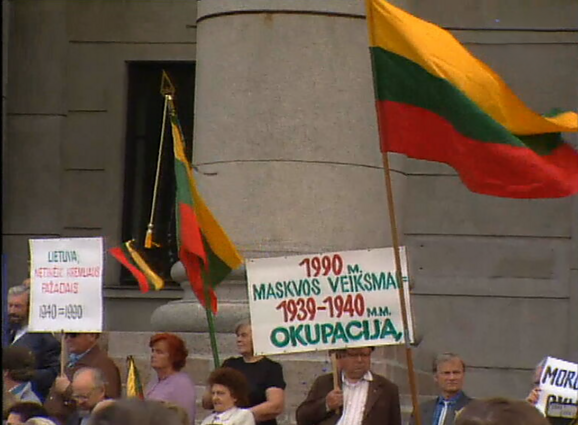
At the time, Soviet troops would commit crimes – from thefts to assaults on Lithuania’s border posts.
“The soldiers would leave their bases and commit crimes — thefts, murders. We investigated those crimes, but the Soviets claimed we were interfering and that the soldiers had to be returned to their bases, and that the military prosecutor’s office should deal with it,” said Paulauskas.
“Our aim was clear: to demonstrate to people that only the Prosecutor’s Office of the Republic of Lithuania existed here and that only our justice was being administered,” he added.
Relations with foreign countries also appeared ambiguous.
“Travel abroad was possible only via Moscow — ambiguity was unavoidable. Moscow itself faced ambiguity even in relation to me,” recalled Egidijus Bičkauskas, who represented Lithuania in Moscow.
“They could have detained and punished me, but at the time I was a deputy of the Supreme Soviet of the Soviet Union and enjoyed parliamentary immunity. If they arrested me, they would be violating that law and acknowledging that I was not a deputy. At the same time, they would be recognising our independence,” he added.
Less than a month after the January events, the propaganda Kaspervizija television attempted to justify the aggression by claiming that Lithuanians had been arming themselves.
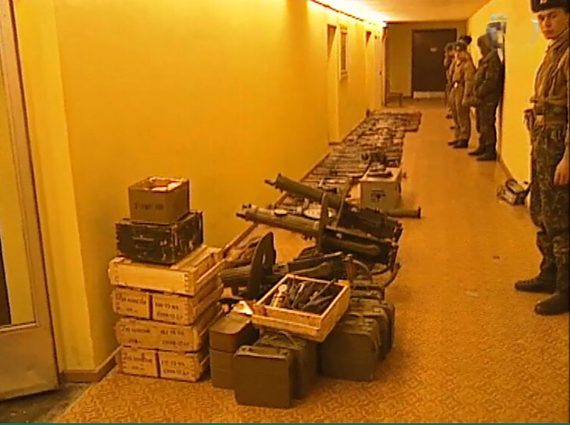
As evidence, it pointed to an arsenal of weapons found at the occupied television station, allegedly put together by the Lithuanian Rebirth movement’s “strike group”. In reality, the weapons were replicas and fakes used for filming.
“Those weapons were needed in the film studio as visual props for dramatisations,” said Mečys Laurinkus, then head of the State Security Department (VSD), the country’s intelligence service.
After the January events, most of the world viewed the aggression as an “internal conflict” within the Soviet Union. Lithuania had not yet been recognised by anyone.
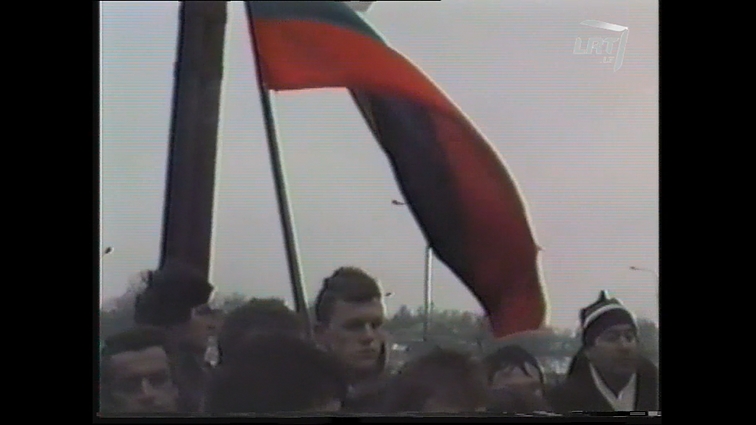
Referendums and recognition
Before the January events, there had been doubts within Lithuania about the need for an independence referendum.
“Vytautas Landsbergis [head of the Rebirth movement] held the view that we, elected to the Supreme Council of the Republic of Lithuania, already had the basis to declare independence and that no additional confirmation was needed,” said Bičkauskas, Lithuania’s representative in Moscow.
“[Soviet leader] Mikhail Gorbachev held a different view, hoping that during a referendum people would vote otherwise,” he added.
The hastily organised vote on February 9, 1991 was deemed illegal by the Soviets, largely because the results were extremely unfavourable to the Soviet Union – more than 90 percent of the two million participants voted in favour of independence.
Iceland and Denmark recognised Lithuania soon after, becoming the first countries in the world to do so.
On the eve of the vote, Kaspervizija and Moscow’s central television broadcast a dubious report about a Russian soldier allegedly beaten by 50 Lithuanians in Vilnius.
Meanwhile, Soviet structures were preparing for their own referendum, scheduled for March 17, to ask whether people backed the preservation of the Soviet Union.
Lithuania did not take part, as it did not regard itself as a Soviet republic. However, the Soviet referendum was still organised ad hoc across the country.
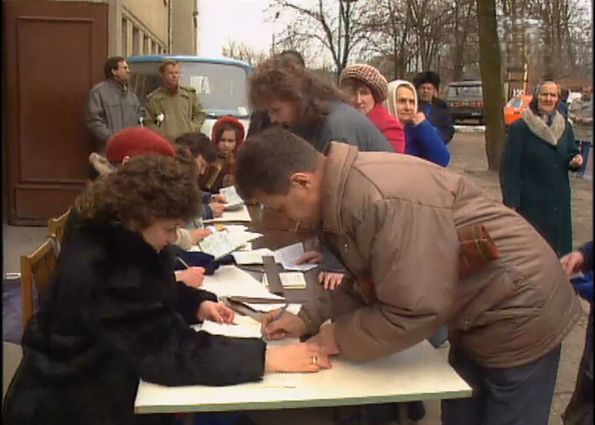
It was conducted in areas that remained under Soviet control, such as military bases and factories. In some locations, the improvised polling stations were set up outdoors, including in places which had “a predominantly Russian-speaking workforce”, according to former prosecutor Paulauskas.
Nixon and pressure on factories
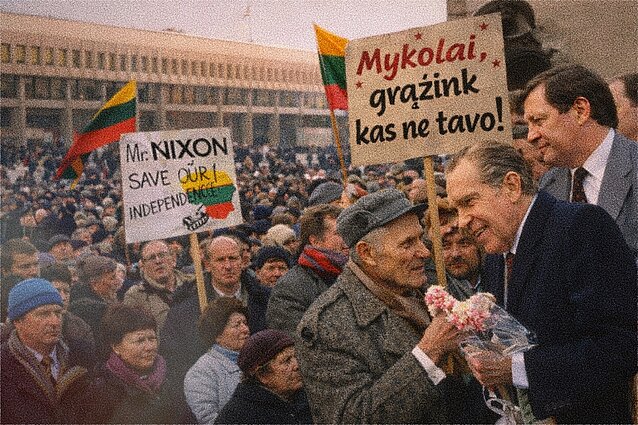
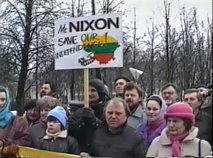
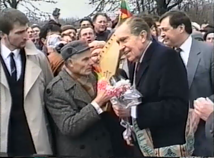
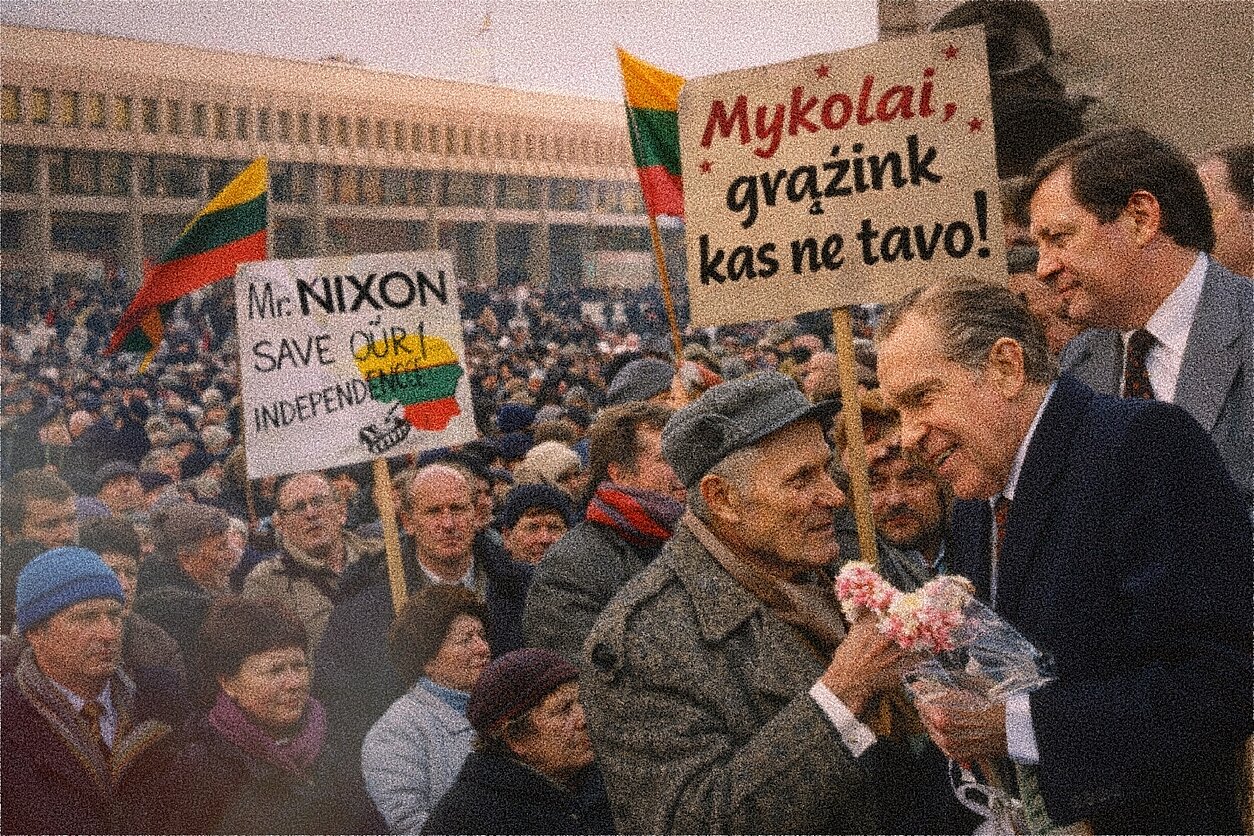
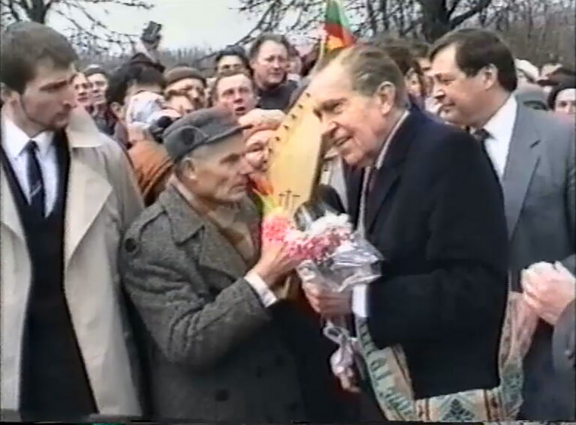
The former US President Richard Nixon, who was impeached and removed from office almost several decades prior, came to Lithuania as part of his visit across Eastern Europe.
The former president held no official position in the United States, but was still greeted with hope and pleas in Lithuania.
At the TV tower, he paid tribute to the victims and met government representatives. A large crowd greeted him with chants of “America” and “Nixon”.
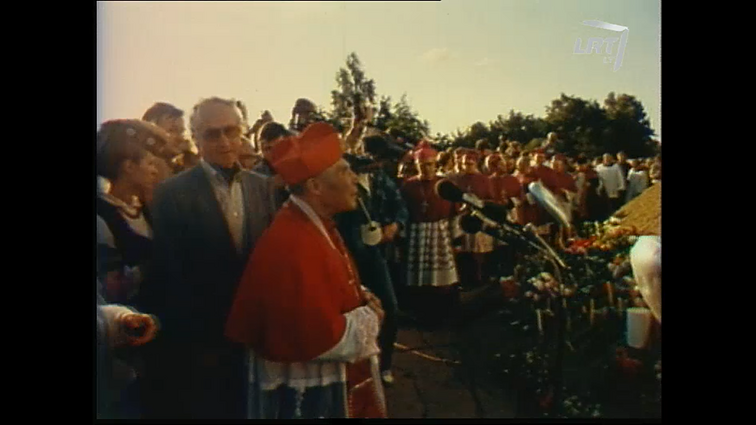
The symbolic visit infuriated those who remained pro-Soviet. At the same time, propaganda prepared reports about Lithuanian people joining the Red Army, empty shops and an allegedly catastrophic economic situation — one created by Moscow itself, which had imposed a blockade.
“In an attempt to provoke an armed conflict, our citizens and border guards were attacked. Counterfeit roubles were put into circulation, and efforts were made to destabilise the situation,” said Gediminas Vagnorius, Lithuania’s first prime minister.
“We also had enterprises that were not subordinate to Lithuania. The main task was to prevent Lithuania from being economically destroyed by stirring up public discontent and showing that the Lithuanian people were overthrowing their own government,” he added.
At that time, Vagnorius’ government was already preparing a survival plan involving vouchers known as talonai, or “vagnorkės”.
Introduced in May, the vouchers initially circulated alongside roubles, before later becoming the sole currency.
Decisions also had to be made on what to do with state businesses.
“We prepared a law on state enterprises, which came into force in 1991. We set it so that the state had to earn 7 percent on capital, while excess profit could be kept,” said Vagnorius.
“This had a strong effect on company directors, including those running enterprises subordinate to the Soviets. I showed them the advantages, and one after another they began to move under Lithuanian jurisdiction,” he added.
The collapse of USSR
In the spring and summer of 1991, various incidents became part of everyday life in Lithuania. In 1991 alone, the country’s customs and border posts were attacked 35 times.
The most brutal assault was the Medininkai massacre carried out by OMON forces on July 31, 1991, which claimed seven lives.
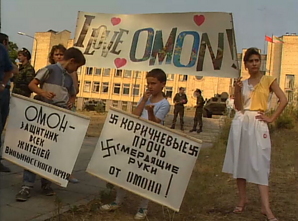
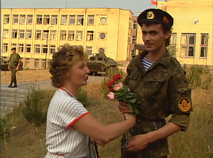
At one point, a crowd gathered outside the OMON headquarters in Vilnius with flowers and placards reading “I love OMON”, expressing support for the perpetrators.
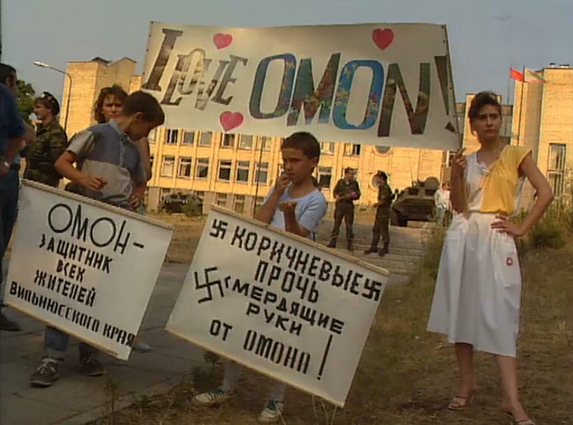
“I think that rally, held a week after the events, was organised by the OMON themselves, in an attempt to demonstrate popular support,” said prosecutor Paulauskas.
“In my view, they felt that we were closing in on them and wanted to portray it as persecution, as if we were unjustly seeking to hold them to account and that the people had come out to defend them,” he added.
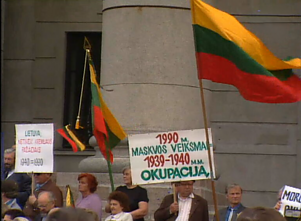
There were more staged protests – for example, public gatherings to honour Lenin monuments that were still standing. Most of such rallies were met by opposing crowds, who jeered and applauded sarcastically.
However, they were no more than comical displays of pro-Soviet loyalty. Far more dangerous were the rampages of the army and OMON structures.
For example, in May 1991, a telegraph and international telephone building on Savanorių Avenue in Vilnius was seized by the Soviet forces.
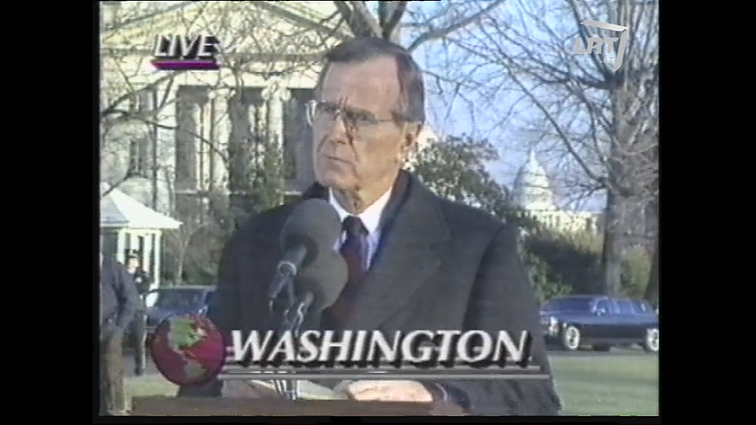
On May 1, employees of the Prosecutor General’s Office of the Republic of Lithuania were also barred from entering their workplace.
“There were many different incidents, but most were concentrated around the seizure of buildings, which became almost routine. This happened in Vilnius, in Riga and in Tallinn,” said Laurinkus, then head of the State Security Department.
Throughout this period, the Soviet forces attempted to provoke violence in order to justify the introduction of martial law. Although incidents did occur, they did not escalate into major unrest. Anti-Lithuanian groups also failed to attract broader support.
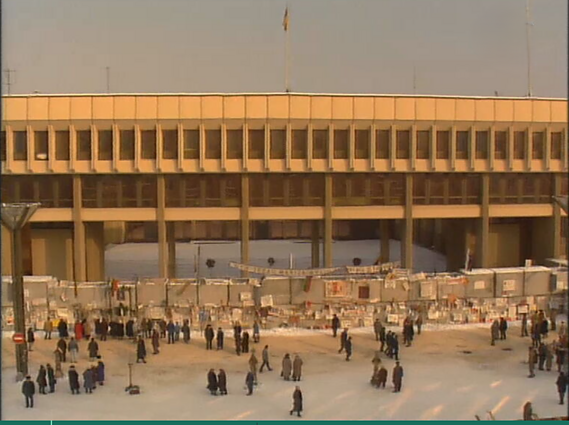
“We managed to defend ourselves against provocations. People of my generation remember how Soviet troops would drive around and fire at trolleybuses, the border, government buildings, trying to provoke us into responding with weapons,” said Vagnorius, the prime minister at the time.
“There were many situations when some of our state leaders lost patience and gave the order to respond with force,” he added.
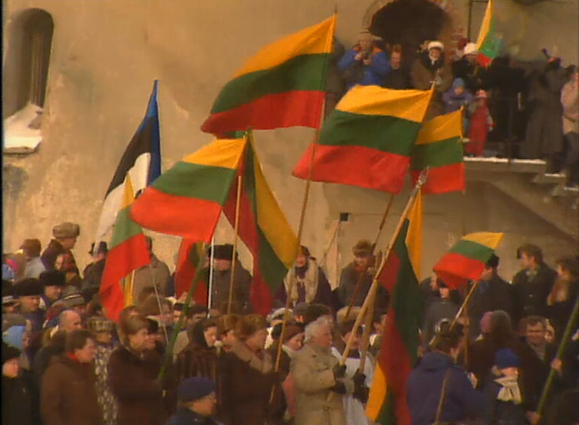
The attempted coup in Moscow took place on August 19–21, 1991, which finished the Soviet Union for good. When the attempted seizure of power by hardline forces failed, the Soviet empire collapsed.
On August 22, Soviet units withdrew from buildings they had seized by force — the TV tower, the Radio and Television Committee and other sites.
The leaders of the Communist Party loyal to Moscow, Mykolas Burokevičius and Juozas Jarmalavičius, were later taken to Russia or Belarus. However, they were detained in 1994 and returned to Lithuania, leading to their subsequent conviction.
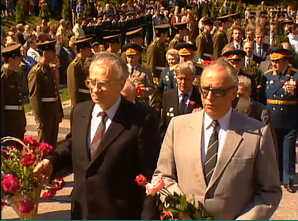
Finally, the main Lenin monument that stood in the Lukiškės Square in Vilnius was toppled on August 23.
“January 13 was the dress rehearsal for the August coup,” said Laurinkus, then head of the State Security Department.
If the coup of Soviet hardliners in Moscow had succeeded, the story could have ended differently, Laurinkus said.
“During the days of the coup, [Soviet] police began patrolling immediately, the army was mobilised and deployed at crossroads. People were called to gather at parliament, and a very different atmosphere was clearly visible,” he added.

Newsletter
Every Friday morning.