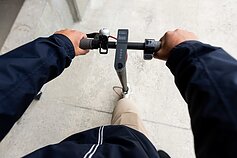
















All riders of electric micromobility vehicles in Lithuania will be required to wear helmets starting next year, under new safety rules aimed at reducing serious injuries. Rental companies will be obligated to provide helmets to customers.
Police data show more than 2,800 violations involving electric scooters and other micromobility vehicles were recorded last year, while 180 riders or passengers were injured. Doctors and road safety experts say helmets are not a formality but a critical measure that can significantly reduce the risk of severe head and facial injuries.
Dalius Matkevičius, head of the Oral, Facial and Jaw Surgery Centre at Vilnius’ Žalgiris Clinic, said the number of injuries has declined this year but remains a concern. Since the beginning of the year, doctors have treated about 200 scooter-related cases, including both hospitalised and outpatient patients, he said.

“Compared with the so-called scooter pandemic of 2023, the situation has stabilised and is now relatively good,” Matkevičius said. Still, he warned that serious trauma remains common.
Helmet choice also matters, experts say. Vytautas Kaupas, a former professional cyclist and co-owner of bicycle shop Velonova, said scooter helmets differ from bicycle helmets in construction and protection.

“Scooter helmets are heavier and stronger, while bicycle helmets are designed for ventilation and sport,” Kaupas said. “The technical characteristics really are different.”
Helmet prices range from a few euros to several hundred. Kaupas said cheaper helmets offer limited protection, while advanced models equipped with impact-reduction systems such as MIPS can reduce impact force by up to 70%.
Matkevičius said injury patterns depend on behaviour. In earlier years, the most common patients were intoxicated riders traveling at night without helmets, often suffering severe facial fractures and brain injuries. More recently, an increasing number of patients arrive wearing helmets and protective gear.
“People started protecting themselves even before mandatory regulation came into force,” he said.

One of the most frequent injuries among scooter riders is a fractured jaw, followed by upper jaw and nasal bone fractures, and traumatic brain injuries. Adults are injured more often, though children are also hurt, especially when carried on scooters by adults.
Experts also warn against using old helmets. Kaupas said helmets generally have a lifespan of about five years, as materials degrade over time due to temperature changes and wear.
While helmet use among scooter riders still lags behind cyclists, specialists say awareness is growing, especially among parents buying full-face helmets for children. Doctors emphasise that helmets can be lifesaving, noting cases where riders avoided fatal injuries because their helmet absorbed the impact.
Safety does not start with a fine, it starts with personal responsibility, Kaupas warned. “We had an incident where a scooter was traveling at 60 km/h in the city and was hit by a car. Not everyone realises that they are not alone on the road. We have to watch what others are doing and be careful,” he said.

Newsletter
Every Friday morning.