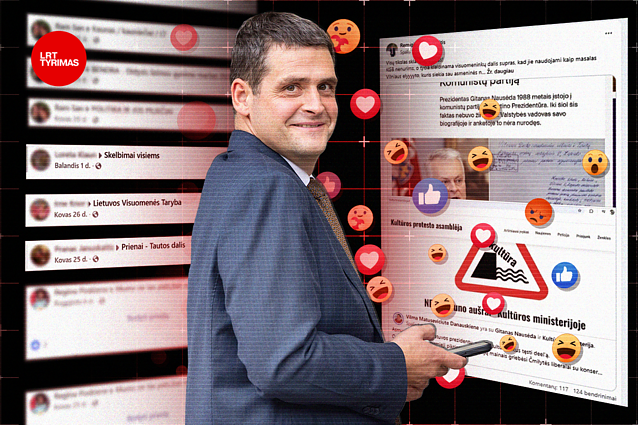
















The LRT Investigations Team analysed the social media activity of the Nemunas Dawn populists and their leader, Remigijus Žemaitaitis, which helped uncover bot clusters and inauthentic behaviour functioning as part of a coordinated campaign to sway public opinion.
LRT reporters worked for three months with online researchers – who are not affiliated with any institutions but whose names and qualifications are known to the team – to analyse the content of 7,800 posts and comments.
The starting point
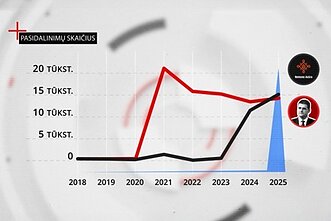
The online support of Žemaitaitis exploded seemingly overnight on March 16. Starting at around 06:00, a large number of Facebook profiles shared an old post from 2021.
The post was shared over 10,000 times to different Facebook groups and by individual profiles, even several times. Some of the profiles were visibly real people. However, not all had signs of genuine online activity.
Before the massive spread, the post had 651 comments and several dozen shares. However, the massive spread earlier this year attracted no new comments, showing signs of possible inauthentic activity.
Old content is revived when there is an attempt to return to certain narratives or topics. “, according to Viktoras Daukšas, director of the disinformation analysis centre Debunk.org.
“Such tasks are assigned both to people working in communications and, if they are used, to some kind of bot farms or other tools that are illegal across all platforms to artificially increase visibility,” he said.
Forming narratives
The social media campaign relies on Facebook groups in the following scheme: the leader of the Nemunas Dawn publishes a post on his profile, then other profiles share it across various Facebook groups.
At least a quarter of such accounts are so-called bots, which automatically distribute posts en masse across dozens of Facebook groups. And although such shares usually attract only one or two reactions, they artificially create the impression that the text is highly popular.
Analysts at Debunk.org note that they have previously tracked so-called intermediate accounts, where several fake accounts are controlled by a real person, which are used solely to share content to select Facebook groups.
“This is not illegal, but there is a degree of coordinated behaviour,” Daukšas from Debunk.org said, adding that artificial sharing using fake accounts can be used to “boost visibility” of each post.

Facebook groups
One of the largest groups where Žemaitaitis’s content is shared is Hottest News of the Day! (Karščiausios Dienos Naujienos!). Despite having more than 24,000 members, posts are largely published by a single account. The profile did not respond to repeated requests for comment from LRT.
The posts attract only a handful of reactions, which indicates that some of its users may also be inauthentic accounts.
The group previously served a different purpose. Its main pinned post was an advertisement for an accounting services company. When contacted, representatives of the company confirmed that the group had operated under a different name and was mainly used to publish commercial content and ads.
Until a few weeks ago, the group administrator was listed as the profile “Artiom Ko”. When approached by LRT, he said he did not administer the group.
“Perhaps the group was created at some point, perhaps there was a change, perhaps I bought the group in the past using Google Ads for my business. I could tell you many different things. I don’t know,” he said.
After the conversation, the profile “Artiom Ko” was no longer listed as the group administrator. The accounting company advertisement was also removed.
Dozens of Lithuanian-language advertisements offering social media groups with tens of thousands of followers for sale can be found on classified websites and through Google searches. Most are business-related, promoting clothing or equipment. Some listings include prices, with groups of this size advertised for between several thousand and 10,000 euros.
LRT spoke to four people selling such groups. They said the activity was not particularly profitable, and that buyers were most often newly established businesses seeking advertising channels.
However, the names of some groups advertised for sale match those of pages now being used to spread disinformation and promote support for Nemunas Dawn.
Possible bot activity
Researchers who worked with the LRT reporters said the Facebook activity of Žemaitaitis and his party’s supporters resembles coordinated human activity.
However, they also identified clear evidence of automated activity, known as bots.
“I would separate cases involving bots, because they are absolutely illegal – this kind of robotic activity is prohibited,” said Daukšas from Debunk.org. “But when we are talking about real people carrying out specific tasks, the question is why. Is it voluntary, paid, or something else?
LRT contacted several people who regularly share content from Žemaitaitis and Nemunas Dawn, with all of them saying they were doing this under their own initiative..
One of them, Janė, who asked that LRT use her first name only, is a former member of the Order and Justice party, founded by Lithuania’s former president, Rolandas Paksas. He was impeached for his undeclared links to a Russian businessman.
Janė said people in her social circle were “anti-system,” which was why she supported Nemunas Dawn.
“At one time, Žemaitaitis and I were party colleagues in Order and Justice,” she said. “But Remigijus betrayed Paksas and destroyed the party. Now the system is attacking him in the same way it once attacked Paksas.”
Janė said she was nostalgic for the Soviet era and felt sympathetic towards Russia.
“I listen to what Russia says, what Putin says, because I don’t trust others,” she said. “I don’t know why – maybe intuitively.”
She also described deep political divisions in Lithuanian society, saying she did not expect to find common ground with the younger generation.

Janė has several thousand Facebook followers, a number that grew during the Covid-19 pandemic. She acknowledges that some of her followers appear to be fake accounts.
Experts say clusters of automated accounts linked to a single profile – often called bot swarms – can rapidly amplify messages, for example, by sharing a politician’s post through intermediary accounts.
Disinformation researcher Nerijus Maliukevičius said bot swarms can be used to increase the visibility of specific political messages.
“Modern information technologies allow for very little authentic human involvement,” he said. “All it takes is a creatively designed algorithm, and an automated propaganda system begins to operate.”
He added that motivation remains a key question.
“Most research focuses on hostile activity by authoritarian actors,” he said. “But these technologies are becoming cheaper and more accessible. They are increasingly tempting domestic political actors, who may be inclined to create bot swarms favourable to themselves. We can probably already observe some local political figures using such methods.”
LRT asked Žemaitaitis whether he or Nemuno Aušra paid individuals to share their content on social media. He replied: “Of course not. What are we even talking about?”
No official probes
Lithuania’s law enforcement and various authorities do not investigate the social media activity of politicians or political parties.
The Criminal Police, which handles cyber crime, said it did not focus on politicians.
“We note that police activity is aimed at preventing and detecting criminal offences and administrative violations. Actions related to the purchase of ‘bot’ reactions operating on social networks are not criminalised,” the department said.
Lithuania’s Police Commissioner General Arūnas Paulauskas recently told reporters that there are about half a million “bots” in the country.
This year, the Criminal Police carried out two major operations targeting equipment known as “SIM swarms,” which can be used to create fake accounts.

Newsletter
Every Friday morning.