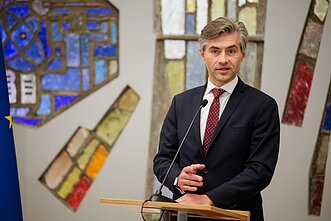
















Lithuanian Prime Minister Inga Ruginienė on Thursday urged the Council of public broadcaster LRT to resign sooner than planned and called on parliament to step back from fast-tracked amendments that would make it easier to dismiss the broadcaster’s director general.
Her comments came as protests continued over efforts in the Seimas, Lithuania’s parliament, to urgently adopt changes to the LRT law easing the procedure for removing the broadcaster’s leadership.
“I call on the LRT Council to convene as soon as possible and address the issue raised by journalists,” Ruginienė told reporters at the government headquarters. “We cannot leave this question for next month.”
If the LRT Council resigns, the broadcaster’s director general and deputy director general would automatically step down as well.
President Gitanas Nausėda has previously said that if tensions cannot be calmed, both the LRT Council and the administration should resign. The same solution has been proposed by LRT Director General Monika Garbačiauskaitė-Budrienė and by about two-thirds of the broadcaster’s employees.
The Council had earlier said it would consider resignation on January 20. On Thursday, however, LRT Council Chairman Mindaugas Jurkynas said the body could convene earlier.
“I will try to call an extraordinary meeting of the LRT Council earlier, at which it would be possible to discuss and vote on the resignation of the LRT Council in corpore. I don’t know if I will succeed, but I will definitely try to do it,” he told BNS.
Ruginienė also urged lawmakers not to adopt amendments that would give the LRT Council broader powers to dismiss the director general.
“It seems to me that both sides have reached a very high emotional level today, and such a decision would be appropriate for everyone,” she said. “We need to sit down and resolve this issue together.”
She said that if the LRT Council and the parliament take the necessary steps, the government would assume a leading role in involving stakeholders to draft a “normal project” and submit it to lawmakers.
According to the prime minister, the proposed legislation should ensure the independence of LRT’s editorial operations, protect freedom of speech and improve governance at the public broadcaster.
“I sincerely hope that all sides will listen, and especially now, as Christmas approaches, I hope we can agree on peace and find the right solutions,” Ruginienė said.
The ruling coalition has sought to allow the LRT director general to be dismissed by a secret vote of seven of the 12 council members, citing failure to approve the broadcaster’s annual activity report or improper performance of duties.
Under current law, the director general can be removed only by an open vote requiring the support of at least eight Council members, and only on grounds of the public interest.

Newsletter
Every Friday morning.