















Lithuanian lawmakers on Thursday approved the first reading of an amendment that would make it easier to dismiss the head of the national public broadcaster, LRT, a move that critics say threatens media independence.
Seventy-six members of the Seimas voted in favour of the bill, with 50 opposed and none abstaining. The measure, drafted by the ruling Social Democrats, was supported by the Lithuanian Farmers and Greens Union and the Nemunas Dawn party. The only vote against from within the ruling bloc came from former Defence Minister Dovilė Šakalienė. Several members of her group abstained.
Prime Minister Inga Ruginienė, Culture Minister Vaida Aleknavičienė, former Culture Minister Šarūnas Birutis, Seimas Culture Committee Chair Kęstutis Vilkauskas, Speaker Juozas Olekas and Education, Science and Sport Minister Raminta Popovienė all voted in favour. Two non-attached lawmakers, Vytautas Sinica and Vitalijus Sersniovas, also backed the bill.
Acting at the request of Birutis, the Seimas agreed to consider the legislation under an accelerated procedure. Lawmakers are scheduled to return the bill to the floor on December 16.

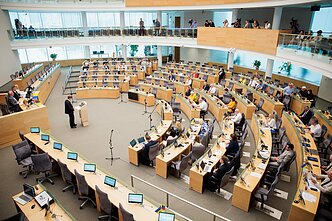
Opposition lawmakers attempted to submit a request for an impact assessment, but Raimondas Šukys, who chaired the session, refused to accept the document. He also rejected a request from opposition MP Agnė Širinskienė to open the bill for public consultation, arguing that once a bill is designated for urgent consideration, it cannot be sent for public review.
Opposition members protested during the session, posting signs that read “Hands off free speech” at their desks. A group of journalists watched the proceedings from the visitors’ gallery.
Supporters cite transparency
Presenting the bill, Social Democrat Audrius Radvilavičius said the measure would make the process for dismissing the head of Lithuanian National Radio and Television (LRT) more transparent.
“An open vote on such sensitive issues could put direct and indirect pressure on LRT Council members, leading to decisions based not on professional and objective judgment but on external or political factors,” he said.

He argued that the current law lacks clear grounds for dismissal and should be replaced with specific criteria. The amendment would require the LRT Council to appoint and dismiss the director general by secret ballot.
Under the proposal, the LRT chief could be removed on a vote of no confidence if they fail to perform their legal duties or if the Council rejects the broadcaster’s annual report. A majority of Council members – seven of 12 – would be required to approve the motion.
Current law requires an open vote and a two-thirds majority – eight out of 12 members – to dismiss the director general, who serves a five-year term.
Opposition warns of political motives
Arvydas Anušauskas of the opposition Homeland Union–Lithuanian Christian Democrats questioned the timing of the amendment, noting ongoing national security challenges.
“The country is facing hybrid attacks, a nationwide emergency has been declared, and it turns out that the most pressing issue is the procedure for appointing and dismissing the LRT head,” he said. He cited recent protests, where demonstrators carried signs reading “Hands off free speech”.
Social Democrat Birutė Vėsaitė, who supported the bill, said she is an avid LRT viewer but pointed to audit findings that highlighted procurement violations, hiring without competition and excessive commercial advertising.

She said she had learned that the Council of Europe had received a complaint about the LRT law and accused some LRT employees of using taxpayer-funded broadcasts to “stir up emotions” during ongoing protests.
MP Rima Baškienė, of the Democrats “For Lithuania” party, noted that after the parliamentary Culture Committee reviewed the National Audit Office’s findings, lawmakers agreed that the LRT law should be overhauled comprehensively rather than in fragments.
Radvilavičius said the Culture Ministry has already formed a working group to examine issues related to public information, including those involving LRT.
Gintarė Skaistė of the opposition conservatives said the ruling bloc’s arguments suggest the amendment is aimed at removing the current director general.
“It seems that the real motive is to change the content of LRT broadcasts, rather than to improve them in line with the audit findings,” she said. “We cannot allow these discussions to turn into a rushing train where decisions are made automatically, without in-depth analysis and discussion with the media community.”
Previous proposal on hold
The Seimas is also considering a separate amendment drafted by Nemunas Dawn and the Farmers and Greens Union that would allow the LRT director general to be dismissed by secret ballot with the support of only six Council members, half the body. Debate on that bill has been suspended pending an impact assessment.
LRT and the Association of Professional Journalists have warned that legislative changes made in haste and without consultation threaten the broadcaster’s independence and media freedom.
Over 10,000 people rallied outside the Seimas on Tuesday to protest what they see as an attack on free speech.

Newsletter
Every Friday morning.