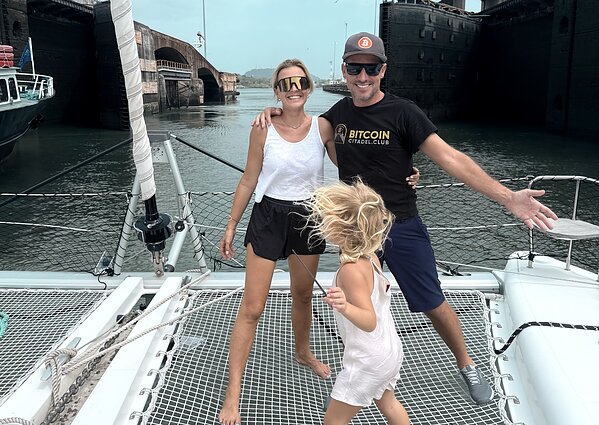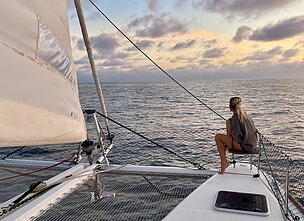













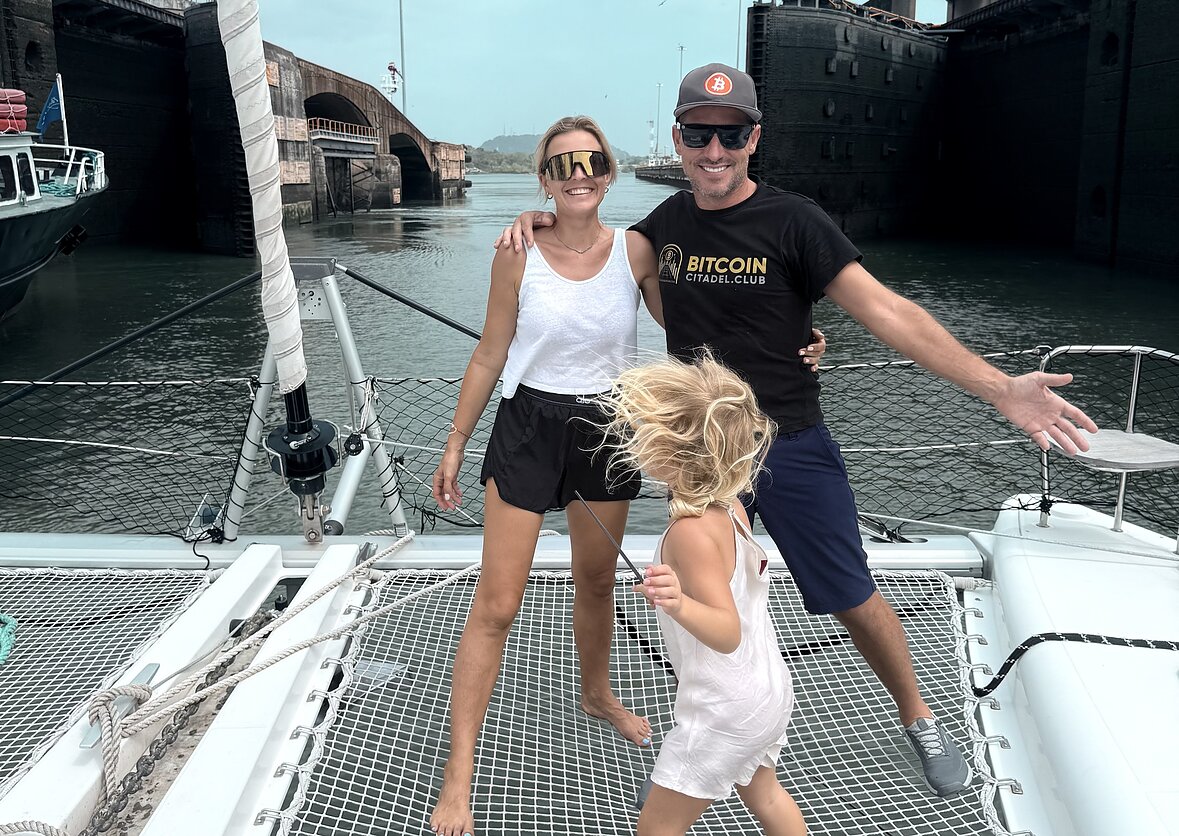
Emilija Malinauskaitė, together with her partner, Steve, decided to sell everything they owned on land, buy a boat, and set off to travel the world. Their daughter, only six months old at the time and now five, joined them on the journey.
The family has no intention of giving up life on a boat – they continue to sail around the world, meeting others who have chosen the same lifestyle as well as local residents.
Before moving aboard full-time, sailing was not new to them – Steve grew up in the south of France, while Emilija herself had worked on yachts there. Later, she obtained a captain’s licence.
The couple enjoyed travelling and had already lived in several countries. After one of their trips, they decided they wanted to travel without leaving their home behind. Once back in France, Emilija and Steve enrolled in sailing courses.
“We learned a bit, then we began renting boats, sailing boats, watching how everything worked, gaining more experience, and then we came to the conclusion that we might actually quite like this. We sold everything we had on land, bought a boat, and left without a plan,” Emilija recalls.
In 2021, the family set off from France. At the time, their daughter Adelina was only six months old. They visited countries around the Mediterranean, crossed the Atlantic, and explored the Caribbean. They are also familiar with the Pacific. Polynesia, in particular, captivated Emilija.
“After the Caribbean, I missed culture the most. I thought I’d see more of it. The Caribbean islands have a rather grim history. And the story of each island is very similar – whichever island you choose, even states change hands between islands, but I missed the culture and antiquity we have in Europe.
“Still, when you travel in Greece, there are temples on every island. You don’t really get that in the Caribbean. And Polynesian culture fascinates me. Another thing – there’s this untouched corner, those first islands: the Marquesas, the Tuamotu Archipelago. They’ve seen so few tourists and are so unspoilt, so pristine, that they enchanted me,” Emilija says.
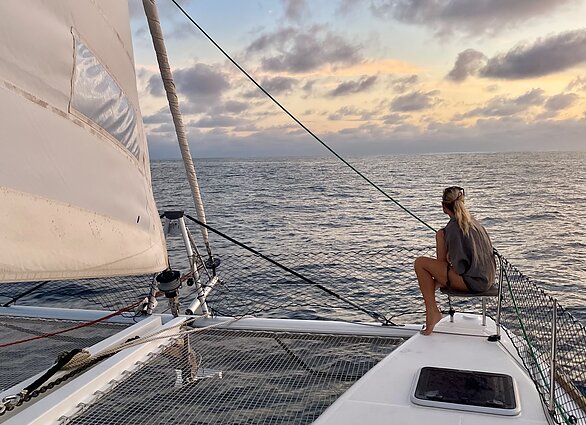
She explains that how often they go ashore depends on the location. In Europe, transport is easy, there are more ports, and distances are short. In Polynesia, the situation is completely different – it can take five days to sail from one island to another.
“If something breaks, getting parts in Europe is actually very easy. Every port has a small shop where you can buy boat supplies. In the Caribbean, it’s more complicated – you need to plan logistics more carefully. And you can’t sail to Polynesia without thinking things through.
We had loads of spare parts: a second autopilot, an anchor, all sorts of screws and wires, so that if anything happened, we could fix it ourselves. On the boat, we’re our own mechanics, our own hairdressers, doctors – we do everything ourselves,” Emilija says.
According to her, if something breaks and they lack spare parts or tools, they can always ask for help from others living on nearby boats.
“That’s what I like about the sailing community – we may have different boats, budgets, outlooks, but when a storm comes, we all stick together,” Emilija says.
She says their family is not isolated from others: they interact with locals as well as with other people living on boats. Different sailing communities follow one another on social media and communicate through messaging apps.
“With some neighbours, we get along better and always invite each other for dinner. There are neighbours you greet and stay friendly with, but you don’t become friends. It’s the same in sailing: we meet, we make friends, we sail together for a while, or sometimes we part ways. Then we agree to meet in an anchorage in two weeks’ time. We all have WhatsApp groups,” Emilija says.
One way boats communicate with each other is via VHF (very high frequency) radio.
“VHF is used more when you already know people. [...] We choose one channel that about five boats use. If I’m taking my daughter to the beach somewhere, I always have a radio so I can talk to my fiance, because not all islands have mobile coverage,” the Lithuanian says.

Emilija admits that communication with family members and relatives on land has become much easier thanks to the Starlink satellite connection that appeared a few years ago.
“When we first started sailing, my family wouldn’t hear from me for about five days, because I was at sea,” she says.
According to her, their five-year-old daughter Adelina has no complaints about life on board either.
“We always ask her whether she wants to return to the boat. But it’s hard to say, because she’s lived on a boat since she was six months old, so basically it’s the only life she knows. For her, the boat is home – she doesn’t really know what it means to have a different kind of home than one that floats,” Emilija says.
You use what you have
She says maintaining a boat is not cheap. If a part breaks, it usually costs more simply because it’s made for a boat. But a lot also depends on maintenance.
“We thought it through quite well, because we invested a significant amount at the start – in good batteries, a solar power system, then spare parts, which at the beginning of the trip cost us a lot of money. But now, if something breaks, our expenses are small because we fix everything ourselves,” she says.
On land, many things are a click away: you can order meals, groceries, clothes, all sorts of goods without leaving home. But on a boat, that doesn’t exist – you live with what you have.
“You know there’s none – and you don’t need any. You open the fridge, and see you have yesterday’s fish and rice. No tomatoes, but there are some frozen courgettes. Fine, it’ll be courgette. You cook with what you’ve got. We no longer have the expenses most people don’t really need anyway,” Emilija says.
According to her, living on a boat has made her stronger mentally.
“It’s far from sitting on deck with champagne every day watching the sunset. When you’re in a small space for a long time with no way to leave, the relationship between people is very important. I think I’m much stronger emotionally after all these trips than I was before, when I lived on land,” she says.
Thinking about the future, Emilija says that for now, life on a boat is much more suitable for them.
“And I don’t see any place on land that could change that, at least for now. But you never know,” she adds.

Newsletter
Every Friday morning.