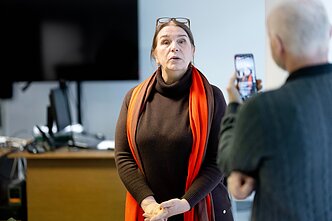














Artificial intelligence in the field of defence is no longer a vision of the future but a present-day reality. Visiting Vilnius, Dr Una-May O’Reilly of the Massachusetts Institute of Technology (MIT) said that her research shows how rapidly AI can be applied to strengthen cybersecurity, becoming an increasingly vital tool for modern defence.
Battle between AIs
It took several years to develop a system that allows Ukrainian drones to identify, with around 90% accuracy, the number and type of mines in a given field – a project achieved with input from Lithuania’s Riflemen’s Union and its partners.
According to the organisation’s commander, Colonel Linas Idzelis, the next goal is to adapt AI for use in drone swarms. While not a new idea, he says European militaries are falling behind.
“The Geran drones flying into Ukraine are released in swarms. If you shoot one down, others adjust their flight paths and continue – they communicate with one another. That means there’s no longer a human operator. These drones rely on algorithms that help them avoid interference and change course dynamically. This has been happening for several years now,” said Idzelis.

Experts attending a joint conference of Lithuanian universities and MIT said AI’s potential is virtually limitless. Paulius Vaitkevičius, Head of Innovation in Software Development at technology company Novian, revealed that a new AI assistant is being developed for the Lithuanian Armed Forces to help detect sources of disinformation and propaganda.
“Artificial intelligence is already fighting information wars on the other side. Bots generate fake news and artificial content that spreads widely online. We need a strong AI on our side to counter it – it’s becoming a battle of AI versus AI,” said Vaitkevičius.
This kind of social engineering can even influence elections. The recent Romanian presidential campaign, for example, saw a Kremlin-friendly candidate come close to victory after a major push on TikTok. While some call it democracy in action, Moscow continues to exploit social media for its geopolitical aims.
A double-edged sword
MIT professor Dr Una-May O’Reilly studies artificial intelligence through the lens of cybersecurity. She describes AI as a double-edged sword – both a threat and a tool for defence.
“We know that those with malicious intent can use AI, but we can also use it more effectively for defence. The key is to understand where such an arms race could lead and to prevent escalation before it reaches a point that becomes dangerous for us,” said Dr O’Reilly.

How can Europeans catch up and accelerate their defence industries? The answer, experts say, lies in the American approach. The US defence sector invests billions in research and experimentation, fostering collaboration between scientists, manufacturers and military clients to achieve results and technological leadership.
If AI still seems like something out of science fiction, one need only look at the origins of one of the most advanced fighter jets in the world.
Forty years ago, the US Air Force launched its stealth fighter programme, dedicating enormous resources to the effort. Competing American defence firms developed rival prototypes, and one eventually triumphed – the F-22 Raptor, today considered the most advanced fighter aircraft in existence. Around 200 have since been commissioned by the US Air Force.

Newsletter
Every Friday morning.