












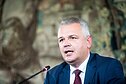

Prime Minister Inga Ruginienė has reiterated her belief that a shorter workweek represents the future for Lithuania, but experts warn the country must first boost productivity, efficiency and global competitiveness before moving to a four-day model.
The idea gained momentum after the Covid-19 pandemic, when widespread remote work blurred boundaries between professional and personal life, leading to burnout for many employees, said Milda Vilikanskytė, LRT’s Brussels correspondent.
Belgium became the first European country to legalise a four-day workweek in 2022. But the option remains voluntary: workers can request the change, and employers can deny it only with strong justification. The arrangement is initially set for six months and then reassessed.
Still, the Belgian example shows limited uptake. As of 2025, just 0.8% of employees and 3% of companies had embraced the schedule. The main reason, Vilikanskytė said, is that hours remain the same – 40 per week – compressed into four longer 10-hour days.
“Nothing disappears,” she explained. “You still need to work 40 hours a week, only now you do it in four days instead of five. That can mean more stress even if you get Friday off.”
Union leaders in Lithuania share that concern. “People think they’ll only work four days and lose nothing,” said Lithuanian Trade Union Confederation chairwoman Dalia Jakutavičė. “But if you don’t reduce weekly hours, the work simply shifts into longer days. Only cutting the total norm – for example, from 40 to 32 hours – creates more free time.”

Mixed results in Lithuanian trials
Several Lithuanian companies have already experimented with the model. Tech firm OBDeleven offered employees trial periods of four-day weeks, provided productivity remained high.
Marketing director Juozapas Preikša said the experiment was a mixed bag: at first, it created more stress and dissatisfaction, especially in client service and logistics, where 24/7 availability is critical. But over time, people learned to plan better and cut unnecessary meetings, making them more efficient, he said.
Still, Preikša warned the system works less well in sectors that depend on constant availability. “If a programmer is off Friday but a client issue comes up, things fall apart,” he said.
Legal flexibility and risks
Lithuanian labour law does not prevent companies from experimenting with reduced schedules, said Mantas Mikalopas, a partner at law firm Widen. Employers can already adopt different models: 32 hours with reduced pay, or 40 hours compressed into four longer days.
“There are even provisions allowing some public sector workers with small children to work 32 hours but get paid for 40,” Mikalopas said. He added that hybrid models, such as 32 scheduled hours plus standby duty for emergencies, are also possible.
But he cautioned that legal disputes may arise if employers later want to revert to the five-day model. “Once a contract is changed, going back isn’t simple. My advice is to include an exit clause when introducing such arrangements,” he said.

Productivity, demographics and competitiveness
Employers argue that Lithuania’s economy is not yet ready for widespread adoption.
“Neither technology nor artificial intelligence is currently applied at a level that allows reducing working hours without harming competitiveness,” said Eglė Stonkutė, an economist at the Confederation of Lithuanian Industrialists. “Lithuanian industry already faces labour shortages […], and compared with the US or Europe, we don’t work the most hours.”
She also pointed to demographic pressures. “Our population is ageing and the workforce is shrinking. We cannot expect people to work even more. Reducing hours may be inevitable, but how to compensate for lost productivity remains unanswered,” she said.
Analysts note that local-oriented companies may be able to adapt sooner, but export-driven businesses tied to global markets face tougher constraints.
OBDeleven’s Preikša also sees artificial intelligence as a potential driver for greater efficiency, but warned against moving too quickly. “Lithuania should first secure strong positions in global markets. Wages are rising, productivity is improving. Let’s reach EU levels first – then we can afford to relax,” he said.

Newsletter
Every Friday morning.