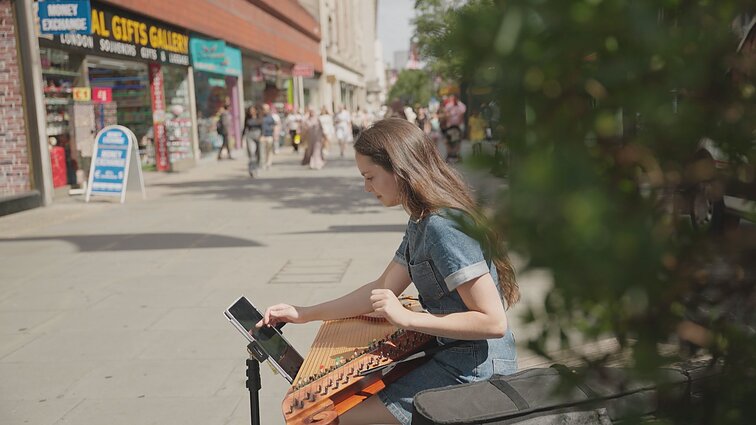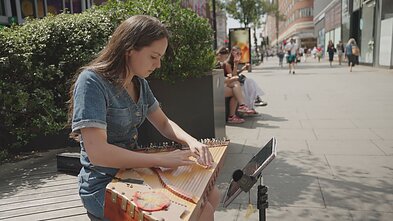
















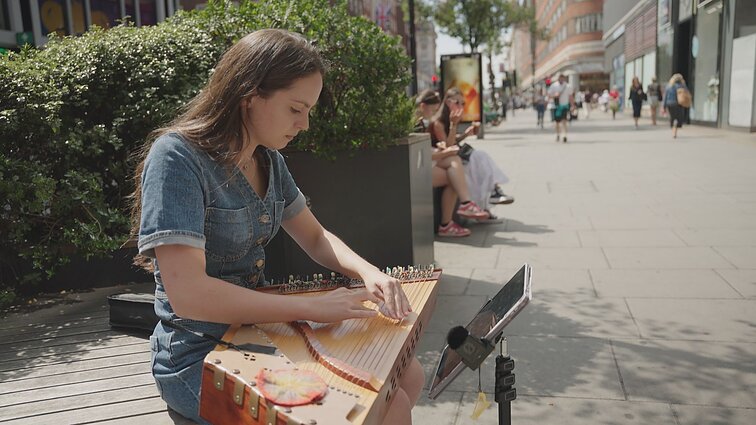
Kaunas-born Emilija Karaliūtė, now living in London, often delights the city’s residents with her kanklės music. In the UK, this traditional instrument is little known, so in London she feels unique – and uses the chance to share Lithuania’s culture and traditions.
The musician can often be found performing in some of the busiest Underground stations. “I always introduce myself, saying I’m from Lithuania, I’m a musician, and I play a traditional Lithuanian instrument – the kanklės,” Emilija says.
“When I perform concerts, I always do it through the prism of Lithuania. I include interesting facts about the instrument, our culture, and traditions,” she adds.
After finishing her studies at the Juozas Gruodis Conservatoire in Kaunas and later studying music in London, Emilija says she stands out in the British capital – while everyone in Lithuania knows the kanklės, here it is exotic and completely unfamiliar.
“They don’t have [such an instrument], so they’re amazed,” she says.
While many Lithuanians complain of fierce competition in London and say it is hard to stand out, the 25-year-old smiles – for her, it is the opposite.
“Sometimes I even wish someone could film after my concerts – the crowd rushing to see the instrument, asking how it’s made, saying how beautiful it sounds. They want to see recordings, read more about the kanklės and about Lithuania,” she says of foreigners’ curiosity.
Emilija says her main aim is to make sure that anyone who encounters her never forgets the kanklės.
“They associate it with angels’ music, with something divine. People enjoy the stories I tell, and it makes them experience the music differently,” she says.

“People like the history of the kanklės. When someone died, Lithuanians would go to the forest, cut down a tree, and make the instrument. When they played, they believed the deceased was speaking through it. Often, after hearing this, people share their own stories of loss,” she adds.
She believes Lithuanians too often feel embarrassed about their traditions and heritage in front of foreigners. For her, it’s the opposite.
She admits that her career has pushed her to learn more about the kanklės and Lithuanian culture – and in turn, this has made her more patriotic.
“People like it – the British and Scots are proud of their traditions. They enjoy their own folk music. If they see someone sincerely presenting their homeland, they appreciate it – and if it’s a young person doing so, it’s even more interesting,” Emilija says.
Her career in London began in popular bars, where musicians of all styles perform. There, the Lithuanian kanklės player became a novelty act for British crowds.
“People would stand in front of me with pints of beer. It was an interesting experience. They were good listeners, even if the atmosphere wasn’t ideal. But I would leave with a heavy heart – it wasn’t the right place to showcase the instrument or talk about my country,” she says.
Later, encouraged by a friend, she started playing lunchtime concerts.
“I played in many churches and cathedrals across England. These concerts help me build a solo career. People learn about the instrument, approach me, and ask for my contacts. Some even want to learn the kanklės themselves,” she says.
At such concerts, she was noticed by music agency representatives, who believed a Lithuanian kanklės player could make a name for herself in London.
“Then the agency promotes you, and you start playing at different events and weddings. That’s how it began – advertising myself everywhere with recordings and photos. That’s how I got my first private concerts, weddings, and other events,” Emilija recalls.
She later passed a tough audition and was granted a two-year licence to perform in London Underground stations. More than three million passengers use the Tube every day. For emerging musicians, it’s the equivalent of an arena or even a stadium.
“It’s a huge audience that many dream about, but not everyone gets the chance,” she says.
To play in the largest stations, Emilija bought special equipment to amplify her instrument. She says most musicians in the Underground play pop or rock, so her performances stand out and are more likely to catch the attention of hurried commuters.
“Thousands of people pass by in those two hours. I find it scarier to play on the street than on stage, because you wonder whether people are interested. Many just walk past without stopping, even if they’ve never seen the instrument before. But now I focus on those who do stop,” she admits.
Her goal is not only to showcase herself and the instrument but also to earn a living. To attract a bigger audience, she mostly plays popular songs.
After countless performances in the Tube, she has learnt Londoners’ tastes – and knows which songs get more attention and money.
“I like including Metallica or Queen – songs that sound unexpectedly good on a traditional instrument. I’ve noticed that in busy places, fast songs have more impact,” she reveals.
Still, she admits – while she gets plenty of attention, the money is not always what she would hope for.
“My record was 100 British pounds, but that’s rare. Usually it’s 40 to 50 pounds for two hours. There are positives though – you meet people, you can rehearse your programme, try new pieces and see what the audience enjoys,” she says.
Her other stage is the city itself – London’s streets, squares, parks, and courtyards.

“I don’t sit still, I try to perform in as many different places as possible – that way, more bookings come in,” she says.
“I know some people associate street performance with something negative, like begging. But I don’t play for the money. I go out with the goal of meeting someone – a musician who wants to play with me, or someone who wants to book me for an event,” Emilija says, adding that she uses public performance to promote herself as a musician.
The hardest part, she says, is carrying all her equipment from home to wherever she is playing. With no assistant, she has to do everything herself.
“Sometimes I felt like giving up. My home is on a hill, and I have to climb for 10 minutes with all this stuff. But all the effort is worth it when someone appreciates it, compliments me or offers to collaborate,” she admits.
Recently, she was noticed by a British performer.
“We first met six years ago and played together. Then, five years later, he wrote to ask if I could add kanklės to a few of his songs. That was an important step,” she says.
For now, Emilija is still playing on the streets and in stations – but she insists this is just the beginning. She dreams of an international career and is working towards it every day.
“You don’t have to be famous to play abroad. Music is a way of communicating, especially if you have a traditional instrument,” she says.
It has been six years since Emilija first began promoting the kanklės in London. Over time, her efforts have paid off – she can now support herself entirely through music.
“I’m booked with concerts until December. That’s enough to get by. But I think I need to change my mindset – maybe it’s normal to have more work and money one month, and less the next, but you prepare for that. I just need to plan better. I’m still learning,” she admits.

Newsletter
Every Friday morning.