















Lithuania will soon have to decide whether to accept at least 158 migrants or pay a so-called solidarity contribution exceeding 3 million euros under the European Union’s new Migration Pact. The government plans to make the decision this year, before the pact takes effect.
Opposition lawmakers argue the decision should be made sooner so the country can prepare for integration or include the payment in the national budget.
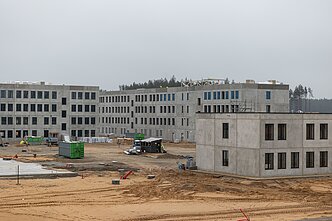
Four years ago, a shelter converted into a refugee reception centre was overcrowded, with about 400 people living in a space designed for nearly half that number. Today, about 200 people – mostly Ukrainians – live there. Across Lithuania’s four migrant reception centres, about 450 people are housed, with capacity for nearly twice as many.
“Transit migrants travelling through Lithuania from another EU country usually stay here for up to a month. Ukrainians tend to stay much longer,” said Gediminas Pocius, head of the Reception and Integration Agency.
Unlike during the 2021 border crisis with Belarus, attempts to enter Lithuania from the eastern neighbour are no longer a daily challenge for border guards. In contrast, southern EU states are again seeing a surge in migration via the Mediterranean. The EU decided last year to redistribute migrants under a quota system, which would assign 158 migrants from southern countries to Lithuania.
“The relocation and integration of 158 people would not be a major challenge for Lithuania,” Pocius said.
The EU would allocate up to 10,000 euros per relocated person, but member states can choose to pay a fine instead, a so-called solidarity fee. For Lithuania, that would total more than 3 million euros.
“It could be that Lithuania chooses either to accept the refugees or to pay the money – or a combination of the two,” said MP Laurynas Šedvydis, chair of the parliamentary Human Rights Committee.

Acting Interior Minister Vladislav Kondratovič said the number is small compared with the roughly 20,000 foreign workers who arrive annually for jobs, but acknowledged the issue is sensitive.
Former Interior Minister Agnė Bilotaitė, who initiated the pushback policy during the Belarus border crisis, urged swift action to prepare for integration or choose payment instead.
“I would be more inclined to choose the financial option for Lithuania, taking into account potential risks and the possibility of unsuccessful integration,” said Bilotaitė, now an opposition MP.

Language remains the greatest challenge for migrants, Pocius said, along with housing and access to interpreters for less common languages. “Right now, the Lithuanian language teaching system for foreigners is not really a system at all,” he added.
Interior Minister Kondratovič said a special migration commission will make the decision, noting that cultural proximity of migrants to Lithuania could be one consideration.

Bilotaitė countered that the quota system will not allow countries to pick and choose.
Politicians across the spectrum agree the EU’s new system must function properly, as Lithuania may one day need it.
“Lithuania is minutes away from another refugee crisis,” Šedvydis said.
Eurostat data shows nearly 200,000 asylum applications were filed in the EU in the first three months of this year alone.

Newsletter
Every Friday morning.