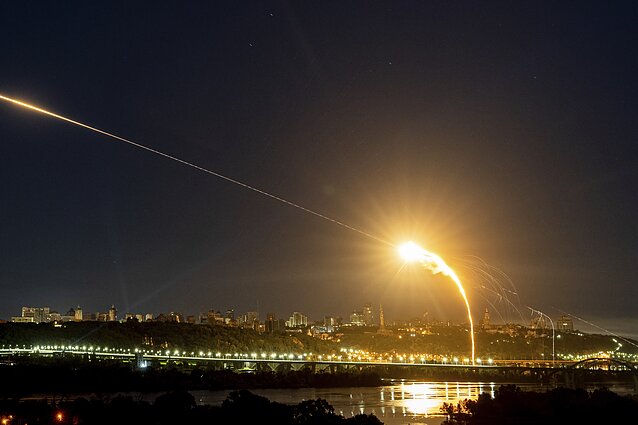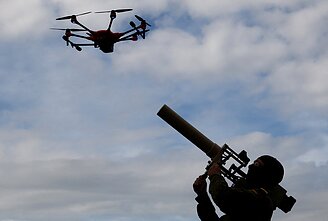












Over the last few weeks, several drones breached Lithuanian and NATO airspace. Previously, a long-range strike drone Geran2 had breached the Latvian border. So, Houston, we have a problem. The Civic Centre for Defence and Security Analysis Locked N Loaded provides analysis on Russian long-range strike drones (LRSDs).
Purpose of use
The starting point is summer/autumn 2023, when Russia started using Iranian Shahed type LRSDs (now it is called Geran2). In comparison with cruise/ballistic missiles, LRSDs have lower speed (200 km/h vs 600-800 km/h), weaker warhead (from 50 to 90 kg vs 400 kg of explosive material), lower cost ($200k vs $1-10m), not radically different operational range (up to 2000 km vs 3500 km) and not sufficient resistance against electronic warfare.
That’s why they were (and still are) mainly used against targets that are less covered by air defence (civilian infrastructure, residential areas), essentially as a weapon of terror against civilians.
Moreover, they are used to overload the opponent’s air defence system. During massive combined attacks or MCA (missiles + drones), the use of air defence missiles and munitions against LRSDs allows faster and more powerful cruise/ballistic missiles to reach targets easily.
However, the situation is changing rapidly. Since 2024, it has become clear that with technological improvements (electronic warfare survivability, navigation improvements, engine improvements, combat power enhancement), increasing drone production capacity and testing of swarm operations (a dozen or more drones against a single target), LRSDs themselves are useful as a sufficient deep-strike capability, especially during massive attacks.
This was one of the reasons for developing decoy drones (like the Gerbera) that fulfil the same function as LRSDs did for missiles – to reach a massive effect. There is also a growing number of other attack drones at various ranges (such as Molnia). Moreover, in order to increase the lethality and attention of air defence, decoy drones are used with small warheads (a few kilograms).

Production and logistics
Russia produces about 90-100 Geran2/Shahed drones per day (about 3,000 drones per month), while the production of all types of long-range drones has reached about 5,500 drones per month.
It is important to note that Russia is capable of innovating, manufacturing, and deploying LRSDs without foreign support (Iranian, Chinese). This support may be useful but not crucial, as it was two years ago. Very likely, the manufacturing of these drones will only grow.
However, Russia also faces problems. The supply chains are long, include intermediate stops, which complicates the delivery of drones to the launch sites.
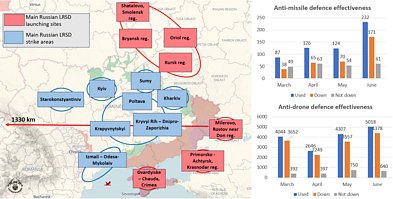
The Shahed/Geran2 drones are produced at two main sites: Elebuga and Izhevsk (1,300 km from the contact line). The production of components for these drones is also under development – in Moscow District (980 km from production places), Russia produces warheads for the Shaheds, and in Cheboksary (400 km from production sites), it produces Kometa antennas which allow to use drones and missiles during jamming.
This results in the periods of lower intensity of LRSD strikes that occur every few months. Russia is likely forced to save long-range drones to organise larger-scale strikes. In addition, the Ukrainian forces are capable of reaching these drone production sites with their deep strike capabilities, but are unable to create a game-changing effect – mostly because they lack long-range and powerful missiles or sufficient amounts of long-range drones, not because of effective Russian air defences.

Operations
Every operation begins with intelligence and targeting. Russia uses long-range ISR (intelligence, surveillance and reconnaissance) drones to find high-value targets. This information is mainly used for quicker and more powerful deep strike capabilities, such as cruise and ballistic missiles. However, long-range ISR drones and other intelligence methods are used to have a bigger and more comprehensive picture, prioritise and disseminate targets for combined deep strikes (missiles + LRSDs).
After the target is cleared, LRSDs are ready for launch. Shahed 136/Geran 2 have several launching platform options:
- stationary launch when it is launched from a stable platform on the ground
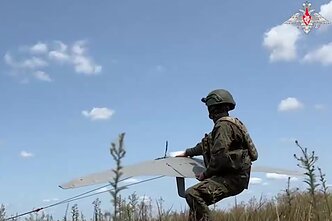
- launch from a container mounted on a truck or other mobile platform. Five Shaheds can be launched from one container
- launch from a moving vehicle, such as a jeep
This way, Russia has the flexibility to choose launch methods, employ deception against the opponent, and improve operational security. This is probably one of the reasons why the Ukrainians rarely succeed in destroying Shahed launch sites.
Importantly, launching and logistics are highly interconnected. Russia uses warehouses near launching areas to store drones, spare parts, mount them on launching platforms and repair them. The distance to the depots can be up to 70 km. This can be useful for locating launching sites or warehouses. For example, using this information, Ukraine conducted a drone strike on Russian warehouse at Yeisk, near the LRSD launching site at Primosk Ahtyrsk.
As mentioned before, LRSDs are increasingly used not only to terrorise civilian populations or overwhelm air defence systems, but also to attack military targets, such as the Kropyvnystkyi military airport (200 km), logistics hubs near the frontline or Slovyansk (30-50 km). The share of missiles in deep-strike operations is decreasing. For example, in November 2024, the ratio of missiles to LRSDs was 1:9; in June 2025, it was 1:21.
It doesn’t mean that Russia uses fewer missiles, the overall numbers are increasing, but LRSD strikes are intensifying at an even faster pace.
In June, the total number of strikes was around 5,000. In July, it likely will have grown. Russians are already capable of deploying more than 700 attack drones in a single strike. The New York Times estimates that, this autumn, they will be capable of sending 1,000 drones in a single strike. Massive combined attacks (MCA), of at least 10 missiles and 300 LRSDs, are launched following 4-7 days of lower intensity strikes. Over May, June, and July, MCAs could be sustained for a few days in a row.
If we look at the most frequent Russian launch locations, we see that they are often areas between 300 and 400 km from the line of contact. The targets in Ukraine are also about 300–400 km behind the line on the Ukrainian side.
Certainly, there are exceptions – areas in western Ukraine are also targeted (Starokonstantinyv airport, Vynitsa, Lviv). Still, the trend is clear. The average or standard direct range of drone strikes is 700–800 km. Shahed/Geran-2 drones have a range of 1500–2000 km. So why are they used over the operational range of only 700–800 km? Moreover, why aren’t they launched from deeper inside Russia, where the launch sites would be even safer?
The answer is quite simple. Shahed/Geran-2 drones do not fly in a straight line like missiles, they follow predetermined routes – manoeuvring, circling, meandering – until they reach their targets. This results in a shorter effective strike radius (“kill zone”) but a longer overall flight path.

Countermeasures
In 2025, Ukrainian air defences have been able to intercept about 50–70% of cruise and ballistic missiles, depending on the month. This means that around 60 missiles per month successfully hit their targets. Several or even dozens of missiles may reach their objectives in a single strike.
The efficiency of the anti-drone defence is even higher. Ukrainians shoot down or jam 80-90% of LRSDs. However, due to the large number of drones deployed during one attack (500–700), the 10% (50–70 drones) that get through still cause significant damage. This is especially critical if many target a single location (city).
Electronic warfare (jamming) is one of the main anti-drone tools. Between 30 and 50% of drone losses are a result of Ukrainian EW. Drone are simply diverted from their targets by changing their pre-programmed route algorithm. Ukraine also uses helicopters, light subsonic combat-training aircraft, and mobile groups.
Recently, LRSDs have been flying at altitudes above 2 km, thus reducing the effectiveness of previously successful mobile air defence teams with heavy machine guns. However, when drones appear near their target, mobile groups with machine guns can still be effective. And machine guns are not the only option – mobile groups also have portable air-defence systems, anti-aircraft artillery, etc.
Ukrainians are also developing the capacity to use drones as air defence tools. It is very effective against Russian long-range ISR drones and, increasingly, LRSDs.
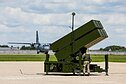
Modern air defence systems (NASAMS, PATRIOT, F16 air defence weaponry) are also there, but their cost effectiveness isn’t very credible. Moreover, supersonic jets involved in operations may get damaged because of the huge differences in speed between aircraft and drones. During the June 28–29 drone attack, one F16 likely hit a drone with cannon and, since the explosion was too close, the pilot couldn’t manoeuvre and crashed.

Suggestions
Russia will likely continue to develop its LRSD capabilities. A consistent technological and military analysis of these processes is needed, as well as developing adaptive and revolutionary countermeasures at the national, regional, and NATO levels.
In case of a large-scale conflict, Russia’s MCA operations (including LRSDs) will likely target the Baltic Sea region in order to block NATO forces and logistic routes, attacking the military and civilian infrastructure located in logistic hubs. This indicates the need to develop joint, mutually supportive, and integrated air defence and electronic warfare capabilities at both national and regional levels.
Amid uncertainty regarding the practical contribution of US forces to deterrence and defence in Europe, member states in the Baltic region need:
- Allocate responsibilities to the military, active reserve, home security, paramilitary organisations to properly protect military assets, critical infrastructure, and civilians. They also need to be trained and made interoperable.
- Improve early warning systems to detect any approaching objects at a sufficient distance to allow for timely decision-making.
- Develop intelligence capabilities (electronic intelligence, drones, etc) to identify the adversary’s deep-strike infrastructure (and other targets) at a range of 300 km or even deeper.
- Maintain not only traditional weapons (eg HIMARS) capable of striking targets at 300 km, but also long-range attack drones able to engage targets at 300 km or greater distances. Consider deploying these capabilities outside one’s own territory.
- Air defence solutions should not be limited to highly effective, sophisticated yet very expensive systems. In case they are lost and there are shortages of air defence missiles, it will be very difficult to recover rapidly.
Regarding this:
- Develop electronic warfare capabilities to counter aerial threats.
- Integrate older air defence systems, aircrafts, and helicopters that can contribute to the destruction of targets such as LRSDs.
- Develop mobile air defence teams equipped with heavy machine guns, MANPADS, AAA guns, and mobile electronic warfare systems.
- Develop air defence drone capabilities and related competencies.
- Integrate all these components into a unified, flexible system with enhanced situational awareness.
Romanas Judinas is an analyst at the Civic Centre for Defence and Security Analysis Locked N Loaded

Newsletter
Every Friday morning.