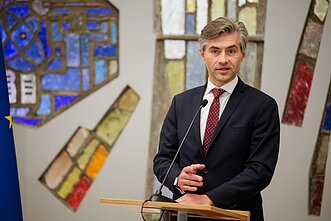
















Lithuania is attracting fintech companies, but in order to be a decision-making hub rather than just a service centre, it needs to invest in skills, argues Tom Hashimoto, Associate Professor at the Faculty of Economics and Business Administration, Vilnius University.
After the United Kingdom left the European Union, Lithuania managed to attract global digital banking giant Revolut, which chose Vilnius as its EU headquarters. That trend continues, now another major global player, Robinhood, has received a license to open its European crypto centre in the Lithuanian capital.
But such projects demand more than just service provision – they require decision-making capabilities and operational management. Which raises a key question: is our labour market ready?
While London remains one of the world’s leading fintech hubs alongside New York, cities like Berlin have recently been making strides by attracting top-tier fintech startups and strengthening their innovation ecosystems. Unlike traditional industries, fintech doesn’t rely on heavy investments in physical infrastructure.

There’s no need for factories or logistics centres – innovation happens in labs and offices, and the most valuable asset is knowledge and talent. The scale of global competition for top talent is evident when companies like Meta or OpenAI offer compensation packages of up to $100 million – comparable to those of elite footballers.
Vilnius is already well-established as a centre for high-quality labour in financial and business services. However, until now, it has mostly specialised in global service centres rather than true innovation hubs. Services provided here tend to be technical or transactional in nature, ensuring smooth operations for companies domestically and internationally.
While these roles go beyond simple “back-office” tasks, they’re still more about execution than strategy.

Robinhood’s decision to establish its crypto hub in Vilnius signals a shift. Increasingly, important decisions will need to be made locally. This kind of high-level activity requires a labour force capable of managing knowledge and information, understanding macroeconomic trends, and analysing corporate finance.
Even executives with prestigious MBAs can’t make sound strategic plans without access to quality data: from company financials to broader economic indicators. In other words, if we want to become a true decision-making centre in Europe, we need top-tier professionals at every level.
Lithuania is a small country. Although emigration and brain drain have slowed in recent years, the number of children and young people remains low, and universities are competing fiercely for new students.

Social media and modern trends have popularised flashy, “instagrammable” degree programmes. But it’s worth remembering that institutions like Harvard still offer traditional economics degrees built on foundational courses such as Intermediate Microeconomic Theory.
Meanwhile, at Oxford, despite having high-profile executive education programs, one of the most sought-after degrees remains the classical Philosophy, Politics, and Economics (PPE) undergraduate program – a known launchpad for future leaders.
Lithuania already has a flexible and advanced regulatory environment – our institutions respond quickly and adapt well. Now it’s time for our universities to raise their ambitions too. Instead of focusing only on business schools that chase external prestige, we must invest in globally respected programs in the fundamental disciplines.
If Vilnius wants to truly become a decision-making hub for Europe, we must develop the full ecosystem – not just support roles, but a strong strategic core.
What we need now is strategic economic thinking. And we need to start fostering it today.

Newsletter
Every Friday morning.