






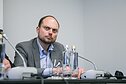

A newly published book in Russia distorting the history of Lithuania – complete with a foreword by Foreign Minister Sergey Lavrov – is a warning signal that Moscow is seeking to apply greater pressure on its neighbours, says Carolina Vendil Pallin, an expert with the Swedish Defence Research Agency, in an exclusive interview with LRT.
Russia is a state that seeks to forge its future in the past and has been rewriting history for years. “They are saying: ‘Look what we can do to you, how we can insult you – and you can do nothing about it.’ It’s a form of power projection,” emphasises Vendil Pallin.
However, the Kremlin elite is ageing and now faces a profound challenge: war demands transformation, but the country's leadership is determined to preserve stability at all costs.
Summary of the article
- A falsified book on Lithuanian history recently published in Russia is part of a broader pattern of warning signals.
- Russia is attempting to forge its future by rewriting and controlling the past.
- Obsession with history is evident not only in President Vladimir Putin but also across Russian institutions.
- Moscow seeks to increase pressure on NATO without open conflict, probing for cracks in the alliance’s collective defence and Western sanctions.
- Russia will have to confront the fact that its top political leadership is aging.
You said that we should take the new book by the Russian experts on Lithuanian history very seriously. Why?
We should make a list of early warning signals, and that is definitely one of them. It doesn't mean that Russia is preparing an armed aggression, but it does mean that it wants to apply more pressure. I don't think a book like that just comes out of nothing, and especially not if Sergey Lavrov writes the preface to it.
It's something worth noting but not being provoked by.
Further reading
Do you think anyone actually believes the things written in that book? Who is it meant for? It's not for Lithuanians, it's not for ordinary Russians to read either, right?
No, no. It's like when Russia carries out a cyber-attack and we call them out and they say, 'no, no, we never meddle in the internal affairs of other states'... It's the Russian way of saying, 'we know that you know, that we did it, but you can't do anything about it.'
And it's the same with publishing a book like this. 'Look what we can do to you, look at how we can insult you, and you can't do anything about it.' It's a power of projection, I would say.
Can the Western countries do anything against such actions?
We can't prevent them from publishing lies and distortions of history. Russia is the country that is banning books; we should not become that country. As I said, I think it's worth noting, and it's part of Russia's ambition to apply more pressure in our region.

Before the invasion of Ukraine, Putin co-authored an Op-Ed on Ukrainian history. We see where that led us. But you say that this time, it's not necessarily a precursor to any military actions – yet?
Of course not. But it's part of Russia's playbook. We need to see it in conjunction with other measures that they take.
Russia is very much a country that is trying to forge its future in the past. This policy of taking control over, and rewriting history goes back quite a few years. One particularly telling development was Putin's decision to take control of the historical archives and make them a presidential institution. Even the joint statement with China on May 8 includes a paragraph on the need to defend true history. And that's, of course, talking about history the way the Russian government wants to write it.
Some suggest that Putin became obsessed with history during the Covid lockdown. Is that plausible, or is it simply a systemic tool borrowed from other authoritarian regimes?
I think it's both. I think they reinforce each other. In the Tucker Carlson interview, Putin almost exploded into an excursion into history, and Carlson just sat there, baffled.
So you have this probably personal interest in history, but there's also the institutional element. I already mentioned the historical archives, but there's also the Council on Military History, chaired by SVR [intelligence chief Sergey] Naryshkin, and then that you have [former culture minister and historian Vladimir] Medinski sitting in Istanbul [negotiations]. I mean, there's an obsession with forging history to suit whatever political goals that Russia has.
Could ordinary Russians believe in such a vision of history, or is it more of a part of the regime ideology so disconnected from the general public that it's just self-fulfilling?
The short answer is that we don't know. It's difficult to interpret opinion polls in authoritarian systems, and repression in Russia is only increasing. We thought it was bad before 2022, but now the scale is entirely different.
Again, one doesn’t exclude the other. I think there is a concerted ideological effort to promote a certain writing of history, always centred on the Second World War and the fact that this political regime is dependent on having an external enemy – the West.
But there is also an appeal in the imperial narrative of Russia as a great power. That resonates with many Russians. So it’s not just Putin or the institutions – they reinforce each other.

Do you share the assessment that the West can at some point in the future become a real conventional military enemy for Russia? Or is it more convenient for the regime to keep it as an ideological enemy?
It's almost impossible to answer. They need an enemy. When they celebrated the 10th anniversary of the annexation of Crimea, they had these pageants – everything from Poland in the 17th century, Napoleon in the 19th century, and, of course, the West in WWII. Everything is upside down. But this is the rhetoric.
Russia is quite open about its ambitions in Ukraine – it wants full control. That’s what's behind ‘demilitarisation’ and ‘denazification’ of Ukraine: the desire to decide who is the nominal Ukrainian president.
But they also want to fracture the sanctions regime, and they also seek to reshape the European security architecture in a way that gives Russia more of a say.
And it's just fascinating how very consistent the Russian policy is. The recent joint China-Russia statement repeats the same formulations from [former President Dmitry] Medvedev’s 2008 and 2010 proposals for a new security architecture in Europe.
They use OSCE [Organisation for Security and Co-operation in Europe] language on ‘equal and indivisible security’ – but apply it very differently. Not just to states, but to alliances. They argue that no state or alliance should be allowed to increase its security at the expense of another, which effectively means that countries like Finland and Sweden, or the Baltic states, should not be allowed to join NATO without Russia having a say.
Militarily, Russia is weaker than it was in 2022 – it will take decades to replenish the equipment it lost. But military power is always relative. It will take time for us to build up forces that can more effectively deter Russia.
If there were a real ceasefire in Ukraine, Russia could redeploy their forces in our region – they are battle-hardened in a way that we are not.
But they could apply that pressure without actually going to war to influence our decision-making. And that, I think, they would prefer – to probe for cracks in NATO Article Five, the sanctions mechanism.

Recently, we heard the threats towards both Finland and Sweden coming from Russian officials. In your opinion, is that something new, related to your membership in NATO, or have they always considered you part of the Western alliance?
When our accession process took place, their response was not that forceful. They issued the usual statements about military technical responses, never outlining exactly what they are. But when we acceded, they said, 'well, you were always part of the West anyway'. I think that's for several reasons.
First, they were busy in Ukraine. Second, all of the NATO enlargements that have taken place after 1991, except the first one, happened on Putin's watch. I don't think this is something he likes to draw attention to.
If you’re a Russian general overseeing Northern Europe, then you're aware that Finland and Sweden joining NATO means that they are now part of the practical defence preparations. NATO will allocate resources to us that it didn’t before. That changes Russia’s strategic position in our region.
But we should only expect that they will keep on. Every time they make a new deployment, every time they change something in the Leningrad Military District (previously known as the Western Military District), they will say that it's a response to something that we have done.
I think Russia evaluates NATO’s collective capabilities, not just what small states like Finland, Sweden, or the Baltics are doing. They have plans, and they implement them. I lost count of the number of times that they said they were going to deploy Iskander as a response to something that we did. But they had planned that already. We knew they were going to do it anyway. But it makes big headlines every time Russia threatens with something like that.
Do you think their threats against the West are still successful?
They're skilful in creating narratives that they know will create headlines in our newspapers and in our media.

What do you think about the future of Russia? Can the regime created by Putin survive without him?
We don't know. I suppose you can say that for any country. But Russia always appears incredibly stable until it suddenly isn't. It's a country that has gone through political instabilities quite a few times in the past hundred-plus years.
When I look at Russia's political system and how it actually works right now – It's very centralised. As I said, the level of repression has increased monumentally, as has surveillance and propaganda. And there's this mosaic of different institutions that function not only to monitor individual citizens but entire regions as well. If the governor doesn't deliver the election result that the Kremlin expects or falls short in delivering the required number of military recruits, then he could find himself facing corruption charges or just being replaced.
But this increased centralisation, it could be a strength of the political system, but it could also be a weakness.
An inherent weakness of all authoritarian systems, especially the ones that are not party-based, is the succession. Every time you have a presidential election in Russia it gets overshadowed by then next. You had it in 2008 - people immediately started talking about 2012, when the presidential term was prolonged, but then 2018 became the problem. And now everyone's talking about 2030 and 2036.
Another thing that they will need to address is the fact that the top political leadership is ageing. And I'm not talking about Putin because compared to Trump, he's a spring chicken. But when you look at the Security Council, the average age is just under 70, I think. The inner circle, most of whom sat in the Security Council for 10-15 years. This means that you don't have mobility in the political system. I mean, look at Lavrov, Bortnikov, Patrushev.
They are facing a paradox: the war demands substantial change, yet their ambition is to preserve stability, always.

Newsletter
Every Friday morning.