







The Lithuanian government will be able to impose national economic sanctions on Russia and Belarus if the European Union fails to extend its measures.
On Wednesday, the parliament passed the amendments to the Law on Restrictive Measures Due to Military Aggression Against Ukraine with 93 votes in favour, none against and two abstentions.
The amendments were drafted by the Foreign Ministry and backed by the government, although Prime Minister Gintautas Paluckas has said that if there is no regional agreement on sectoral sanctions, it makes little sense for Lithuania to act alone.
The changes will allow the government to impose two types of sanctions: asset freezes and sectoral restrictions.
Once the bill takes effect, the government will be able to restrict the export of goods, technologies, services and software that could be used by the Russian or Belarusian military, or to strengthen their defence, security or industrial capabilities.
The government or its authorised institution will designate individuals, legal entities and organisations subject to the restrictive measures.
The freezing of funds and economic resources will not apply to individuals already sanctioned under EU measures.
The legislation outlines five criteria for sanctioning individuals – three for restricting exports, and two for imports.
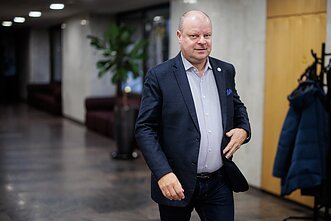
Foreign Minister Kęstutis Budrys, who initiated the amendments, said the need for such legislation became apparent over the winter, when the EU began facing difficulties in extending existing sanctions.

EU sanctions are extended by consensus of all member states, which raises concerns that any one country, such as Hungary, can veto the move.
If the EU fails to extend its sanctions, Lithuania is weighing two alternative options: Plan B would involve coordinated action among 26 member states, while Plan C would mean introducing national-level sanctions, the minister said.
Vilnius wants not only Lithuania but also other EU members bordering Russia or Belarus to impose measures if the EU sanctions are not extended. This would prevent goods from the two countries from entering the bloc by land and increase trade costs.
Budrys has said that Latvia, Estonia and Poland already have similar legal tools in place and can use them if needed.
The EU has adopted 17 sanctions packages against Russia since February 24, 2022, when Moscow launched its large-scale invasion of Ukraine. These sanctions target both specific individuals and key sectors and companies of the Russian economy.
Lithuania has also imposed its own national sanctions on Russian and Belarusian citizens. These include entry restrictions, limits on issuing residence permits, and additional security checks for people arriving from outside the EU. Russian and Belarusian citizens are also prohibited from bringing or taking Ukrainian hryvnias, and the import of agricultural products and feed originating from Russia or Belarus is banned.
Russian citizens without residence permits are also barred from purchasing real estate in Lithuania.

Newsletter
Every Friday morning.