













Following Moscow’s 2022 invasion of Ukraine, ethnic Lithuanians from Russia and Belarus have been stuck in limbo waiting for the country’s citizenship.
Olga Savenkova arrived in Lithuania from Russia’s Kaliningrad in 2013. With no knowledge of the Lithuanian language, she began her studies at the Vilnius Lithuanian Home, a school established in 1990 to attract children of Lithuanian descent living abroad. A significant number of its students come from Russia.
Her ancestors were Lithuanians who lived in the Dzūkija region in the second half of the 20th century. Later, part of her family moved to Kaliningrad, where Savenkova was born and raised. She came to Lithuania due to her Lithuanian heritage and interest in the Lithuanian language, which she had started learning while still in Russia.
“In my family, the Lithuanian language survived to some extent, because my great-grandmother – she passed away just two years ago – spoke Lithuanian better than Russian until the end of her life, even though she lived in the Kaliningrad region, right next to the Lithuanian border. As an adult, I was able to have conversations with her in Lithuanian,” she said.
Although Savenkova has spent most of her adult life in Lithuania, earned a university degree, and now works at a local bank. And even though she has been cleared for Lithuanian citizenship, Savenkova’s application has been stuck at the country’s president’s office which has to issue the final approval.
The path to citizenship
Savenkova submitted her application for citizenship on March 3, 2022 – just over a week after Russia launched its full-scale invasion of Ukraine. “It was clear that [because of the war] the process could take longer and become more complicated – and that’s exactly what happened. I’ve now been waiting three years for a decision from the president,” said Savenkova.
She notes that she could not submit her application earlier because she spent seven years gathering documentation to prove her Lithuanian heritage. She compiled a family tree and conducted research in various archives.
According to her, the war intensified the scrutiny of applications submitted by citizens of Russia and Belarus, which also affected the timeline for document submission.

Following an initial review, her documents were forwarded by the Migration Department to the Citizenship Commission, which issued a recommendation on whether or not to grant Lithuanian citizenship. The final decision then rested with the president.
Savenkova said the commission endorsed her candidacy in September 2023 and sent a recommendation to the Office of the President. After further checks by the State Security Department (VSD), the country’s intelligence service, the commission again recommended granting her citizenship in October 2024.
“Just before the New Year in 2023, presidential decrees were issued granting citizenship, and there were almost no Russian or Belarusian citizens among them,” she said.
The decrees issued in November 2023 named only two individuals from the Russian Federation and Belarus – one from each country. Before the full-scale invasion of Ukraine, dozens of people from these countries were granted Lithuanian citizenship each year.
According to Savenkova, dozens of people find themselves in similar situations. They have joined a group chat where they share updates on the progress of their applications and track each new package of presidential decrees on citizenship. They also maintain their own statistics.
Savenkova and other group members not only follow developments closely but also regularly send inquiries to the Office of the President, requesting updates on their case statuses. The replies they receive usually state that there is no legally defined deadline for the president to make a decision.
She adds that the most recent inquiries were sent in April and May this year, and the responses were the same as before.
In one of the replies from the Office of the President, which Savenkova shared with LRT.lt, it was stated: “After reassessing the circumstances and updating the procedure for granting citizenship of the Republic of Lithuania to citizens of the Russian Federation and the Republic of Belarus, due to the exceptionally high volume of applications submitted and the president’s workload, the timeframe for consideration may be prolonged.”
According to presidential adviser Ridas Jasiulionis, following Russia’s full-scale invasion of Ukraine, the Office of the President suspended the consideration of citizenship applications submitted by Russian and Belarusian nationals.
“The processing of applications for citizenship of the Republic of Lithuania submitted by Russian and Belarusian nationals – citizens of states posing a threat to Lithuania’s national security – was temporarily halted,” Jasiulionis wrote in a response to LRT.lt.
Previously, the Office of the President had merely informed the public that applicants from these countries were subject to additional checks. The fact that the procedure was later resumed can be inferred from the response sent to Savenkova in April this year.
Despite this, the option to halt the granting of citizenship to Russian and Belarusian passport holders had already been under discussion at the president’s office in 2023. At the time, the president’s chief national security adviser and the current foreign minister Kęstutis Budrys, stated that Lithuania should introduce restrictions for such applicants.
“Such restrictions are necessary under wartime conditions, while Russia and Belarus continue their aggression against Ukraine,” Budrys said in March 2023.
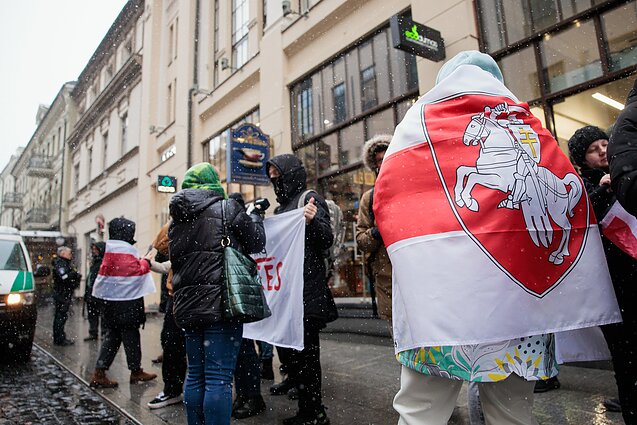
This statement came ahead of a parliamentary vote on the introduction of national sanctions against Russian and Belarusian citizens. The Seimas National Security and Defence Committee (NSGK) proposed, among other measures, to suspend the consideration and approval of citizenship applications from Russian nationals.
However, lawmakers – under pressure from the public, as Russian and Belarusian citizens were actively petitioning against the new restrictions – decided not to include the NSGK proposal in the bill. Thus, the prohibition was not enacted, though the national sanctions law was passed.
According to presidential adviser Jasiulionis, there are no formal restrictions on reviewing applications from Russian and Belarusian nationals.
“At present, the additional checks and assessments have been completed, and the president will soon review the applications that underwent further scrutiny,” the adviser said in a written comment.
Different priorities
The current chairman of the Seimas National Security and Defence Committee (NSGK), Giedrimas Jeglinskas, stresses the importance of political intervention in citizenship matters – especially in the current geopolitical climate.
According to him, procedures laid out in legislation may have been unquestioned in the past, but the situation has now changed.
"Granting citizenship without proper caution, when there is a risk that the person may harbour intentions or interests unfavourable to Lithuania, would be extremely dangerous from a security standpoint," Jeglinskas told LRT.lt.
When asked whether long-term residence in Lithuania, adherence to the law, and additional background checks were sufficient grounds for granting citizenship, the politician again returned to the issue of potential threats.
"Everyone can present their own version of the story – claiming to be loyal, not a threat, and so on. But the so-called ‘sleeper agent’ concept is real in practice," said the NSGK chairman.
Public debate over granting citizenship to Russian nationals intensified in the context of the case of Eduardas Manovas, who was convicted of spying for Russia. In December last year, Interior Minister Agnė Bilotaitė launched an internal investigation at the Migration Department to determine whether Manovas had acquired Lithuanian citizenship legally.
During the Soviet occupation, Manovas was deported to Russia with his parents as a child. After Lithuania regained its independence, he returned and obtained a Lithuanian passport. However, according to the Prosecutor General’s Office, since 2018 he had been cooperating with Russia’s GRU military intelligence agency.
In April 2025, Manovas was sentenced to 8.5 years in prison for espionage.
‘Kitchen-table nationalism’
Former chairman of Lithuania’s Constitutional Court and now a Member of the European Parliament, Dainius Žalimas, argues that the mass suspension of citizenship applications without individual assessments is unjustified.
"These people have entirely legitimate and well-founded expectations to become Lithuanian citizens if they’ve fulfilled all the constitutional and legal requirements. Their loyalty has been – based, I would say, on kitchen-table nationalism – because I see no other reasoning, that everyone who applies poses a national security threat," he tells LRT.lt.
According to Žalimas, such a practice contradicts the decisions of state institutions that have already issued the necessary evaluations for granting citizenship.
"The president is not a tsar. He cannot single-handedly decide people’s fates. We are talking about individuals who have proven their loyalty and met all the necessary criteria for obtaining citizenship. In my view, this is an abuse of discretion," he adds.
At the same time, the politician acknowledged that the president does have a certain degree of leeway in such decisions.
"That discretion is permissible if there are serious reasons. But individual circumstances must be considered. You cannot assume a priori that someone’s origin automatically makes them untrustworthy just because they come from a particular country," Žalimas said.

‘What more can I do?’
A few years ago, Savenkova and her husband, also a Russian citizen, bought their first home in Vilnius. Although she holds a permanent residence permit and enjoys certain rights, she stresses that those rights are limited.
"It sounds banal – but if war broke out in Lithuania, I couldn’t register with [the military]. That means I wouldn’t even be able to defend my own home, my land, my property. [...] I don’t know what will happen tomorrow. But if necessary – I want to defend Lithuania, because this is my home," Savenkova said.
One more restriction she faces is the inability to claim land once owned by her Lithuanian ancestors.
"It’s ridiculous – for all these 12 years, I was very much needed in Lithuania. The state paid for my education, housing, and food. I attended college, studied for free, and received a scholarship as a diaspora Lithuanian. Now I’m working, paying taxes.
That means Lithuania invested in me – taught me the language, the culture. And then, when the war began, I became disposable," she said.
"What else do they want? I don’t understand. What more can I do to prove my loyalty?" Savenkova added.

Newsletter
Every Friday morning.