








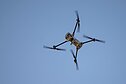




By now we all know it to be one of the greatest raids in modern military history – a fleet of FPV drones took off from unmarked lorries parked near military airfields and proceeded to decimate one of Russia’s nuclear deterrent branches.
In the brazen operation on June 1, at least several dozen Russian aircraft were destroyed on the ground, thousands of kilometres from the battlefields in Ukraine. One important detail, however, was left largely unnoticed – the attack relied heavily on Artificial Intelligence.
According to Ukrainian officials, AI tools were used to train the drone software to help identify targets and suggest striking points for each aircraft – they also guided the drone to its target if the connection was lost to the operator, authorities said. Yet, each drone was still controlled by a pilot, according to Ukrainian President Volodymyr Zelensky.
Although this was not a case of fully autonomous drone technology or drone swarms, the raid once again demonstrated the growing use of AI in warfare – on both the Ukrainian and Russian sides.
Previously, Ukrainian observers and authorities have reported that Moscow has begun using quasi-autonomous drones to strike both civilian and military targets.
According to a well-informed source who wished to remain anonymous due to the direct threat posed by Russia, Moscow’s forces have "AI algorithms that independently select targets, though their effectiveness is unclear".
Ukrainian forces have previously seized Russian drones fitted with hard drives containing AI software. "But it’s not easy to understand what these programmes are capable of," the source said.

"This is just the beginning – it’s unclear what it will look like in six months or a year," he added.
According to Anna Hehir from the Future of Life Institute, which researches the impact of advanced technologies on humanity, their researchers have not registered fully autonomous systems in Ukraine.
“We are seeing that weapons that are being claimed as autonomous still have a lot of human control, by both sides [in Ukraine],” Hehir said. “They have a lot of issues with autonomous navigation [...] and the systems in use right now have human involvement.
“There are claims they exist, but we just haven't seen them yet,” she added.
However, the trend is clear – world militaries are moving toward automatisation and increased drone use. However, some assumptions about the complete robotisation of war have not proven correct.
“Remote operations have proved to be a major shift in the balance of power,” said Peter Asaro, a philosopher of science, technology and media, with a research focus on AI.
“The idea was that big militaries like Russia and the US will control military technology, but drones have destabilised this balance,” said Peter Asaro, a philosopher of science, technology and media, with a research focus on AI. “This is a lot of why Ukraine has been able to hold back such a large army.”
A decade ago, the assumption was that drone warfare would quickly advance to be completely autonomous, according to Asaro.
“The conflict in Ukraine undermines that argument – autonomy isn’t what’s effective in those systems,” he said.

Great Britain is one of the countries that have officially called for integrating lessons from Ukraine into its military strategy – the country plans to dedicate more resources to drones and automation.
However, this does not mean that everything old will be discarded.
“Not every act of war can be waged with drones in trucks. The [British] review concludes that tanks still matter, for instance, not least because they protect troops on an increasingly transparent battlefield,” The Economist wrote earlier this month.
Meanwhile, according to Ukrainian soldiers speaking off the record, nearly two-thirds of old military doctrine has been thrown out in urban areas and open steppe terrain specifically because of drones. However, the opposite has been true in forests, where much of the old and time-tested tactics have remained in use.
Lithuania’s approach
“Artificial intelligence is no longer something entirely unexpected – it’s becoming a necessity,” Liudas Abisala from RSI Europe, a Lithuanian company specialising in drone development and production, told LRT.lt.
“This is definitely being worked on – fully autonomous solutions will absolutely be implemented in Ukraine, where your job ends once you prepare the drone for launch,” he said. “The Russians are also developing a solution where, with the help of AI, [the drone] flies based on terrain and recognises targets on its own. These kinds of initiatives exist, and they will only grow.”
“This is being worked on in Lithuania as well. Everyone sees the direction we’re heading,” Abisala added.
Lithuanian manufacturers are cooperating with Ukraine to develop autonomous or AI-driven drones.
“Training AI requires an enormous amount of data – no one has as much as Ukraine,” he said.
However, questions remain about how much progress is being made in Lithuania’s military. While Russia and Ukraine experiment with artificial intelligence on the battlefield, Lithuania is only now introducing drone operator programmes. This has drawn heavy criticism from Lithuanian fighters who served in Ukraine and claim that the process at home is moving too slowly due to bureaucratic hurdles at the top.

“The negative discourse – that everything is moving too slowly and everything is lost – is shaped by civil society members with experience in the war in Ukraine,” Aleksandras Matonis, a well-informed defence commentator and journalist, told LRT.lt.
According to him, Lithuania is now running three-week courses to train FPV drone operators, with hundreds already trained. There is also ongoing development of reconnaissance drone capabilities in every battalion.
“Is it moving as quickly as similar processes did in Ukraine? It’s not – we live in peacetime,” he said.
Lithuanian AI-based solutions, such as drones flying according to terrain or algorithms capable of identifying minefields, are already being used on the battlefield in Ukraine.
“For some reason, they haven’t yet been tested in Lithuania – but they’re already working in wartime conditions in Ukraine,” said Matonis.
Manufacturers often withhold more detailed answers and technical specifications due to the risk of espionage from Russia, Belarus and China, Matonis added.
LRT.lt reach out to the Lithuanian Armed Forces for comment.
Limit and control?
In May, the United Nations held consultations in New York on limiting – regulating or even outright banning – the use of AI in lethal weaponry, particularly in cases where a drone or system could make its own decision to kill.
The discussion was hastened by Israel’s use of artificial intelligence in Gaza, which has been cited as one of the main reasons behind the colossal number of civilian casualties. The so-called Lavender AI system generated tens of thousands of targets for Israeli forces.
Although a human was still required to authorise a strike, critics argue that the sheer volume of suggested targets made it impossible to fully weigh all the information.
While more than 120 countries participated in the UN consultations on autonomous weapons, Russia – along with China and the United States – showed little appetite to significantly restrict or ban the development or use of lethal autonomous weapons.
As UN diplomats from the Baltic states and Poland told LRT.lt, countries near Russia are reluctant to tie their own hands, knowing that the Kremlin is already successfully developing this technology.
Now, The NGO sector and human rights advocates are increasingly concerned about the growing threat to civilians posed by the unregulated “killer robot” industry.
“It comes with the acknowledgement that there will be autonomy in some weapon systems, it just has to have meaningful human control,” said Hehir from the Future of Life Institute.
The UN is now pursuing a "two-track" approach: attempting to ban some technologies – such as fully autonomous weapons capable of deciding itself whether to kill a human being – while aiming to regulate others.
“This is more with European interests, because they need to arm up fast,” Hehir added.

Newsletter
Every Friday morning.