




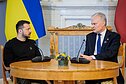

Leaders of the Bucharest Nine and Nordic countries pledged Monday to work toward gradually increasing defence spending to at least 5% of their gross domestic product in response to mounting security threats, particularly from Russia.
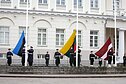
The commitment was made in a joint statement issued following a summit in Vilnius, co-chaired by Lithuanian President Gitanas Nausėda, Polish President Andrzej Duda, and Romanian President Nicușor Dan.
“We are moving towards reaching at least 5% of GDP on defence and defence-related investments to match security threats and challenges,” the statement said. “We call on all Allies to urgently invest more, individually and collectively, to ensure fully resourced plans and credible capabilities to prepare for, deter and defend.”

The announcement aligns with US efforts to encourage NATO allies to meet a 5% defence target. Diplomats say NATO countries may seek to formalise the goal at the upcoming summit in The Hague later this month, potentially splitting it into two components: 3.5% for core defence spending and 1.5% for related needs such as dual-use infrastructure.
While NATO Secretary General Mark Rutte, speaking earlier in Vilnius, acknowledged the need for higher spending, he stopped short of endorsing a specific percentage.
Support for Ukraine reaffirmed
The summit focused heavily on security challenges posed by Russia’s ongoing war in Ukraine and NATO’s preparations for the Hague summit.
“We met today at a pivotal moment when the security environment continues to deteriorate,” the leaders said. “Russia remains the most significant, long-term, and direct threat to Euro-Atlantic security.”

The joint statement reiterated support for Ukraine and called for continued investment in Europe’s military industrial capacity, including faster production, smarter procurement, and multinational defence projects.
Leaders also encouraged stronger NATO-EU cooperation, especially in areas such as military mobility and capability development, while ensuring that non-EU allies are included.
“The security of Ukraine is an integral part of the security of the Euro-Atlantic region,” the statement said.

No peace without accountability
The leaders reaffirmed their backing for US-led peace efforts and praised initiatives by the UK and France under the so-called Coalition of the Willing. However, they noted that Russia has “shown no genuine interest in peace”.
They urged that NATO’s summit in The Hague demonstrate the alliance’s continued support for Ukraine, including the country’s eventual membership in NATO.
“We stand firm on Allied decisions and commitment regarding Ukraine’s irreversible path to full Euro-Atlantic integration,” the leaders said. “Ukraine has the right to choose its own security arrangements and to decide its own future, free from outside interference.”
Constraining Russia and condemning its backers
The statement also called for intensified efforts to constrain Russia through sanctions, adding that leaders are prepared to adopt new measures.
They called for Russia’s international accountability for war crimes and the war of aggression, emphasising that frozen Russian assets should remain immobilised until Russia compensates Ukraine.

The statement condemned support for Russia from North Korea, Iran and China, and denounced “intensifying and highly confrontational actions” against Europe, including sabotage, cyberattacks, election interference, and airspace violations.
“These malign efforts will not prevail,” the leaders said.
They also praised Moldova for its continued reforms and pledged to deepen strategic partnerships with the European Union and other global partners, including those in the Indo-Pacific.
The next Bucharest Nine summit will be held in Romania in 2026.

Newsletter
Every Friday morning.