









As European Union countries ramp up military spending, public support across the continent remains uneven. While the war in Ukraine, growing hybrid threats from Russia and uncertainties regarding US commitments to NATO have galvanised policymakers, polls reveal a more complex picture of public sentiment and national priorities.
This is A European Perspective* on defence in Europe.
Navigate our interactive map to find reports from European Public service media.
“We should have listened better to Central and Eastern Europe,” President of the European Commission Ursula von der Leyen admitted in a speech at the Globsec security conference in Prague in August 2024. It was an acknowledgement of a blind spot in European security strategy – one that many countries are now trying hard to fix.
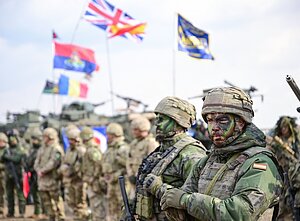
Europe, including Russia, is the region of the world where military spending increased the most in 2024, jumping by 17% to surpass its level at the end of the Cold War, according to the latest report by the Stockholm International Peace Research Institute (SIPRI).
Within the European Union, defence expenditure reached an estimated €326 billion in 2024, about 1.9% of the EU’s GDP. This marks the 10th consecutive year of growth, with a substantial increase of over 30% compared to 2021.
Notably, 23 of the 32 NATO member states met or exceeded the alliance’s guideline of allocating at least 2% of GDP to defence spending in 2024. As tensions rise on NATO’s eastern flank, the United States has renewed its call for allies to raise defence spending to 5% of GDP – a demand expected to be a key focus of the NATO summit in The Hague this June.
Governments in the Baltic region have already expressed support for the proposal, with Estonia, Latvia, and Lithuania committing to increasing defence spending to 5% of GDP in the coming years, LSM reports.
Meanwhile, Poland allocated more than 4% of its GDP to defence already in 2024. France, which is currently allocating 2.1% of its GDP to defence, expects an increase of over €3 billion annually under the 2024–2030 military spending plan. Germany’s military spending increased by 28% in 2024 and Chancellor Merz vowed in his first government statement to make the Bundeswehr the strongest conventional army in Europe.
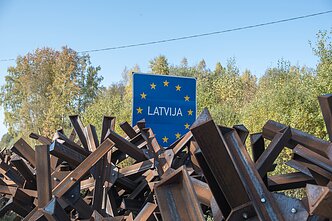
Finland began building a metal barrier along its 1,340-kilometre border with Russia, and Spain planned to devote €14 billion to improve the equipment and working conditions of its defence forces.
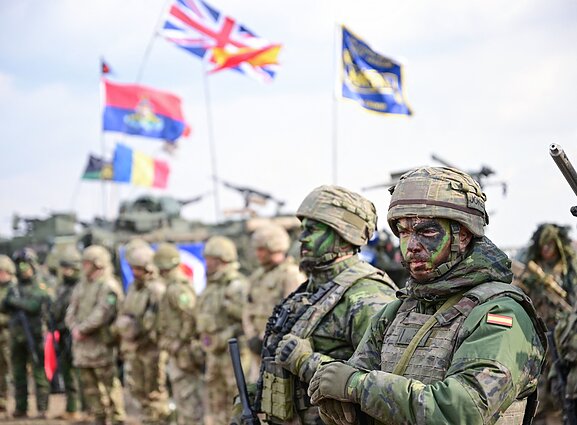
But how is civil society responding to this global trend? According to the Autumn 2024 Standard Eurobarometer, 33% of EU citizens believe security and defence should be a top EU priority in the next five years, placing it ahead of migration (29%) and economic issues (28%). This is a percentage, however, that masks significant national differences.
Uneven public responses
In frontline countries such as Lithuania (49%), Finland (48%), and Poland (46%), security and defence dominate public concern. In contrast, just 12% of Spain’s population and 19% in Greece prioritise defence, focusing instead on employment, migration, and climate change.
According to Félix Arteaga of the Elcano Royal Institute, Spain’s historic neutrality and Cold War isolation shaped a culture wary of military investment. While public perception of the Armed Forces has improved since the end of General Francisco Franco’s dictatorship, military spending remains low in public priorities.
In early 2025, Prime Minister Pedro Sánchez vowed to reach NATO’s 2% goal before 2029 – but “not at the expense of social policy”, he said, stressing: “We are not going to enter into an arms race.”
Similarly, in France – long seen as central to Europe’s defence posture – public unease is growing, as shown by Franceinfo’s recent exchanges with its readers.
“We must not sacrifice our social model in the name of security,” warned Prime Minister François Bayrou, speaking during recent pension reform consultations. President Emmanuel Macron’s announcement of increased defence spending caused alarm among opposition parties, who warned of cuts to other public budgets and demanded greater transparency.
Meanwhile, in traditionally neutral Switzerland, almost half of the population would like to spend more money on the military than parliament currently allocates, SRF reports. And in Czechia, CT highlighted that more than a third of respondents consider 2% of GDP per year to be ideal for defence spending, with a similar proportion willing to invest more. However, the idea of allocating 5% of GDP for defence is supported by only one in 20 Czech citizens.
Some 1,000 kilometres closer to the Russian border, the same initiative receives much wider support. A Lithuanian survey conducted by Vilmorus and commissioned by the BNS news agency revealed that 44% of respondents approved of the plan to invest 5% of GDP in defence, LRT reports.
Interviewed by RTBF for A European Perspective, Hadja Lahbib, the EU Commissioner for Preparedness, Crisis Management and Equality, addressed these regional differences: “A Spanish citizen may worry about heatwaves and fires; someone in Finland thinks of hybrid threats and pipeline sabotage. Perceptions differ, but all are valid.”
She argued that resilience across the EU – whether toward cyberattacks or natural disasters – requires coordinated investment. “Preventing disaster is 10 times cheaper than reacting to it,” Lahbib said.
Showing a united front
While a common EU army remains off the table, the European Commission stated its intention for a common defence of the EU’s borders with Russia and Belarus in its White Paper for European Defence, released in March 2025.
General Robert Brieger, Chairman of the European Union Military Committee, stressed the urgent need to reduce Europe’s reliance on the US for security.
“There are capacity gaps in European defence that need urgent attention – air defence, drone defence, strategic transport, precision weapons,” he said in an interview with ORF. “Europe has made progress, but it still relies heavily on US support in several key areas. The ambition is to be fully defence-ready by 2030.”
Pacifist voices
Yet, amid the trend toward militarisation, pacifist voices are also growing louder. Across the continent, political figures and activists are raising concerns that the arms buildup could empower extremist movements and destabilise the European project itself.
“The pressure to buy additional weapons will only strengthen the far right, which could lead to the collapse of the European Union or at least its idea. In the Left, we have a clear position on this – even more weapons and the accumulation of military equipment will not lead to stabilisation and peace in the world,” said Matej T. Vatovec of Slovenia’s Left, quoted by RTVSLO.
This sentiment is echoed by Vincent von Siebenthal, president of the organisation Left-wing Christians in French-speaking Switzerland, who argues that peace should be pursued through trade and dialogue, not through an arms race, SRF reports.
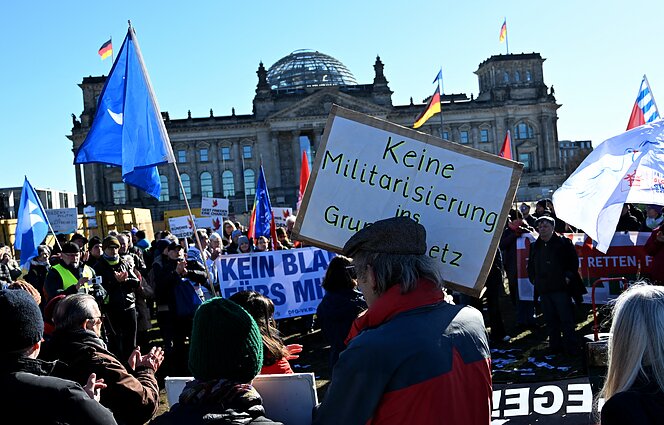
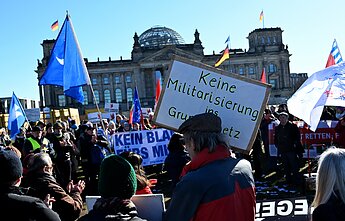
Meanwhile, in Germany, tens of thousands of people took part in traditional Easter marches for peace in April. Yet despite the turnout, some see signs of decline in the movement’s broader influence.
In an interview with DW, Olaf Müller, professor of philosophy at Humboldt University in Berlin, expressed concern that the pacifist movement in the country is at one of its lowest levels in decades, indicating a challenging environment for pacifist voices in Germany.
“I think the pacifist movement is demoralised, and one of the reasons is that if you take to the streets now against militarism, you are automatically suspected of playing Putin’s game,” he said.
Meanwhile, in the Netherlands, the New Peace Movement saw a surge in memberships, according to NOS. The group is organising a counter-summit to coincide with NATO’s June summit in The Hague, aiming to offer a platform for voices critical of Europe’s current defence trajectory.

*A European Perspective is an editorial collaboration connecting European Public Service Media. Find out more here.
Reporting by Catherine Tonero and Eric Juzen (RTBF), Johannes Perterer and Hendrik Vervaeke (ORF), Sara Badilini (EBU), Alexiane Lerouge (EBU)
Additional content provided by AFP (France), BR (Germany), CT (Czechia), Franceinfo (France), ERR (Estonia), LSM (Latvia), LRT (Lithuania), RTBF (Belgium), RTP (Portugal), RTVE (Spain), Suspilne (Ukraine)
Sub-editor: Eoghan Sweeney (EBU)
Research and coordination: Sara Badilini (EBU), Luis Garcia Fuster (EBU), Martin Sterba (EBU)
Project Management: Alexiane Lerouge (EBU)
A European Perspective has been co-financed by the European Union's Preparatory Action – “European Media Platforms”