




Vilnius is hosting on Monday a summit of the Bucharest Nine and Nordic countries with a focus on defence funding and support for Ukraine.
The summit brings together leaders from the Baltic states, Poland, the Czech Republic, Slovakia, Hungary, Bulgaria, Romania, Denmark, Norway, Finland, Sweden, and Iceland, as well as NATO Secretary General Mark Rutte and Ukrainian President Volodymyr Zelensky.
The meeting is aimed at aligning regional positions ahead of NATO’s summit in The Hague.
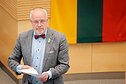
“The Vilnius summit will centre on two main topics: preparations for the NATO summit in The Hague and support for Ukraine. Those will be the focus of two dedicated sessions,” Deividas Matulionis, Lithuanian President Gitanas Nausėda’s chief national security adviser, told BNS ahead of the event.
The NATO summit in The Hague is set to take place in about three weeks, with military spending expected to top the agenda.

Five percent
US President Donald Trump has for some time been urging allies to more than double their military spending commitments, up to 5 percent of GDP.
NATO members are currently committed to spending 2 percent of GDP on defence, although not all of them have yet reached that target.
In response to the potential challenges of allocating 5 percent of GDP, Rutte has proposed that NATO members raise defence spending to 3.5 percent and commit a further 1.5 percent of GDP to broader security-related expenditures.
“If we manage to reach a decision in The Hague to jointly raise our defence budgets to at least 3.5 percent purely for defence within the shortest possible time, then that summit could rightly be called historic,” Matulionis said.

The adviser said the goal of Monday’s meeting in Vilnius is to agree broadly on the 5-percent target, “without dividing the commitment into parts”.
“We’ll try to push for moving toward 5 percent for defence. That’s our goal,” he said. “If 14 nations recognise the need to go in that direction, that would be a very strong political signal going into the negotiations in The Hague.”
So far, the Baltic states and Poland have publicly announced plans to allocate 5 percent of GDP or more for military spending.
Despite Slovakia’s and Hungary’s sceptical stance on aid to Ukraine, Matulionis said this issue will remain an important topic in Vilnius.
Traffic restrictions
Traffic restrictions have been put in place in the Lithuanian capital during the summit.
From Sunday through Monday evening, parking is prohibited in the lot near Cathedral Square, on Šventaragio and Stuokos-Gucevičiaus streets, on the section of Universiteto Street between Šventaragio Street and Liejyklos Street, and on the section of Jakšto Street between Gedimino Avenue and Beatričės Street.
On Monday, all traffic except public transportation is banned on Kosciuškos, Arsenalo, Vrublevskio, Šv. Jono, Barboros Radvilaitės and Trispalvės streets.
Short-term traffic stoppages are expected on routes between Vilnius Airport and the city centre due to motorcades, potentially causing delays for public transport.
Drivers are advised to plan ahead, allow extra time for travel and use alternative routes where possible.

Newsletter
Every Friday morning.