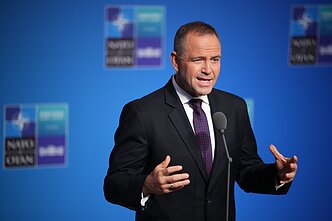














Lithuania is developing a card payment system to be used in case of an internet outage during mobilisation, Simonas Krėpšta, a member of the Bank of Lithuania’s board, said on Friday.
“The system in Lithuania is not just being planned; it’s being developed. We’ve talked about it before, but now it’s being developed, and preparations are underway so that, during mobilisation, if there’s no Internet connection, people will still be able to pay not just with cash, but also with payment cards,” Krėpšta told BNS.
“We see that some people sometimes don’t have cash and are used to paying by card. We believe this added functionality would be useful and would increase our country’s resilience in the face of unexpected situations during mobilisation,” he said.
According to Krėpšta, state institutions started work in developing the system when they were tasked by the previous government to prepare for a potential mobilisation.

Defence Minister Dovilė Šakalienė and a group of Social Democratic MPs have registered draft amendments to the Law on Payments to allow card payments during mobilisation, even if there is no connection, or if the account has been frozen.
The proposal passed its first reading in the parliament in late April.
If the parliament, Seimas, adopts the amendments during its spring session, the offline payment system could be operational within a few months, Krėpšta said.
Reuters reported earlier this week that Finland, Sweden, Norway, Denmark and Estonia are rolling out offline card payment systems to provide a back-up if internet connections are lost, including due to sabotage.
Krėpšta said that the system being developed by the Bank of Lithuania is primarily intended for mobilisation, but he did not rule out the possibility of using it in other situations where internet access in the country is cut off.

Newsletter
Every Friday morning.