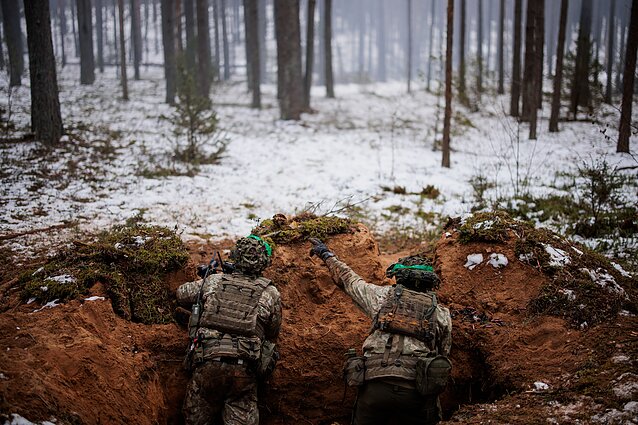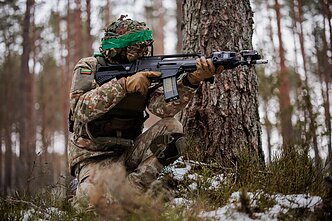









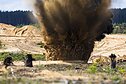


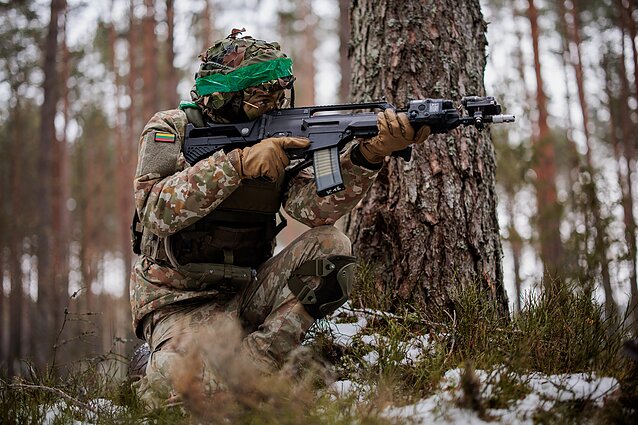
Lithuania's military is in urgent need of a new, larger training area. With the number of troops increasing and more NATO forces arriving, the existing training grounds in Rūdninkai and Pabradė are expected to become overcrowded.
Varėna District in southern Lithuania, bordering Belarus, hosted a military training ground more than a century ago. It was used by the Lithuanian army from 1925 during the interwar period. In other words, it has long been considered a strategic location.
Lina Kasparaitė-Balaišė, who has conducted academic research on the area, says that debates over the training ground now echo those of the past.
“At the time, when the training area wasn’t in use, part of the land was distributed to local residents. Some people simply moved in and began living there. It was a complicated period – independence wars, the state re-establishing itself – so there were a lot of nuances,” explained Kasparaitė-Balaišė, deputy director of the Ninth Fort Museum in Lithuania’s Kaunas.
General Raimundas Vaikšnoras, the chief of the country’s armed forces, has publicly stated that Lithuania needs a training ground in the south of the country.
A site is being sought in the south for the same reason as a century ago – its strategic border location near Belarus and Poland, which is now known as the Suwałki Gap. NATO commanders see the narrow stretch of land connecting Poland with the Baltic states, and flanked on both sides by Russia’s Kaliningrad and Belarus, as a major vulnerability in any potential conflict.
The push to create a military training ground there indicates Lithuania's defence plans, according to Associate Professor Deividas Šlekys from the Institute of International Relations and Political Science at Vilnius University.
Further reading

“A training area is also a fortified zone which could serve as a man-made defensive region during wartime. In peacetime, it's used for training,” he said.
“If we look at the existing training areas in southern Lithuania – Pabradė is on the border [with Belarus], and Rūdninkai is also near the border. Adding another one in the south would give us a network of training zones spread along the border region, used for drills in peacetime and forming a defensive perimeter in wartime,” said Šlekys.
He argues that without a new training area, the idea of universal conscription also cannot be realised. Defence Minister Dovilė Šakalienė previously stated that conscription could only be implemented if the military has a fully developed infrastructure capable of supporting the necessary number of recruits.
“If we’re planning and thinking about implementing universal compulsory military service in five or ten years, then we need to start building that infrastructure now,” Šlekys added.
The government once again finds itself forced to tread carefully, for reasons strikingly similar to those of a century ago.
“A training area significantly affects the comfort and way of life of surrounding communities,” Prime Minister Gintautas Paluckas said last week.
“But it’s a strategic need, so those interests must be balanced. There is a way to reconcile them, because municipalities [...] need investment in public facilities, road infrastructure to attract investment,” he added.
According to Deputy Minister of National Defence Orijana Mašalė, the benefits mentioned by the prime minister could be formalised in a dedicated law on military training areas.
For example, the government could commit to improving roads, establishing nurseries, and encouraging investment. Talks with local authorities are already under way and are expected to conclude in the coming weeks.
“There must be mutual value – both for our military and for the local authorities,” said Mašalė.
The government is now looking at 14 possible sites for a new military training ground. The armed forces are expected to give their assessment in the coming days.
In January, the army chief warned that once Russia's war in Ukraine ends, Moscow is likely to redeploy its military forces to the Western Military District. He stressed that this would automatically increase the threat to Lithuania, as Vladimir Putin might decide to test NATO’s resolve.
This concern has been echoed by the outgoing head of Lithuania’s State Security Department (VSD), Darius Jauniškis. He believes it is entirely plausible that Russia will move its forces closer to Lithuania’s borders.

Newsletter
Every Friday morning.