








Following the formation of a new government in neighbouring Poland, hopes were raised for a fresh chapter in relations with Lithuania. However, despite declarations of solidarity, experts say both Vilnius and Warsaw have shown little appetite for closer cooperation.
“We see that over the past 35 years, Lithuania has not developed a political class that could be described as Polonophiles,” Rimvydas Valatka, a prominent Lithuanian journalist and publicist, told LRT.lt.
“We practically have no people who could name 10, 15, 20 contacts in the Polish Senate, Sejm, or Ministry of Foreign Affairs. Relations are mostly maintained through forums like the Polish-Lithuanian Dialogue and Understanding Forum named after Jerzy Giedroyc – ie through intellectuals,” Valatka said.
“Foreign policy is about relationships between politicians,” he added. “I am talking about simple, human relationships, the ability to call Donald Tusk and say: ‘Donald, how are we going to handle this?’”
“Why has Volodymyr Zelensky won the sympathy of most of the world’s political leaders? Why are parliaments rallying behind him?” added Valatka. “It’s not only because Ukraine is fighting a war, but also because this man knows how to build genuine political relationships. Through 'political friendship', a national mission is also being carried out.”
“Neither Defence Minister Dovilė Šakalienė nor Foreign Minister Kęstutis Budrys mentioned Poland as a strategic partner,” said Mariusz Antonowicz, a political scientist at the Institute of International Relations and Political Science at Vilnius University.
“Budrys has previously indicated that Lithuania’s closest neighbours are the Northern European countries and Germany. It’s clear they are deliberately avoiding mentioning Poland. That suggests a mutual reluctance to cooperate,” he added.
For the past seven years, Lithuanian President Gitanas Nausėda has had a close relationship with his Polish counterpart, Andrzej Duda. However, that will soon change – Poland is due to hold its presidential election next month.

Lithuania’s diplomats and politicians have received multiple signals encouraging them to establish ties with Rafał Trzaskowski, the mayor of Warsaw and a presidential candidate.
“I suggested to Vilnius conservatives that they organise a bilateral meeting between the cities of Vilnius and Warsaw. But no action was taken. When former mayor Remigijus Šimašius heard a similar proposal, he attended one event – and that was the end of it. It seems we never did our homework,” said Antonowicz.
Cooperation looked different under Poland’s former populist leadership, the Law and Justice (PiS) party, which was in power from 2015 until 2023.
But that doesn’t mean the relationship was much better, according to Antonowicz, as it mostly centred on ethnic minority issues.
Lithuania maintains a sizable Polish minority population, mostly concentrated along the Belarusian border and around Vilnius. For decades, Lithuania blocked attempts to legalise non-Lithuanian spelling of names in documents, preventing ethnic Poles from writing their names using Polish letters.
There were also plenty of other issues – from education to the controversial Polish minority party in Lithuania, the Electoral Action of Poles in Lithuania – Christian Families Alliance (LLRA–KŠS).
“The Polish side sees it like this: we consistently offer help in areas like security and energy, but they deceive us when it comes to minority issues. For Lithuania, this is a major challenge,” said Antonowicz.
“Poland believes the ‘small matters’ need to be resolved first so they don’t become obstacles later. Lithuania, on the other hand, thinks these issues should be deferred, as we are now facing major geopolitical concerns,” he added.
A good example was the former Lithuanian government allowing names to be written in their original spelling in all official documents, according to Antonowicz.
“There were questions over whether Nausėda would sign the legislation, since he had promised during the election campaign not to do so. In the end, he signed it to avoid damaging Lithuania’s relations with Poland,” he recalled.
Meanwhile, the PiS leadership would meet with the Polish minority party in Lithuania without informing the Lithuanian government. This was meant to show Warsaw’s resolve in dealing with ethnic minority issues, according to Antonowicz.
But the Warsaw and LLRA-KŠS communication lines have now been mostly severed – which was welcomed by Vilnius.
“LLRA–KŠS has not only been distanced by the Polish side, but has itself decided to withdraw from cooperation with the Polish government. Instead, it maintains close ties with Poland’s far-right Confederation party. Although the Confederation continues to grow, it is disliked by both the ruling party and the opposition,” Antonowicz said.
The former Polish Foreign Minister Radosław Sikorski previously said that relations between the two countries rest on the rights of the Polish minority in Lithuania.
“Of course, Polish authorities will not forget about the rights of the Polish minority and will continue to work to ensure them. I believe that Minister Sikorski and other Polish officials will no longer raise this issue as sharply as they once did, especially during Sikorski’s earlier tenure as minister,” said Michał Wojciech Potocki, a Polish journalist affiliated with the Dziennik Gazeta Prawna newspaper.
Donald Tusk, the Polish prime minister, most recently visited Lithuania in March last year when he met with the then Prime Minister Ingrida Šimonytė. It was his first foreign visit after winning Poland’s general election. At the time, Tusk stated that Polish–Lithuanian solidarity was beyond dispute.
Radosław Sikorski, who was appointed Foreign Minister in December 2023, has visited Lithuania twice – once in 2024 and again in 2025.

“In 2007, Prime Minister Tusk and I came first to Vilnius. Unfortunately, this was not properly acknowledged at the time. And that it took so many years to resolve the issue around the Mažeikiai oil refinery, which was then Poland’s largest foreign investment – and, as I understand, the biggest investment in independent Lithuania’s history,” Sikorski told reporters in 2024 after he visited Vilnius, before departing for Warsaw.
“I remember that the Russians cut off the oil pipeline, and Lithuania dismantled the railway. And the issue of a few letters people wanted to include in their passports – well, that could have been resolved in less than a quarter of a century,” he added.
Warsaw sees positive momentum
Potocki, the Polish journalist, said there was little difference in how the governments led by the PiS party and Civic Platform, which came to power in 2023, view relations with Lithuania.
“Both governments regard Lithuania as a country whose foreign policy outlook and position in the region largely align with Poland’s. However, there are certain differences – particularly in how the two countries engage with China. Lithuania’s rhetoric in this regard tends to be more pronounced than Poland’s,” says Potocki.
The main difference between the two Polish governments, he said, is that “the Law and Justice team was more active in maintaining political ties with Lithuania than the Civic Coalition”.
In his view, this contrast stems not from differing attitudes towards Lithuania, but from differing strategies for Poland’s role in Europe – either by forging strong ties with major EU powers, as Tusk favours, or by pursuing a more regionally focused policy through initiatives like the Three Seas Initiative or the Bucharest Nine, as PiS did.
“Tusk has always prioritised relations with Europe’s major powers. Regional policy has never been a strong point of his government. That is beginning to change, especially in light of Donald Trump’s return to power in the US,” said Potocki.
Lithuania did show initiative to improve ties under the 2016–2020 government led by Saulius Skvernelis.
“The first major gesture was the removal of obstacles linked to the Mažeikiai oil refinery [owned by Poland’s Orlen], specifically the reconstruction of the railway line that enabled the plant to operate normally. This was a key step that brought the PiS-led government closer to its Lithuanian counterpart. The initiative came from the Lithuanian side.
This unblocked bilateral relations and created favourable conditions for addressing Polish demands, including those relating to surname spelling and other minority issues. This move was noticed and appreciated by the Polish authorities,” he said.
Potocki also recalled that it was the PiS government that reduced its support for LLRA-KŠS and its leader, Waldemar Tomaszewski.
“PiS was very dissatisfied with Tomaszewski’s stance on foreign policy, particularly his views on Russia and Belarus. Despite the ideological and [conservative] worldview similarities between PiS and the LLRA–KŠS, the divergent positions on Russia and Belarus, as well as certain financial irregularities discovered in Tomaszewski’s party, compelled PiS to distance itself from LLRA–KŠS. This was acknowledged positively on the Lithuanian political side,” he said.
Potocki also noted other encouraging trends in Lithuania’s political climate.
“An increasing number of representatives of the Polish minority are building careers within Lithuania’s administration and in Lithuanian political parties. A Polish surname is becoming less of a barrier to a career,” he said.

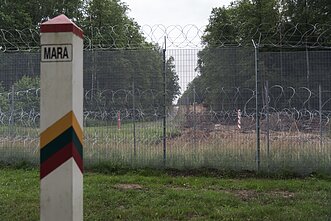
Now, the two countries are eyeing larget securitychallenges ahead, including the construction of defensive line on the border with Bealrus and Russia, as wel las the defence of Suwalki Gap – a small stretch of land connecting the Baltic states and Poland, but vulnerable to a potential Russian attack.
“For Poland, NATO’s Article 5 has always been of utmost importance. Despite the belief in Lithuania, Poland is not capable of defending itself against Russia on its own,” said Antonowicz from Vilnius University.
“At the same time, Poland is not showing a strong desire to take the lead – it is being invited to top-level meetings but isn’t proposing initiatives itself,” he added.
Potocki also acknowledges that NATO’s Article 5 is the most critical clause as far as Poland’s security is concerned.
“During my last visit to Lithuania, I observed widespread anxiety about the surrounding geopolitical developments, including fears that Donald Trump might withdraw the US from NATO.
Donald Tusk’s government unequivocally supports all security-related proposals currently being discussed in Brussels. Article 5 remains a cornerstone of Poland’s policy, and its allies can rest assured that Poland remains committed to upholding the North Atlantic Treaty, including about [defending] Lithuania,” the journalist said.

Newsletter
Every Friday morning.