















While rearmament and tax changes dominate Lithuania’s political agenda at the moment, what are the chances that politicians will address previously passionately debated questions like same-sex civil partnership or the Istanbul Convention?
The coalition agreement and the government programme do not mention any plans to legislate on same-sex partnerships or civil unions. The reason is that the three parties in the coalition do not agree on the issue, which was also controversial in the previous conservative-liberal ruling block.
President Gitanas Nausėda has not so far appeared friendly to the LGBTQ+ cause, insisting that any legal recognition of same-sex unions must steer clear of equating them to marriage.
In a recently published biography by the journalist Laima Lavaste, however, Nausėda hints that he would like to see amendments to the Civil Code that would grant property and other rights to same-sex partners. He nevertheless emphasises that their relations must not be treated as equal to that between opposite-sex spouses.
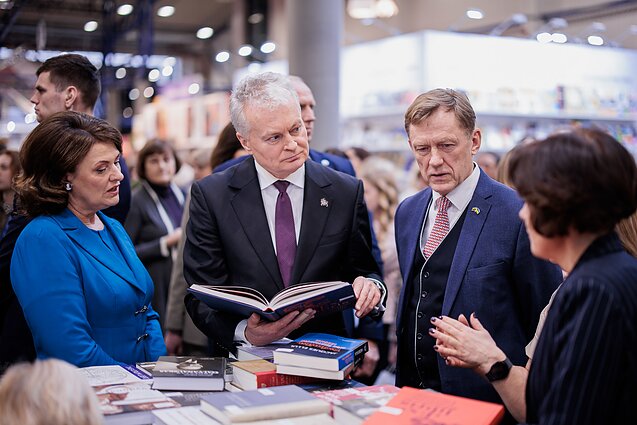
“If we want to address the issue of same-sex relationships, we must do so through other means – not through family structures or formations that de facto become family analogues […] but rather through something like the close relationship institute,” the president says in the book.
“No matter what, it will resemble a family because we are talking about people,” tackles MP Tomas Tomilinas. “We cannot reduce them to the level of economic entities.”
He adds, however, that same-sex partnership “is not identical to a family”.
Tomilinas’ own party, the Democrats “For Lithuania”, has not been sympathetic to LGBTQ rights and its leader, Seimas Speaker Saulius Skvernelis, has maintained that while legislation is needed to regulate same-sex relations, they are not and should not be treated as family.

Moreover, Tomilinas says that raising the issue would only incite culture wars and should be avoided in order to focus on more pressing matters: security and tax reforms.
“Honestly, during such a period of geopolitical instability, I would prefer to postpone these discussions. People would not understand,” Tomilinas says.
Opposition MP Viktorija Čmilytė-Nielsen, who leads the Liberal Movement party, says it is disingenuous of the president to pass all the responsibility to someone else.
“If the president wanted to speed up and solve the issue, he has all the means at his disposal – considering his strong relationship with the current coalition and his overall authority,” she says.

The leader of the Nemunas Dawn party, another junior coalition partner, agrees. Remigijus Žemaitaitis says his group would support amendments to the Civil Code as long as they exclude any references to family, but will not table the legislation himself.
“We have discussed this with Prime Minister Gintautas Paluckas regarding what the legislation could look like. The Social Democrats have committed to drafting a bill within the next year. Let’s wait and see,” he says.
But the Social Democrats, the biggest party in the coalition, deny making such a commitment, aside from individual initiatives.
“There may not be a unanimous opinion within our parliamentary group, but there are certainly thoughts that this issue needs to be addressed and amendments need to be prepared,” says Orinta Leiputė, deputy leader of the Social Democratic Party’s parliamentary group. “What form they will take, I cannot say at this time.”

In the same book, President Nausėda also addresses the Istanbul Convention, another culture war issue that has galvanised Lithuania’s politics.
“I was almost certain that the Constitutional Court would rule that the Istanbul Convention does not contradict the constitution, and that’s exactly what happened. Then, the new Seimas began its term. [...] Ratifying the Istanbul Convention is its responsibility,” he writes.
“I keep hearing this half-hearted remark from him,” retorts Žemaitaitis of the Nemunas Dawn party. “The president can initiate legislation and can push this forward himself. But for some reason, he wants others to do the work.”
His own party, however, does not believe Lithuania needs to ratify the Istanbul Convention, the Council of Europe’s document on battling gender-based violence.
The Social Democrats disagree.
“I also support ratifying the Istanbul Convention. All non-governmental organisations advocate for it,” says Leiputė. However, she cannot promise that the issue will be put on the parliament’s agenda.

Newsletter
Every Friday morning.