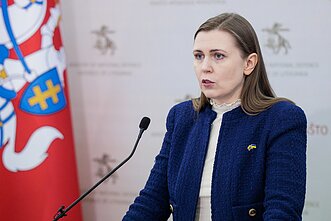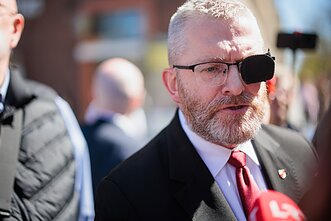









Lithuania is planning to establish four defence industry clusters, open military training areas for testing the products, and set up a new venture capital fund to support the defence industry, Defence Minister Dovilė Šakalienė said on Friday.
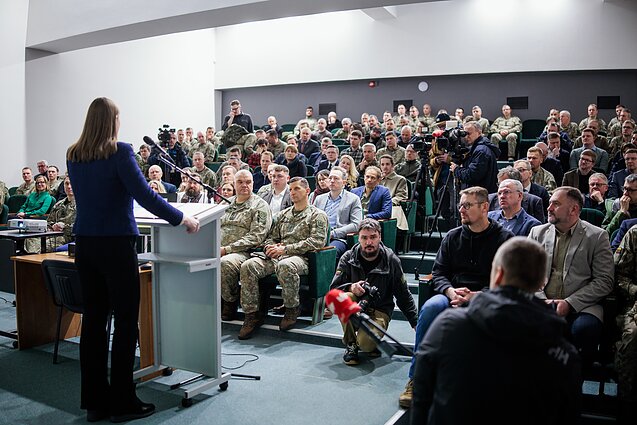
“The principle is simple – make in Lithuania what you can,” she told a news conference at the Military Academy in Vilnius.
According to the minister, Lithuania first plans to produce the necessary quantities of critical ammunition.
“We are capable of producing anti-tank mines and other types of mines here,” she said.
Šakalienė provided details on the three planned critical defence industry clusters.
“The first is the ammunition and explosives cluster. The goal is to have an integrated supply chain for explosives and explosive materials operating in Lithuania, which would allow us to independently supply the Lithuanian Armed Forces and our allies with critical large and medium-calibre ammunition, mines, and other explosives,” she said.

According to the minister, Lithuania needs at least 85,000 anti-tank mines, with 50 million euros earmarked for this purpose.
The second cluster is for manufacturing drones and anti-drone systems, including long-range missile drones.
“I’ll make every effort to attract the development of critical components and technologies here in Lithuania. This process is already moving forward quite successfully,” the minister said.
The third cluster focuses on the production and repair of critical military equipment.
“Yesterday, we spoke with the Poles about how, in certain areas, we are already capable of providing them with assistance and maintenance services when it comes to heavy weaponry,” Šakalienė said.
The minister said that Lithuania also plans to use its “strong civilian maritime cluster” for defence purposes.
“They’re ready to transition into the military file and we’ll create the necessary conditions for that,” Šakalienė said.
“I’ve spoken with defence ministers from several countries and with the defence industry about how we can involve Lithuanian shipyards. They’re ready, eager to cooperate, and fully capable of doing so,” she added.
According to Šakalienė, Lithuania is currently holding the most intensive cooperation talks with defence industry manufacturers from the US, Germany, Ukraine, and the Nordic countries.

“We’ll continue to support our businesses through state orders and purchases. The goal is to pass the necessary amendments during the spring session to establish a real green corridor for the defence industry,” she said.
This category of weapons includes military rockets with explosive warheads, automatic firearms, ammunition with armour-piercing, explosive or incendiary projectiles, all calibres of cannons, howitzers, mortars, grenade launchers, grenades, all types of bombs, torpedoes, mines, and so on.
Plans also call for providing 10 million euros to the MILIinvest fund for defence startups and setting up a new venture capital fund to support the defence sector.
“We’ll allocate 20 million euros for this at a later stage,” Šakalienė said.

The minister also said manufacturers will be given access to military training areas to test their products.
“Where we see a critical need for our military, we’ll open training areas for our industry’s products to be tested and trialled,” she said.
Šakalienė said the government has a clear model for integrating innovation into the Armed Forces.
“We also have a vision for creating a holding company for defence sector enterprises with state capital so that we have a really well-functioning defence industry ecosystem,” she said.
The minister insisted that Lithuania must adopt a “wartime mindset”.
Lithuania is ramping up its defence capabilities in response to Russia’s aggression in Ukraine. The State Defence Council has decided to aim for an additional 12–13 billion euros in military spending by 2030, which would amount to 5–6 percent of GDP.

Newsletter
Every Friday morning.