












Only months after forming the government, the three-party coalition is showing signs of strain. Several leaders are reportedly not speaking to one another and even the president has joined in the verbal feud that mostly plays out on social media.
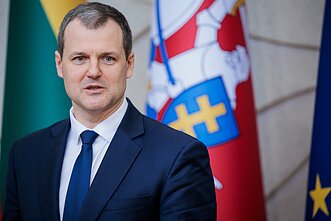
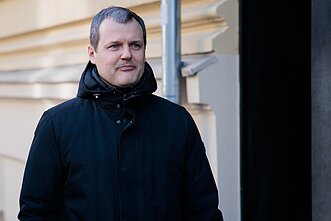
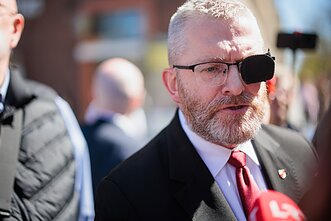
Parliament Speaker Saulius Skvernelis, who leads the Democrats “For Lithuania” party, was the first one to run out of patience with Remigijus Žemaitaitis, his coalition partner who heads the Nemunas Dawn party.
The latter, in meetings with his voters, said President Gitanas Nausėda was going to nationalise people’s bank deposits to fund military spending (in reality, Nausėda only suggested that the government could borrow from depositors).
“The disinformation campaign to discredit Lithuania’s resolve to strengthen its national defence continues,” Skvernelis then reacted. “We are waiting for our main coalition partner to convene the Coalition Council to discuss how the coalition agreement is being implemented.”
He thus called on the Social Democrats, who lead the coalition, to arbitrate in his verbal battles with Žemaitaitis.
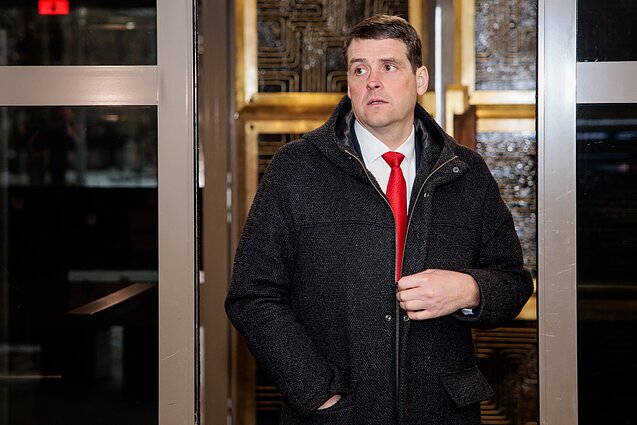
Prime Minister Gintautas Paluckas finally convened the Coalition Council on Monday, with plans to discuss Žemaitaitis’ proclivity for fiery public statements and his mode of communication.
Unlike Skvernelis, however, Paluckas has so far seemed eager to deescalate.
“The first thing to do is to communicate, not to shut one another. Every time we say that someone does not have the right to say something, every time someone needs to be contained, we provoke a conflict,” Paluckas insisted.
President Nausėda, meanwhile, also took a stab at Žemaitaitis, saying he was “talking to the gods or to himself” and that his statements could provoke a bank run.
“Mr Žemaitaitis should be put on trial for such talk,” the president said.
Nausėda has even said he does not see the current coalition surviving for long, suggesting that the Social Democrats and the Democrats “For Lithuania” should ditch Žemaitaitis’ Nemunas Dawn.
Further reading
Žemaitaitis says he won’t comment on coalition matters, but he is posting on Facebook several times a day.
Responding to the president’s remarks, he posted that justice is administered by the courts, even accusing Nausėda of political persecution. The president shot back that telling the truth is not political persecution.
The Coalition Council meeting on Monday did not seem to produce a breakthrough.
“We talked about current affairs and topical issues. As promised, we discussed political and communication culture. As you can see, we did not get into a fight and parted amicably without any additional emotional strain,” Paluckas told reporters after the meeting.
Žemaitaitis, meanwhile, said he is what he is and will not temper his communication.
Much smoke without fire?
Despite the constant name-calling, political analyst Gabrielė Burbulytė does not think that there will be any changes in the coalition at least until the start of the next parliamentary session in March.
“Everybody is pushing away the issue: let’s wait, they say, let us work, let’s wait for March, let’s wait for the start of the session,” Burbulytė, lecturer at Klaipėda University, tells LRT TV. “I think they’re actively preparing for the session that starts in March and that’s when we’ll hear more resounding announcements.”
Ignas Kalpokas, associate professor at Vytautas Magnus University in Kaunas, does not believe in sudden changes in the coalition either. The Social Democrats are interested in maintaining their majority in the parliament, he says, and if it comes to making a choice between Žemaitaitis and Skvernelis, it is not a given they’ll stick with the latter.
“It’s elementary mathematics: the Social Democrats plus Nemunas Dawn still have 71 seats [out of 141], […] while Skvernelis will probably be put in a position where he either calms down or his own future in the coalition may be in question,” says Kalpokas.
Further reading
Either way, for Žemaitaitis it’s a win-win situation, he adds. If Nemunas Dawn stays in the coalition, all the better, and if it is thrown out, this will allow Žemaitaitis to play the martyr and score popularity points without much political risk.
“Since Žemaitaitis has taken on the role of a crusader and shaker of the system, he cannot sit still by definition, he needs to constantly remind of himself, to stir up the waters in which he is boiling, because otherwise someone new will come along, someone more interesting,” Kalpokas believes.
Burbulytė notes that Žemaitaitis’ behaviour indicates he may not be interested in staying in the coalition.
“The atmosphere he’s creating with all the door slamming and melodrama since last year creates an opening for him to leave. When and whether he is using it – that is the big question,” she says.
The Democrats “For Lithuania”, led by Skvernelis, have also hinted that they may consider leaving the ruling coalition. The party will have its convention in March when the decision could be made.

Newsletter
Every Friday morning.