












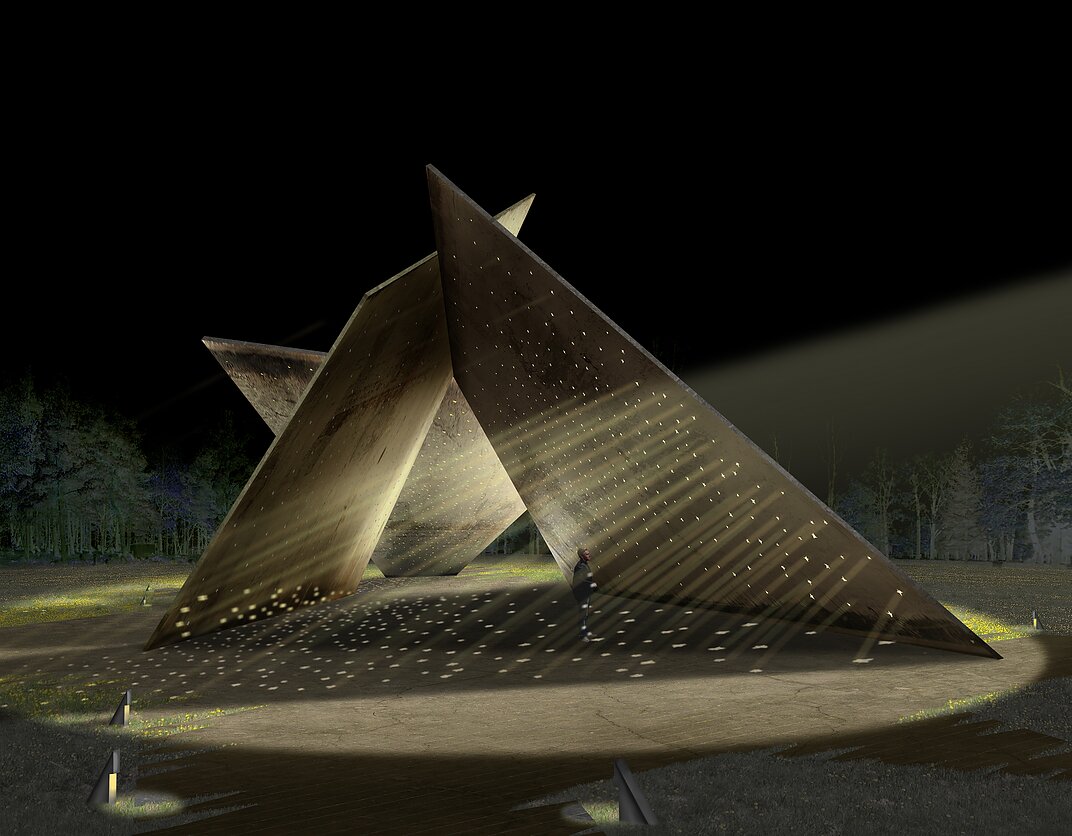
In 2019, the New York-based Lithuanian artist Ray Bartkus presented an idea for a Holocaust memorial, similar to the one found in central Berlin or other European cities and not tucked away in remote areas. Although the proposal was well received by the Vilnius municipality, the idea was seemingly shelved. Why?
According to Bartkus, after four years of discussions he reached a dead-end with the mayor of Vilnius at the time, Remigijus Šimašius.
The artist said he continued his outreach, but only the municipality’s representatives would attend the meetings.
“Something had changed, they didn't care anymore,” Bartkus told LRT.lt. “I felt that everything was stuck.”
The artist presented the idea of the Holocaust Memorial to various Jewish organisations in Lithuania and the United States, as well as various international Jewish bodies. According to Bartkus, the idea was universally well-received.

Bartkus also tried to involve the new mayor of Vilnius, Valdas Benkunskas, but without success.
During his last visit to Lithuania, Bartkus said he met the deputy mayor, Simona Bieliūnė, who told him the topic was sensitive and the municipality would wait for the government’s decision on the abandoned Sports Palace, which was built on a former Jewish cemetery.
In response to LRT.lt, the municipality said Vilnius already had a monument in Paneriai, where thousands of Jews were killed during the Holocaust.
“We cannot comment on the proposals discussed by the previous political leadership and why they might have been abandoned,” the municipality said.
However, Remigijus Šimašius, the former mayor of Vilnius, said he had been in touch with Bartkus only during his second term in office. They had visited a potential site for the memorial, but the plans never materialised.
“Simply put, because it takes time, it takes energy,” Šimašius said. “That work took place in the middle of my term of office. Naturally, it should be continued and we should have very serious talks. I wanted to have a clear agreement with both the Lithuanian Jewish (Litvak) community and our Commission on City Names, Monuments and Memorial Plaques [now the Historical Memory Commission], so that no one would have any doubts about it,” he said.
In a comment to LRT.lt, the Lithuanian Jewish Community said it was not involved in the project and would not comment on it.

Zigmas Vitkus, a historian, columnist, and researcher at the Institute of History and Archaeology of the Baltic Region of Klaipėda University, said there was a need to build a memorial to the Holocaust in Vilnius.
“Let us be generous like the Poles – a museum for every important episode of history. This is, of course, costly, but such museums as centres of memory and education are a great cultural, symbolic, and political capital,” he said.
Meanwhile, the country’s Culture Ministry said the Paneriai Memorial is the keystone project that continues to be developed. In its written reply, the ministry said the focus should remain on existing sites and remembrance projects.
“This will further honour the memory of the victims of the Holocaust and promote a broader public understanding of this painful part of history,” it said.

Newsletter
Every Friday morning.