










The outgoing government of Ingrida Šimonytė took office in December 2020. During its term, it saw a pandemic, a migrant crisis, and Russia’s full-scale invasion of Ukraine. According to political analysts, the crises had limited the government’s ability to keep promises.
The outgoing government began its work at the height of the Covid-19 pandemic. The mood then was serious, with all ministers stressing that the main objective was to contain the virus.
The pandemic has been forgotten, but it was only the first in a series of crises that Šimonytė’s government faced.
For example, Interior Minister Agnė Bilotaitė has made tackling the migrant crisis, orchestrated by the Belarusian regime, her most important job.
“Lukashenko’s attack has been contained, Lithuania has not become a transitional yard, and we are an example of the standard of border protection for Europe,” she told LRT TV.
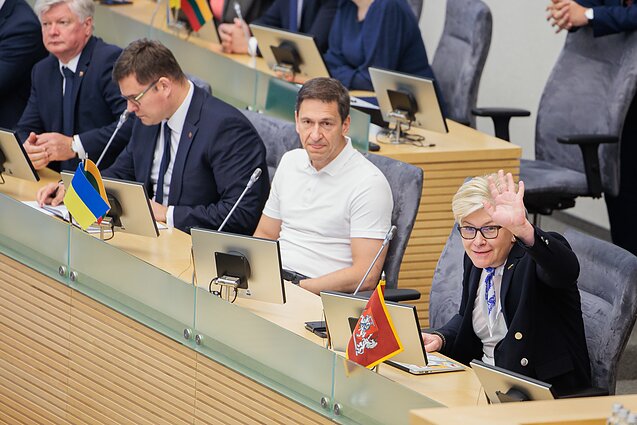
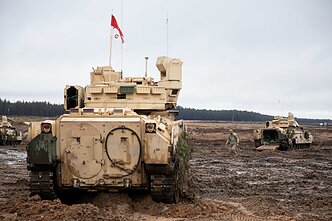
In February 2022, Russia invaded Ukraine. Asked about work in the field of security and defence, Laurynas Kasčiūnas, who became Defence Minister more than eight months ago, said the list is long. The most important achievement, according to him, was the agreement on the deployment of the German brigade in Lithuania, but more could have been done.
“I think we could have had commandant’s offices three years ago – several thousand citizens would have been trained by now,” Kasčiūnas said. “And always the defence minister has to say that more money is needed for defence.”
According to Vaidotas Beniušis, editor-in-chief of 15min.lt news website, the migration crisis was well contained, but defence spending did not keep pace.
“The migration crisis has been handled well, perhaps with some delay, but the decisions taken to keep migrants out and to avoid a falling out with the European Commission are a plus. The defence budget grew, but in the end, we started to fall behind even Latvia,” he said.
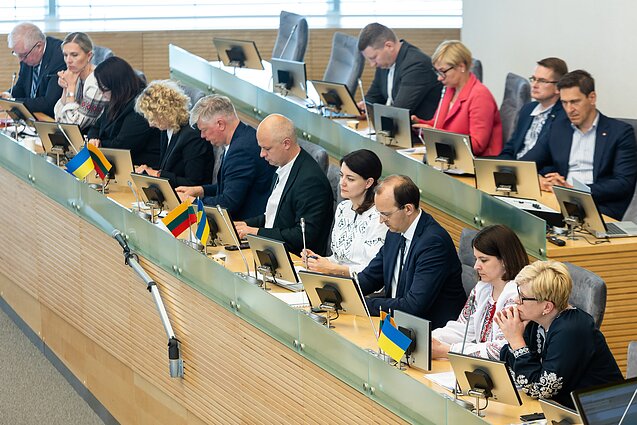
Political analysts argue that the crises have limited the government’s ability to keep election promises, including reforms. However, the reform adopted last May includes changes to the procedure for salary increases for civil servants.
“It was not adopted exactly as the government wanted, but it is better than nothing,” noted Ramūnas Vilpišauskas, an associate professor at the Institute of International Relations and Political Science of Vilnius University (VU TSPMI).
Finished and unfinished work
The Education Ministry has seen the most changes during the outgoing government’s term. Jurgita Šiugždinienė resigned from the ministerial post following public doubts about the transparency of the use of payouts she received while serving as a Kaunas councillor.
Gintautas Jakštas, who succeeded her, quit after scandals over intermediary exams as part of the education reform. The ministry was then criticised for not being prepared for the changes. Jakštas was eventually replaced by Radvilė Morkūnaitė-Mikulėnienė a few months before the end of the government’s term.
When President Gitanas Nausėda was elected for a second term, he replaced the Agriculture and Health ministers. Arūnas Dulkys was succeeded by Aurimas Pečkauskas as health minister. The latter believes the health reform was a success.
“The reorganisation, the creation of health centres – the results are visible. There are a lot of changes in mental health, changes in the reimbursement of medicines,” said Pečkauskas.
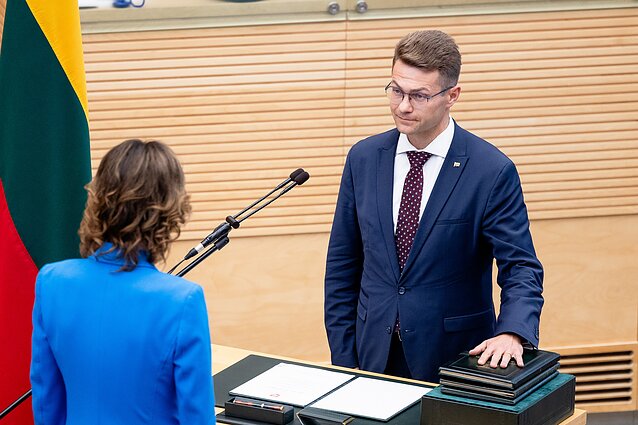
At the end of her term, Economy and Innovation Minister Aušrinė Armonaitė had to explain why large investments by Teltonika were almost halted. However, she sees attracting other investments as the most important work of her term.
“We managed to attract 1 billion euros in investment, which means well-paid jobs for Lithuanians. We implemented the innovation reform and we attracted Rheinmetall,” Armonaitė said.
At the start of the outgoing government’s term, the average wage after tax was around 930 euros. It is now expected to reach 1,350 euros.
“The most important thing is that real wages are growing at the fastest pace in the EU. Wages grew faster than in any OECD country and outpaced inflation,” stressed acting Social Security and Labour Minister Vytautas Šilinskas.
However, the minister acknowledges that the second pillar pension system will have to be changed because “people are not satisfied with it”.
However, it was the tax reform which was identified as one of the most important tasks of Šimonytė’s government.
“The main work, which was partly successful and partly not, was the tax changes. A third of the changes have been adopted, and the defence fund law is important,” said outgoing Finance Minister Gintarė Skaistė.
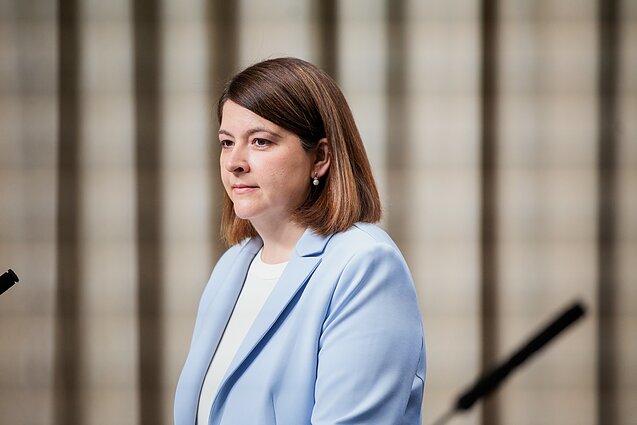
However, the entire tax reform package was not adopted. In September, Skaistė admitted that the newly elected parliament would have to decide on the tax changes.
“I think we have failed to mobilise a consensus, as highlighted by Prime Minister Šimonytė herself, on the financing of the most important functions of the state, on what the budget should be, and consequently, on what the taxes should be,” noted Vilpišauskas of VU TSPMI.
“In the absence of a bigger budget, it is not possible to achieve substantial changes in education, health care, or social protection, and there has been no substantial breakthrough in these areas during the term of office,” Beniušis, editor-in-chief of 15min.lt, added.
‘Social-democratic’ government
Economist Algirdas Bartkus sees the situation more positively.
“In health care, if no efforts were made to fix the system or at least to maintain it, we would have had a catastrophe, a situation worse than now. This government has also perhaps financed education the most out of all,” the economist said.
According to Bartkus, the problem with the outgoing government is that it has not corrected some of the changes that were not fully developed.
“The shortcomings are that they dropped a couple of laws midway, they drafted the legislation to change the taxation of cars, and because it was badly done, they didn’t go back to it,” the economist said.
According to Bartkus, the reasons for the conservative government’s failure are not economic. “This was the most social-democratic and most people-oriented government,” the economist stressed.
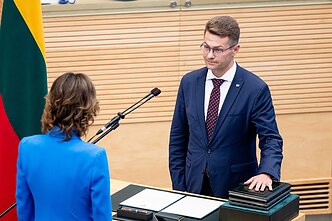
The 18th government will finish its work this week. On Thursday, the new cabinet of ministers will be sworn in after the adoption of the government programme.

Newsletter
Every Friday morning.