











There are challenges when it comes to building the necessary infrastructure for the incoming German brigade, but the work is expected to be completed by the end of 2027, Lithuanian Defence Minister Laurynas Kasčiūnas says.
“Two and a half years for all the construction, that’s the end of 2027. [...] We do feel hard-pressed, I agree, but we can do everything in time,” he told a media conference on Wednesday.
He was speaking after President Gitanas Nausėda said earlier this week that Lithuania could be late with its preparations to host the German brigade amid stalling construction of the necessary infrastructure.
According to Kasčiūnas, the military campus for the German brigade at the Rūdninkai training area should be completed by the end of 2027.
Berlin plans to deploy the brigade of around 5,000 troops in Lithuania by 2027. Germany has said that the pace of its redeployment will depend on Lithuania’s readiness to receive the troops and their families.

“The arrival of the German brigade, with all its parameters, creates in principle the effect of a second army in Lithuania and on the entire eastern flank. This is a huge thing,” Kasčiūnas said, adding that about 20 percent of the brigade will serve in Rukla and the majority of it, 80 percent, will serve in Rūdninkai.
“Officers who arrive with their families will live in Vilnius and commute to work in Rūdninkai, while those who arrive without their families will live in dormitories,” Kasčiūnas said.
The initial brigade group arrived in Lithuania in April with just over 20 troops, and a total of 150 German troops will arrive in Lithuania by the end of the year.
“We have a clear plan for 500 troops of this brigade to be here next year,” the defence minister said.

Crisis in Berlin and Žemaitaitis
Kasčiūnas says the ongoing political crisis in Germany should not prevent the implementation of the brigade project.
“We have the Germans’ word, if they give their word, they keep it. [...] There are no questions here as this is the German political culture and our trust in the Germans,” Kasčiūnas said.
The coalition crisis in Germany, sparked by disagreements over economic and fiscal policy, reached its boiling point last week when Chancellor Olaf Scholz sacked Finance Minister Christian Lindner. It was announced earlier this week that the German parliament will hold a vote of no confidence in the chancellor in mid-December, paving the way for an early general election in late February.
“We can predict a union with the Christian Democrats [...] who fully support, and sometimes even more than that, the reinforcement of the eastern flank, the deterrence and the redeployment of the German brigade,” the Lithuanian minister said.
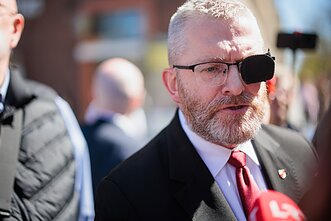
Nor will the political situation in Lithuania hinder the plans, Kasčiūnas believes, referring to the new ruling coalition that includes the controversial Dawn of the Nemunas party whose leader Remigijus Žemaitaitis is on trial for anti-Semitism.

“The Germans are very well aware that Žemaitaitis is not Lithuania, that Lithuania is a nation that wants to live in freedom and independence and appreciates Germany’s security guarantees,” Kasčiūnas told the media conference on Wednesday. “No matter how much he messes things up for us here, the Germans distinguish between where Žemaitaitis is and where Lithuania is.”
Around 900 million euros
The urban study of the Rūdininkai military campus was presented on Wednesday, showing that the area will cover about 190 hectares of land. According to the Defence Ministry, this is the largest military infrastructure development project in Lithuania’s history.
The military campus is being developed in phases. During the first phase, it will be built by Eikos Statyba under a construction contract. The second phase will be a public-private partnership.
According to Kasčiūnas, the tender for the second phase will be launched as early as this year.

The capsule to mark the start of the first phase of the construction was buried at Rūdininkai in August. This stage will include the construction of administration buildings, military equipment maintenance and storage infrastructure (warehouses, parking lots, repair workshops, garages for equipment), a guard building, dormitories for 600 soldiers, and a canteen.
The second phase will include the design, construction and maintenance of residential, administrative, sports and technical buildings, as well as the installation of nearly 300,000 square meters of military grounds and other structures such as a helipad and engineering networks.
The Defence Ministry has consulted eight companies on the implementation of the second phase, Kasčiūnas said, adding that the whole military campus will cost around 900-950 million euros, which will be allocated by Lithuania from its own budget.
The cost of maintaining the campus is still being negotiated with Berlin, but Germany will have to pay the bulk of the maintenance costs, he said.

Newsletter
Every Friday morning.