















As Americans vote in the presidential election, the Lithuanian president’s senior adviser Kęstutis Budrys and Foreign Minister Gabrielius Landsbergis say they believe in Washington’s long-term commitment to Vilnius no matter who secures the top post.
“What we cannot allow, and I don’t believe that it will happen, is that the collective security commitments on the US part will falter, that it will weaken because the weakening of the trans-Atlantic link is the end of the common European framework and of NATO’s future,” Budrys told the radio Žinių Radijas on Tuesday.
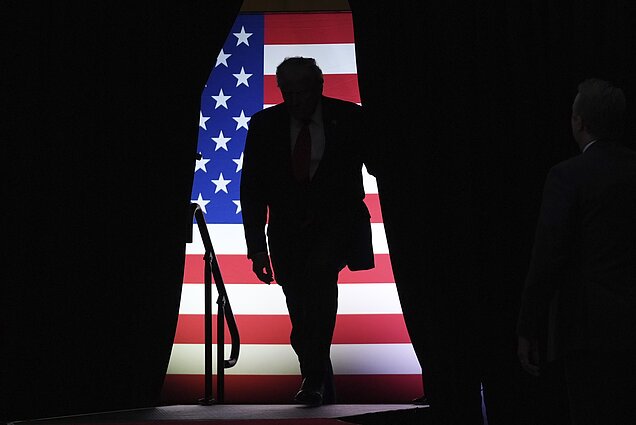
President Gitanas Nausėda said back in September that the continued presence of US troops in Lithuania was Lithuania’s goal, regardless of who would win the US presidential election, Democrat Kamala Harris or Republican Donald Trump.
“Planning and political discussions” will determine how many US troops there will be in Lithuania in the long run, Budrys said on Tuesday, but he also urged not to give so much significance to this issue.

“We are talking about a lot of important things here and the geostrategic situation in the world right now, with so many competing poles, with emerging nuclear powers, [...] it is complicated,” the presidential adviser said.
“To navigate all of this, the US will have to maintain its focus and involvement in European common affairs. That means that we will have to be more involved in what is happening in the Indo-Pacific area and the world will become even more interconnected among democracies,” he added.
“So we have a complex puzzle here, well, and it will not be the case that a battalion will be pushed from Germany to Lithuania, and then from Lithuania to somewhere else... It will be only a small piece of the big picture,” Budrys said.
A US battalion battle group of up to 1,000 troops is deployed in Lithuania.
No luxury to choose
Foreign Minister Landsbergis also said on Tuesday that he expects Washington to remain Lithuania’s main security partner no matter who wins the US presidential election.
“We don’t have the luxury to choose, diversify, or express preferences; the United States is and will remain Lithuania’s main strategic security and defence partner,” he told reporters.
“I just hope that whoever is elected, that direction will not change from the US side,” he added.
Landsbergis said he is confident that Lithuania will have enough arguments to convince the new US administration to pay attention to regional security.
“We do have excellent arguments both in terms of defence funding and acquisitions from the US, as well as in terms of our Indo-Pacific strategy and other similar factors that are important to both sides,” he said.

According to the minister, the challenge lies in maintaining US attention on supporting Ukraine.
“Those arguments about how one outcome or another of the war in Ukraine would affect European or transatlantic security didn’t prevail in the debates,” he said.
Landsbergis noted that it is not entirely clear what strategy each party in the US election has regarding the war in Ukraine.
“We have to wait to see that; we must be ready with our arguments and prepared for scenarios that might not be very favourable,” he said.
The West fears that NATO will face turbulent times ahead if Trump wins the election.
During his 2017–2021 presidency, Trump criticized NATO allies for what he said was insufficient spending.
He warned in February that he would encourage Russia to do “whatever the hell they want” to any NATO member country that fails to meet the alliance’s defence spending target of 2 percent of GDP.
Meanwhile, Harris has criticised her opponent’s statements on more than one occasion. She is expected to continue the policies of outgoing US President Joe Biden, cooperate with allies, and stand by NATO.
Western allies also fear a Trump presidency could mean a decrease in military aid to Ukraine from the US, which is Kyiv’s main military backer.

Newsletter
Every Friday morning.