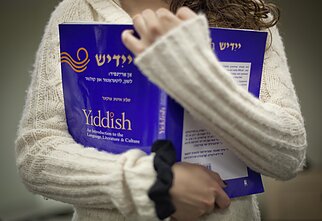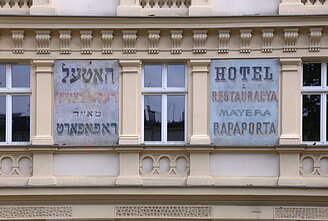









Yiddish, the language of secular Jewish life, was nearly wiped out alongside its users in Eastern Europe, but is now increasingly studied as a storehouse of Jewish heritage.
The Yiddish language emerged about a thousand years ago in what is now Germany. From there, large Jewish communities settled in Eastern Europe where Yiddish eventually became the language not only of everyday communication but also of Jewish intellectual and cultural life. Newspapers, books, songs and plays were published in it.
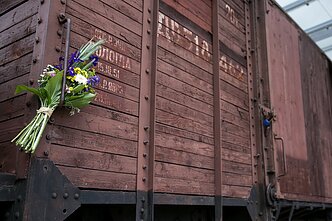
Before the Second World War, more than 10 million people used Yiddish, but most of them were killed during the Holocaust. The few survivors abandoned the language in a drive to assimilate into their new English- or Hebrew-speaking environments.
In recent years, however, Yiddish has experienced a revival, in keeping with the “third-generation interest” principle formulated in 1938 by the American historian Marcus Lee Hansen: what the son wishes to forget the grandson wishes to remember.
Vilna, Yiddish Jerusalem
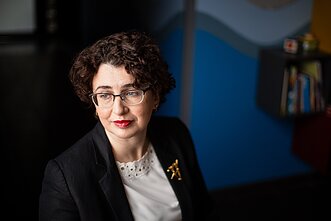
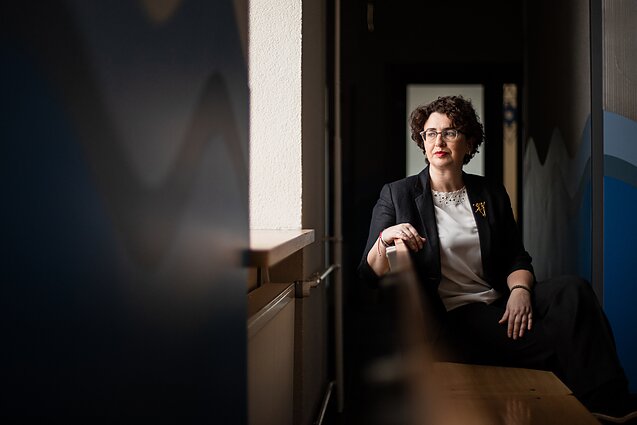
Ruth Reches, the headmistress of the Sholom Aleichem ORT Gymnasium in Vilnius, explains that the word ‘Yiddish’ simply means ‘Jewish’. The language originated about a thousand years ago in what is now Germany and was strongly influenced by German, only written in Hebrew alphabet.
Yiddish-speaking Ashkenazi Jews have migrated throughout history. Large communities have settled in Eastern Europe: in Lithuania, Ukraine and Poland. The language developed accordingly, adopting many Slavic words.

One distinctive dialect was Litvish Yiddish, says Reches. It became established in almost the entire Grand Duchy of Lithuania around the 15th century. Litvish was mainly used by Jews living in the territories of present-day Lithuania, Belarus, and north-eastern Poland.
“Our Yiddish dialect differs from the Polish and Ukrainian Yiddish dialects, for example, in the pronunciation of vowels. In addition, [Litvish] had the greatest cultural significance, as it was most actively used in intellectual circles,” she says.
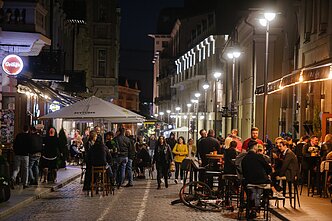
“In the 18th and 19th centuries, Yiddish experienced a boom. It became the language not only of everyday communication but also of Jewish intellectual and cultural life. Newspapers, books, songs and plays were published in it. Vilnius was one of the most important centres of Yiddish culture and was known as the Jerusalem of the North,” adds Reches.
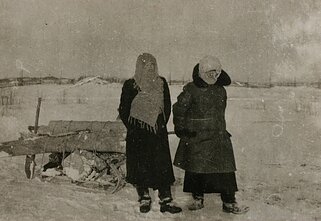
Before the Second World War, more than 10 million people spoke Yiddish. The language suffered a major blow when millions of its users perished in the Holocaust. Most of the survivors emigrated to Israel and the United States, where they switched to either Hebrew or English. In the Soviet Union, Yiddish was also actively pushed out of existence.
“Although Yiddish in Lithuania was almost wiped out in the Holocaust, along with most of Lithuania’s Jewish communities, it is still studied and researched by Yiddish scholars around the world. [...] Although Yiddish became a minority language after the war, it has never been completely forgotten,” emphasises Reches.

In Lithuania, she says, Yiddish is spoken by very few people on a daily basis, although there are older generation Jews who remember it.
Globally, the number of Yiddish speakers is significantly higher, between one and two million. The largest numbers are in the ultra-Orthodox communities in the USA, Israel and Canada.
The richness of curses
According to Reches, Yiddish folklore and proverbs are an inexhaustible storehouse of Jewish humour and wisdom.
“You’ve probably heard at least a few. For example, A mentsh trakht un Got lakht (א מענטש טראַכט און גאָט ארט לאַכט) – ‘Man plans, but God laughs’,” she says.
Yiddish folklore is full of stories about Hershel of Ostropolis (הערשעלע אסטראפאליער), a Jewish folk hero who deceives the rich and the foolish. In one story, famished Hershel entered an inn’s kitchen to steal some food. The cook tells him: “This food is not for you!” Herschel replies: “Don’t worry, I just wanted to see what there was to eat.”
“There are many curses in the Yiddish language. They are often humorous, though harsh. They show that people in those days knew how to express emotions in inventive ways, to convey anger or frustration with a large dose of irony.”

Zolst vaksn vi a tsibele, mitn kop in dr'erd! (זאָלסט װאַקסן װי אַ ציבעלע, מיטן קאָפּ אין דר'ערד) – May you grow like an onion with your head in the ground.
Zolst vern a blintshik un zikh opkegen af der vant! (זאָלסט װערן אַ בלינציק און זיך אָפּגעען אױף דער װאַנט) – May you turn into a pancake and stick to the wall.
The Yiddish-language press was very active in interwar Lithuania. One of the biggest newspapers was Der Tog (The Day).
Yiddish renaissance
According to Reches, Yiddish has survived thanks to a number of important historical, social and cultural factors.
“Yiddish is still used by ultra-Orthodox Hasidic communities, especially in the USA, as the main language of daily communication, education and prayer. Several million Hassidim still pass the living language from generation to generation.
“The preservation of the rich literary and cultural heritage of Yiddish has been and continues to be the concern of many cultural organisations. For example, the YIVO [Institute for Jewish Research] in New York or the National Yiddish Book Center (USA), which has digitised thousands of Yiddish works.
“Language teaching in universities and cultural centres is also contributing to the revival of the language among intellectuals, students and enthusiasts of Jewish culture. [...] Yiddish summer courses are growing in number all over the world. In addition, digital resources and apps such as Duolingo make it possible to learn Yiddish online,” she says.
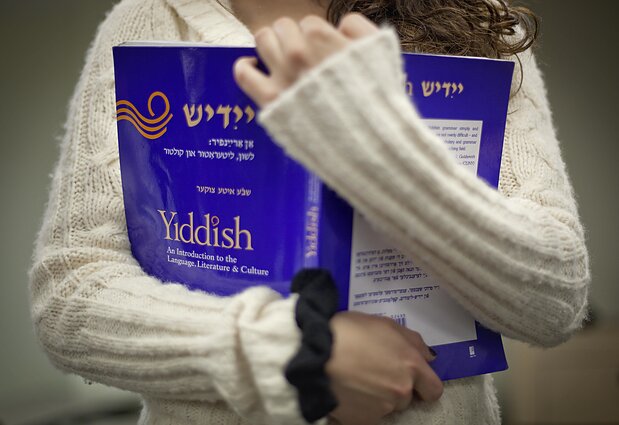
Reches believes that Yiddish is undergoing a renaissance at the moment: “Although there is no mass return to Yiddish as an everyday language, there is a growing interest in it as a cultural heritage among Jews around the world.”
This is also evident in the arts and music.
“Klezmer music, which has its roots in Eastern European Jewish folk music, has been revived and is now popular all over the world. Literary festivals, Yiddish theatres and other events are proliferating to raise public awareness of the uniqueness and beauty of the language.
“Yiddish also has strong links with progressive social ideas. Young activists are therefore discovering Yiddish as a way to express their values and identity,” notes Reches.
Finally, Yiddish has become a symbol of Jewish cultural resistance and survival. “For many people, learning Yiddish is not just about learning the language, it is a way to express their connection to the past, to fight the threat of cultural extinction and to strengthen their Jewish identity.”
There is also a phenomenon of third-generation interest – what a son or daughter wants to forget, a grandson or granddaughter wants to remember. Many young Jews, especially the descendants of third- or even fourth-generation immigrants, are no longer pressured by the need to assimilate and therefore begin to search for their cultural identity.
“Today’s young Jews feel strong and secure in society. So they often begin to look for a deeper connection to their roots, to revive and preserve their family’s cultural heritage. This includes Yiddish.,” says Reches, adding that people study Yiddish literature, music, and theatre.
Yiddish in Lithuania
In spring 2024, Yiddish was included in the List of Intangible Cultural Heritage. According to Reches, this is a significant step towards the preservation, recognition and transmission of the Yiddish language to future generations.
“Of course, this inclusion also encourages greater public interest in Yiddish, increasing access to funding and support from the state and other institutions to promote educational and cultural initiatives,” she points out.
She also notes that various cultural events dedicated to the Yiddish language and Jewish culture take place in Lithuania.
“For example, international festivals, literary readings and Yiddish theatre productions that bring the Yiddish heritage closer to the general public. Several Lithuanian museums and memorials, such as the [Vilnius Gaon] Jewish [History] Museum in Vilnius, also preserve historical memory and provide Jewish cultural education,” she shares.
And in the summer, a two-week intensive Yiddish language course was held in Vilnius. Reches, who organised the course, says that the idea was born out of a desire to promote the preservation of Yiddish language and culture.
“We realised that Yiddish language and culture in Lithuania, where it had deep roots, had been forgotten for a long time. We wanted to give people the opportunity to get to know this treasure better,” she says.
The idea was implemented in cooperation with the Lithuanian Jewish (Litvak) Community and the World Jewish Congress. The courses were attended by international lecturers – Dov-Ber Kerler, Anna Verschik, Yuri Vedenyapinas, Leyzer Burko, and others.
“We paid a lot of attention to both language and culture. The course programme included not only language lessons, but also discussions on Yiddish history, culture and Jewish lifestyle, participation in various interactive events, and an introduction to Yiddish literature, theatre and music,” says the organiser.
She is delighted that the event has attracted a lot of interest, including from foreigners.
“Although Yiddish is not widely spoken in Lithuania, we felt a great desire to get to know our roots and learn more about this unique language and culture. The course attracted young people searching for their heritage, academics and enthusiasts interested in the preservation of Jewish culture and the revival of Yiddish. New friendships were made,” smiles Reches.

Newsletter
Every Friday morning.