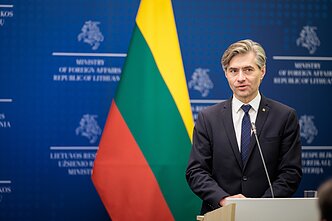



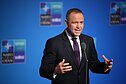
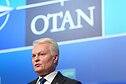






NATO must respond with concrete actions to the deployment of North Korean troops to Russia, says Deividas Matulionis, permanent representative of Lithuania to NATO.
The deployment of North Korean troops to assist Moscow on the battlefield in Kursk, a Russian territory under the control of Ukrainian forces, was confirmed on Monday by NATO leader Mark Rutte. He made the remarks after a meeting with the South Korean intelligence service.
“It was a very informative and good presentation, I can’t say much in detail, but one thing is clear – it is confirmed that North Korean troops are indeed deployed on Russian territory.
“There is no confirmation yet that they are on Ukrainian territory, but this is indeed a serious new escalation to which we must respond appropriately. And not just with a statement, but with concrete actions that would help create a situation where the benefit to them would be less than the harm to the international community,” said Matulionis.

Asked what the response could be, Matulionis stressed continued support for Ukraine.
“We hope that the secretary general’s statement should be followed by a further discussion on concrete steps on how to continue and increase military support to Ukraine, and perhaps even to start talking within NATO about the issue of the removal of geographical restrictions on long-range weapons.
“There is also the issue of sanctions. And, importantly, deeper cooperation with the Pacific countries – Japan, Australia, New Zealand, South Korea – in the field of the defence industry, which we believe is very important,” he said.
Matulionis confirmed the information that appeared in the public space that between 10,000 and 12,000 North Korean troops may be stationed in Kursk.
“This is a real army and the troops are currently undergoing additional training. But let’s understand, it will not be that simple – integration, language, management and chain of command. The question is how they will work there. The situation is serious, but the strategic balance will not be fundamentally altered by North Korean forces,” he says. “But the fact [of their presence] is very worrying indeed.”

Newsletter
Every Friday morning.