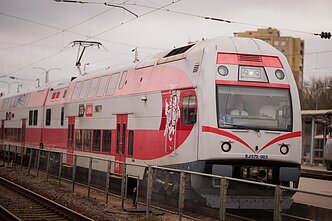
















Train routes to Poland and Latvia remain unprofitable for the state-owned Lietuvos Geležinkeliai (Lithuanian Railways, LTG) despite their popularity among travellers.
Every day, a train leaves Vilnius railway station for Mockava, southeastern Lithuania, where passengers change trains to go to Poland. People who gather before their journey say they choose the train because it is convenient.
“We are going to Lviv via Poland, and from there to Kharkiv,” Maria, a Ukrainian national, told LRT TV. “Before, we took a very long bus ride with the children, but it was difficult. On the train, they can sit, lie down, or walk around.”
Meanwhile, a Portuguese traveller said he simply preferred trains. “I flew to Amsterdam and took the train to Stockholm, Helsinki, a ferry to Tallinn, and a bus to Riga. Now, I'm here,” he said.
Currently, it takes over eight hours to reach Warsaw from Vilnius and around four hours to get to Riga by train.
Car enthusiast Vitoldas Milius previously tried to overtake trains by car. He said he succeeded both times, but only by a small margin of around 40 minutes.
“Under certain road and weather conditions, you might not be able to overtake the train,” he said.

The international route from Vilnius to Poland started in December 2022, while the route to Latvia was launched in December last year.
“Latvia is more popular. This is probably due to the shorter journey because people can go back and forth in one day,” said Dangis Rupeika, head of international transport at LTG Link.
According to him, passenger traffic to Poland this summer increased by 13 percent compared to last summer.
However, there are not enough commuters to make the routes to both Poland and Latvia profitable. According to the railway reps, both domestic and international routes rely on subsidies. Last year, the state allocated 53 million euros to domestic routes alone.
According to Gediminas Vaičiūnas, associate professor at VILNIUS TECH, Lithuania remains a railway backwater in the context of Europe. The Baltic states have different gauges than the rest of Europe, including Poland. Therefore, a change of trains at Mockava is needed.
“Our infrastructure is not so much passenger-oriented as freight-oriented,” said Vaičiūnas.
The best way to improve train connections between neighbouring countries is to modernise the railway, he added.
“Perhaps we need to wait for Rail Baltica,” said Vaičiūnas.
The European-gauge railway link between the Baltic states and Poland, Rail Baltica, was due to open by 2026 but is now experiencing delays.

Newsletter
Every Friday morning.