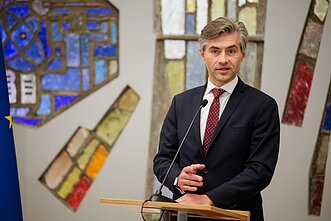















Over 150 public figures signed an appeal to the president this week, urging him to reject politicians who have broken their oaths of office by making anti-Semitic statements. Conservative MP Emanuelis Zingeris says that on Monday, on the occasion of the commemoration of the Day of Remembrance of the Jewish Genocide, he received concerned comments from representatives of Germany, the United States and Israel.
Lithuania’s Jewish community representatives note that attacks on Jewish monuments occur almost every year: buildings, flags and synagogues get desecrated. This year, an attacked smashed a window of a community centre.
The community also says they are also worried about anti-Semitic statements by some Lithuanian politicians.
Specifically, Remigijus Žemaitaitis, who stepped down as an MP earlier this year, was found by the Constitutional Court to have broken his oath and the constitution with anti-Semitic statements online. In his Facebook posts in June 2023, Žemaitaitis suggested that “the Jews and Russians” oppressed ethnic Lithuanians during World War Two and were responsible for the 1944 massacre of the village of Pirčiupiai. In fact, the atrocity was committed by German SS troops.
In May 2023, Žemaitaitis posted a news story about a Palestinian school demolished by Israel in the West Bank. He added that Israel’s actions “increase the anger and, at the same time, the hatred towards Jews and their nation” and quoted an anti-Semitic rhyme.
Žemaitaitis rejects accusations of anti-Semitism and has He is now running for parliament with the Dawn of the Nemunas party.
“We will not allow this kind of experimentation in Lithuania as we are seeing now in Germany, where pro-fascist forces are starting to reappear in the eastern lands,” says conservative MP Emanuelis Zingeris, himself a member of Lithuania’s Jewish community. “That is why all of us here are trying to create a spectrum of society that will oppose it.”

Faina Kukliansky, chairwoman of the Lithuanian Jewish Community, says she misses a clear position from President Gitanas Nausėda condemning the incitement of anti-Semitism by some politicians. According to Kukliansky, some of the statements have also attracted the attention of German representatives.
“What I am most appalled about are the observers, who are numerous, they just watch, they don’t say anything, not only the president, but there are also people who read about it and show no reaction,” she says.
Over one and a half hundred artists, writers, scholars, and public figures have signed a public letter to the president and political parties, urging them not to form coalitions and reject politicians who “threaten Lithuania”.
“Perhaps the only thing we can do, which is what we see in France and Germany, is to form a strong cordon to prevent marginal groups, which we used to call populists but who are now more dangerous than populism, from coming to power,” says Vytautas Ališauskas, a philosopher at Vilnius University.

Art historian Giedrė Jankevičiūtė, a recipient of the National Prize, says she never signs political petitions, but she made an exception for this one.
“What is happening in the Lithuanian political space, the positions of some politicians, they are really directed towards evil in our country,” she says. “We have to write letters, go to the streets, do something. I find it hard to believe that Lithuanian citizens can say things that divide Lithuanian society.”
According to the signatories of the public letter, all actions and statements that weaken Lithuania’s commitment to European values and democracy push the country into the sphere of Russian influence and power.

Newsletter
Every Friday morning.