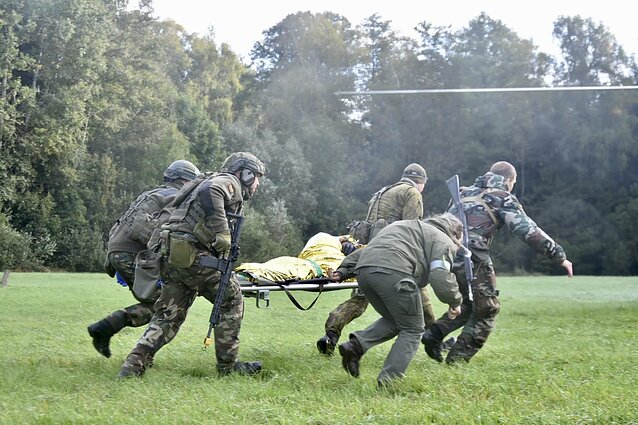













Lithuania will launch military basic training for those registered with commandant’s offices in October, Defence Minister Laurynas Kasčiūnas has said.
“On October 7, the first group of 70 individuals signed up for the commandant’s offices will be invited to attend a ten-day military training course,” he told journalists on Wednesday.
Kasčiūnas added that two more groups of 70 people each will complete military training courses in November.
“This marks the start of our military training course. In addition to this, we have other training programs,” the minister said.
“This year, we plan to train another 100 drone operators, and those registered with the commandant’s offices will also have this opportunity. Additionally, 100 people across Lithuania will take a hybrid course because information warfare and combating disinformation are also very important aspects of the commandant’s offices,” he said.
According to Kasčiūnas, another 200 people will receive practical training in civil resistance skills.
“This includes first aid, identifying enemy equipment, behaviour during an attack, and making and using Molotov cocktails,” he explained.

The minister said that by the end of the year, around 500 to 600 people will be trained through various programs at the commandant’s offices, with plans to train about 3,500 more next year.
“But the primary focus is, of course, on military training,” Kasčiūnas stressed.
According to the minister, about 6,000 people have registered with the commandant's offices so far.
“Registration is ongoing and active; you can sign up right now,” he said.
Active citizens from the untrained reserve have been encouraged to register with the commandant’s offices since early May.
In peacetime, units under the command of the commandant’s offices will consist of professional military personnel, reservists, members of the paramilitary Riflemen’s Union, and civilian volunteers. Their training will be provided by the National Defence Volunteer Force.
In wartime, their functions will include combating illegal armed groups, protecting important facilities and infrastructure, setting up checkpoints, ensuring evacuation processes, and monitoring the information environment.

Newsletter
Every Friday morning.