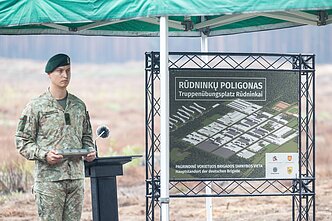














Troops of the German brigade assigned to Lithuania will be temporarily accommodated in Rokantiškės and Nemenčinė next year, Lithuanian Defence Minister Laurynas Kasčiūnas has said.
“Until the final infrastructure in Rūdninkai is ready, we are preparing interim solutions for the first elements of the brigade coming next year,” Kasčiūnas told journalists in Berlin on Friday.
“The German forces will use already existing Lithuanian Armed Forces’ infrastructure in close proximity to Vilnius, in Nemenčinė and Rokantiškės,” he explained.
His comments came after he and his German counterpart Boris Pistorius signed an agreement on the rights of German troops, civilians, and their families in Lithuania.
“Please be assured that those are merely interim solutions and that every effort is being made to find the best ways to speed up the construction in Rūdninkai and have the final infrastructure ready,” Kasčiūnas said.
Nemenčinė in Vilnius District is home to the General Adolfas Ramanauskas Combat Training Centre, and the military facilities opened in the Rokantiškės area of Vilnius six months ago house the Duke Vaidotas Infantry Battalion.

Previously, Lithuania’s political leadership claimed that the site in Rokantiškės would be exclusively used by Lithuanian troops. However, in late August, Kasčiūnas hinted that Lithuania was considering temporarily accommodating German troops in the barracks around Vilnius if the construction in Rūdnininkai was not finished in time.
This option was then criticised by former Defence Minister Arvydas Anušauskas who said that transferring the infrastructure to the Germans would be detrimental to the Lithuanian service.
However, Kasčiūnas stressed on Friday that German troops will be accommodated in Rokantiškės and Nemenčinė only in 2025.
"To build the infrastructure you need at least two or three years. It's just an interim solution agreed by both sides," the Lithuanian minister said, adding that "there is no link to any obstacles".
500 brigade troops next year
Berlin plans to deploy the brigade in Lithuania by the end of 2027 but stresses that the deployment pace will depend on Lithuania's readiness to host the troops and their families and the creation of the necessary conditions.
However, some officials in Germany and Lithuania fear this date could be pushed back.
"We have Plan A, which is the plan. And the plan means we are still aiming to be with the full combat-ready brigade by the end of 2027. This is the objective," German Defense Minister Pistorius underlined.
The German brigade will consist of around 5,000 troops. Lithuania estimates that a third of them will arrive with their families.
Earlier, Lithuania’s Defence Ministry estimated that the investment in the necessary military and training infrastructure could reach 800 million euros.

The German brigade’s initial element arrived in Lithuania in early April, and several dozen soldiers settled in Vilnius and are responsible for planning the brigade’s deployment to Lithuania.
“Next year, we will have around 500 servicemen and women in Lithuania,” the German defence minister said, adding that a part of communications, logistics, and medical personnel will arrive in Lithuania.
Berlin hopes to fill the planned brigade with volunteers, but some of them are sceptical about the possibility of going to Lithuania.
"As far as I know, all the posts for next year are already filled now,” Pistorius said. “Of course, in procedures like these, there might be hesitancy. If your families are involved, you may think twice. That’s OK, and we want to make sure that people feel happy there. At the moment everything seems to be going fine.”

Newsletter
Every Friday morning.