









Lithuanian and German officials on Friday signed an agreement on the rights of German troops, civilians, and their families in Lithuania.
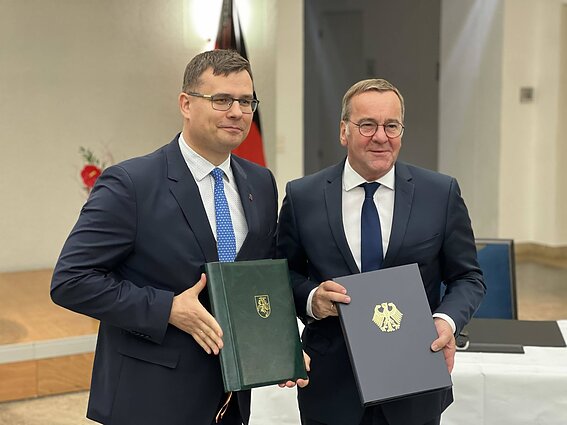
The document was signed in Berlin by Lithuanian Defence Minister Laurynas Kasčiūnas and German Defence Minister Boris Pistorius, as well as Lithuanian and German deputy foreign ministers, Jonas Survila and Tobias Lindner.
The agreement provides for the establishment of German educational and medical facilities in the country, as well as for setting up the military canteens and stores in Lithuania by the German Armed Forces, which will be exempted from tax.
Lithuania has also committed to providing the necessary health care for incoming troops and civilians, but the German military will be able to “set up health care, dental, and veterinary facilities if necessary”.
According to the Defence Ministry, such canteens and stores will also be available to members of other NATO countries’ militaries, who are participating in joint operations and exercises.
It was also agreed during the negotiations that members of the civilian component sent by Germany and members of state-owned enterprises would be granted special tax treatment.
Taxes for economic activities in Lithuania would be paid in Lithuania, provided that they are not carried out by Germany’s Armed Forces or its state institutions or enterprises. Meanwhile, taxes relating to residence and property in Germany would be paid in Germany, for example, inheritance tax.

The agreement also provides that the German Armed Forces may purchase goods and services on their own behalf, which may be transferred for the personal use of German personnel. Such transfers will not be subject to Lithuanian commercial trade legislation. The limitations of tax benefits based on the type and quantity of goods will be unilaterally determined by Lithuania.
The agreement also includes provisions in the area of labour and employment. It has been decided to abolish the special status for the employment of Lithuanian nationals by the German Armed Forces. European Union legislation and Lithuanian law would apply to such cases.
Under the agreement, the children of German brigade soldiers in Lithuania will undergo education in the German language under the German curriculum. The municipalities of Vilnius and Kaunas will provide the necessary infrastructure for German schools. They will also be responsible for the construction of any new educational facilities for German needs.
According to the cost-sharing agreements, Lithuania’s share of the costs will be borne by the government, including the share needed for the construction of the schools.
The agreement also covers the arrival and departure of the German brigade, access to Lithuania’s military infrastructure, the establishment of a military postal service, a radio station, driving schools, and military medical facilities. Radio frequencies would be provided to the German Armed Forces free of charge.
The document still needs to be ratified by both countries’ parliaments.
Berlin plans to deploy the brigade in Lithuania by 2027. Germany has said the pace of the relocation will depend on Lithuania’s readiness to host the troops and their families by creating the necessary conditions.

Newsletter
Every Friday morning.