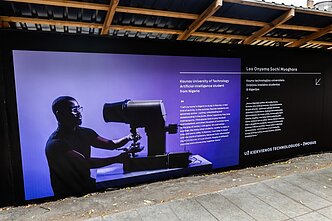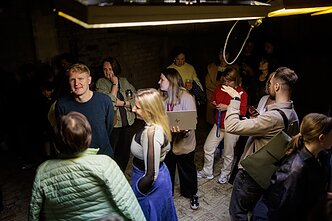













The number of foreigners choosing to study in Lithuania has increased tenfold in 10 years. However, only a few percent of foreign students stay in Lithuania after graduation.
The number of foreign students in Lithuanian universities is growing every year. Most of them come from India, Georgia, Ukraine, Belarus, and Israel, but the geography is expanding.
“We have students from Guatemala, Ecuador. This year, for the first time in several years, we have a student from Australia, so the geography is very wide. Lithuania is becoming known as a country of study opportunities,” says Audronė Račkauskienė, head of International Studies at Kaunas University of Technology.
Foreign students account for slightly more than 10 percent of all students at Lithuanian universities. They are especially numerous in medical study programmes.
“We have 27 percent of foreign students in the entire student population at the university, which means that every fourth student is a foreigner,” says Ingrida Janulevičienė, the Dean of the Centre for International Studies at the Lithuanian University of Health Sciences.
The government has identified life sciences, engineering, and information technologies as priority fields of study for foreign nationals.

Students themselves say they calculate both the costs and the benefits of their future studies, as well as university rankings when choosing a country for study.
“I did my bachelor’s degree in computer science in Italy. The offer of the master’s degree in artificial intelligence and computer science in Lithuania was more attractive compared to other universities. Few countries offer such programmes. There is a reason why people say this is the Silicon Valley of Europe,” says Lebanese student Jad Kaedbei.
“I was looking for a university in Europe. I wanted to study mechatronics. Here, I got the best offer, full tuition fee reimbursement. I also want to try new things, I had never even thought about Lithuania before, but now I think it could be fun,” explains Juan Carlos Espinoza, a student from Guatemala.
However foreign students are cautious about the possibilities of working in Lithuania after graduation.
“If there are opportunities, I think I would stay. But the main goal is to learn as much as possible and improve as much as possible,” says Turkish student Kadir Batuhan Sayan, who studies business management at Kaunas University of Technology.
According to a survey carried out last year by the Education Exchange Support Foundation, almost half of all foreign students in Lithuania would like to work, but the language barrier is the biggest obstacle to getting a job.
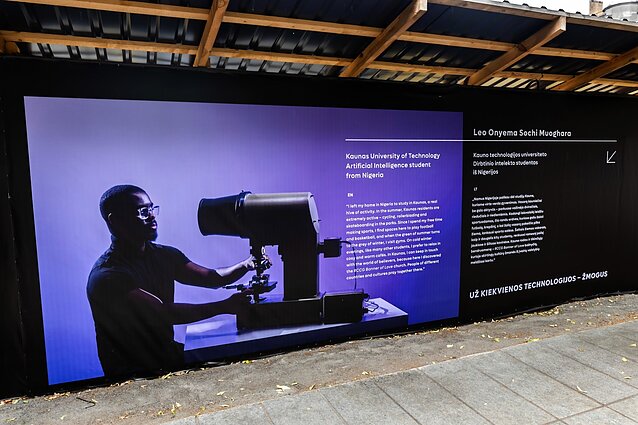
Also, only a few foreigners work in Lithuania after graduation. Most of them are those who started working during their studies or have families in Lithuania.
“Between 5–7 percent stay to work and live in Lithuania, which is a very small number. It is our ambition as a state to increase this number and to make sure that highly qualified specialists stay and work in our country after graduation,” says Indrė Baltraitytė, a representative of the Education Exchange Support Foundation.
The government is planning to encourage more foreign students to stay in Lithuania by including lectures on integration and Lithuanian language training in the scholarship programmes.
Currently, the Ministry of Education, Science and Sport awards 100 scholarships each year to foreigners who choose to study for a master’s degree in Lithuania.

Newsletter
Every Friday morning.