









Teltonika is currently Lithuania’s hottest company with the most impressive expansion plans – of around 3.7 billion euros in a technology centre in Vilnius over the next ten years. Meanwhile, the company’s branch in Molėtai is already up and running – transforming the town and the entire Lithuanian industry.
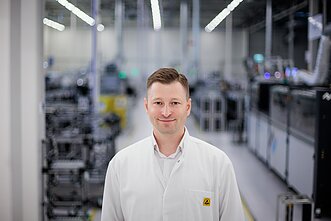
Paulius Rutkauskas, the head of the unit, showed LRT.lt the entire production process – from the component warehouse to the packaging unit.
New in town
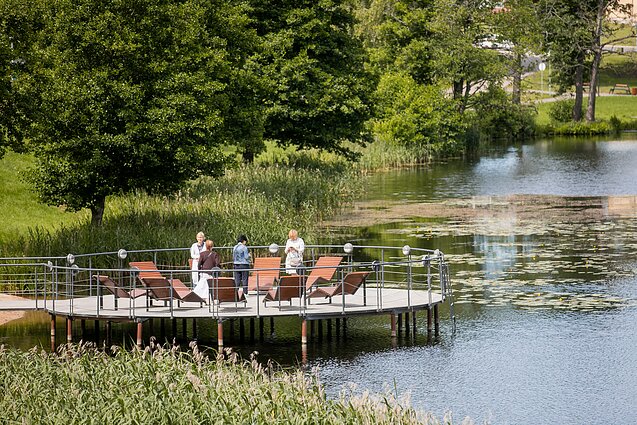
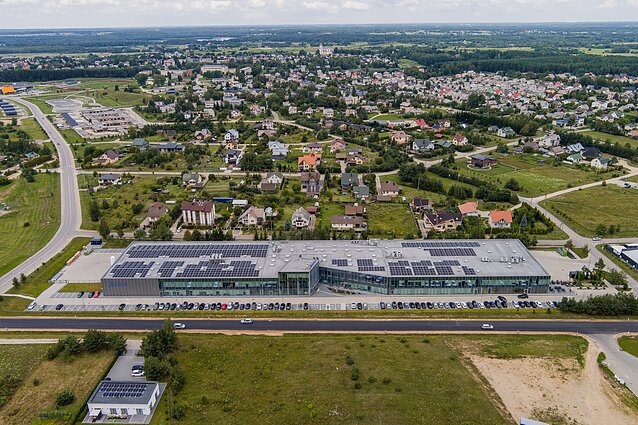
Teltonika’s Molėtai Technology Centre is located on a nearly 2-hectare plot of land at the entrance to the town of around 6,000 people. The modern building not only houses production facilities but also offices, lounge areas, a terrace and a restaurant. A solar power plant is installed on the roof.
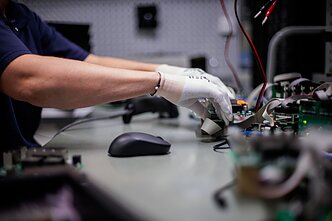
The ground floor houses five production departments: an electronics warehouse, a board assembly department, a testing department, an assembly department, and a mechanical warehouse.
However, as Rutkauskas says, you need to have a “recipe” before you can start production.

“The Teltonika team is designing and thinking up new products. They create the documentation, it’s like baking a cake, you have to know the recipe. In electronics, that recipe is unique and very precise. If you add something wrong, the cake won’t taste as good and the electronics product just won’t work,” he explains.
What Teltonika makes could fill an entire bakery shop.
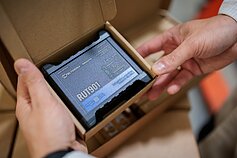
“Our R&D team designs products, in Molėtai we manufacture network equipment (Teltonika Networks), 4G and 5G routers and switches. We also produce charging stations for electric cars (Teltonika Energy) and smart bracelets that detect atrial fibrillation (Teltonika Telemedic). In addition, we produce contract manufacturing products, where customers from all over the world who do not have the production capacity come to us and we manufacture their products,” Rutkauskas explains.

Extraordinary warehouse
Production at Teltonika’s Molėtai Technology Centre starts with the component warehouse.
“We were the first in the Baltics to install automated warehousing systems for efficient warehouse operations. This is the first stage, but we plan to double the size of the warehouse. We are using height instead of floor space and working more efficiently.
“Next, we are going to automate to bring those components to the assembly lines where they are needed,” says Rutkauskas.
The Molėtai Technology Centre was built very quickly, in 10 months.
“We started on January 7, 2022, and on May 2 the skeleton of the building was there, only no windows, no equipment, no people. On October 22, 2022, we celebrated the grand opening and after the weekend, on Monday, we went to work,” says Rutkauskas.
Teltonika currently has two production sites, one in Vilnius and one in Molėtai.
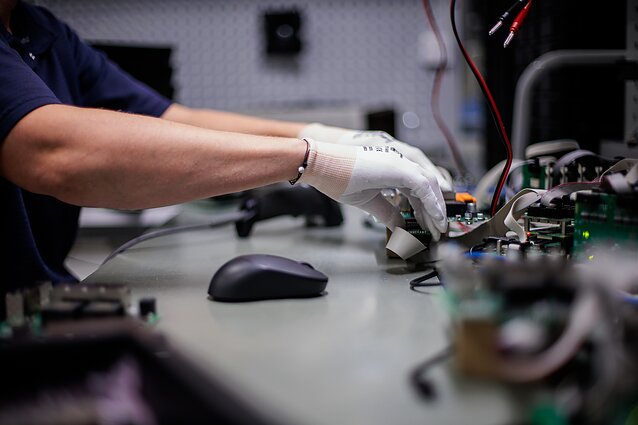
“Of course, we started hiring people much earlier. We used to take them to Vilnius to train. Our goal is to increase our workforce by 30 percent each year. We started with 125 people and today we have 270,” he says.
Work with PCB
Production started in 2022 with two lines and has since expanded to four. A fifth SMT (surface mount technology) line is due to come in September, followed by the sixth and final line a little later.
“When we reach full capacity, we will have around 500 employees in Molėtai and produce around 0.5 million products. At the moment, we are producing close to 200,000 units per month.
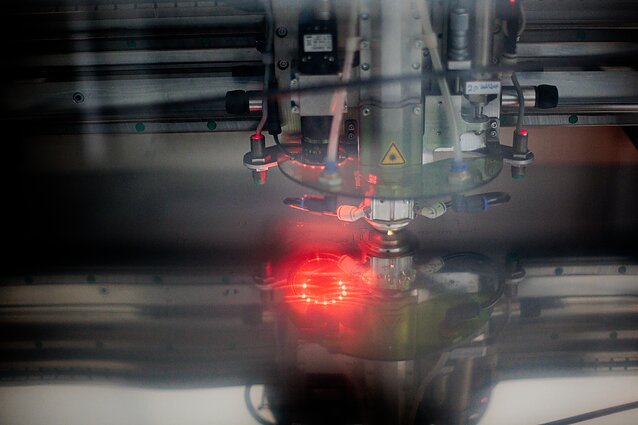
“The way Teltonika produces in Molėtai is basically the same as all over the world. There may be differences in equipment, in manufacturers, but here we have the latest German and Japanese equipment,” says Rutkauskas.
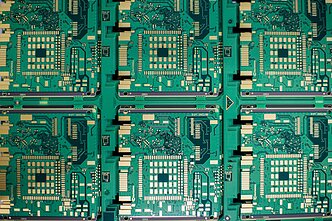
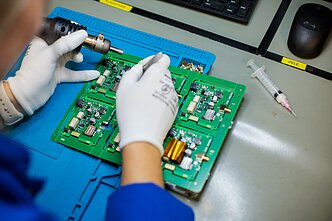
When developing new products, Teltonika engineers have to do this from the ground up. The PCB (printed circuit board) plays the role of connecting all the components. In the past, tube TVs used to be wired together, but as things are getting smaller, electronics are now soldered onto PCBs.
“We design the maximum number of products that can fit on a single PCB board, for example, six. Then we produce six instead of one at a time to make production efficient and competitive in the market,” says Rutkauskas.

PCBs use copper, gold-plated contacts, fibreglass, adhesives and protective lacquer.
“Then the paste is applied, onto which the components are placed. They are then soldered in a nitrogen environment under high-temperature conditions. Connections are made and the product can then be programmed, tested, assembled and sold.
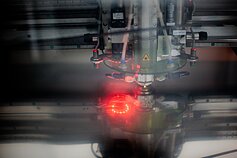
“But the base is the board. We have our own laser in Molėtai, we can cut the necessary stencils ourselves, we are flexible. We used to buy them, but deliveries take time,” explains Rutkauskas.
Special equipment checks that the lead-free paste is applied accurately and to a high standard, and then each robot does its job. “Then they go to the ‘furnace’ where, in a nitrogen environment, under high temperature, the solder melts, then cools and the solder points and contacts appear. Another step is automatic visual inspection, where precise cameras take pictures of the entire product and compare tolerances according to the IPC (Institute of Printed Circuits) standard. If everything is good, we move on to the next stages.”
All the rooms are temperature and humidity-controlled, adds Rutkauskas.
100-percent tested
The soldered PCB is only placed in the product body after testing.
“During testing, we check the product functionally – so that customers get a working product. We program the product, write firmware, ask a lot of questions through the test nodes (what is the voltage, what is the current, do you see Bluetooth, Wi-Fi, connect, disconnect). If the answers are correct, it is considered to have passed the testing. If at least one question is not answered, we can correct it here on site.”
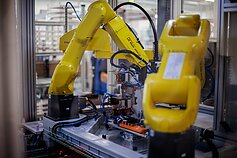
Teltonika’s Molėtai Technology Centre is equipped with robotic systems that slice PCBs into parts. For example, if a product is made up of two boards, the robotic system joins them together and places them on a pallet to be further assembled.
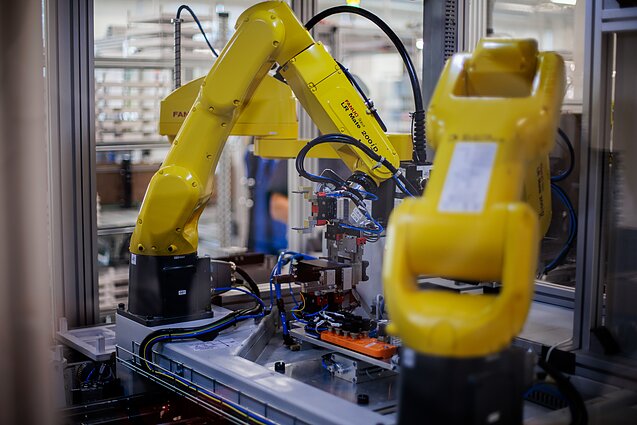
“The electronic semi-finished products are then delivered for assembly. A robot takes the plastic parts of the mechanics and assembles them. We mould these parts ourselves in Vilnius, where we have plastic moulding equipment. By the way, by autumn 2025 we will have a dedicated factory in Vilnius where we will be able to mould most of the components ourselves,” Rutkauskas says.
Once electronics are assembled into the casing, everything is screwed up, a laser engraves product information. The product is completed with power supply options – be they American, Australian or any other – two or three antennas, an instruction manual and the box is closed. “From both manual workstations and robotic systems, it goes down a conveyor to a packaging robot that packs it into a logistics box.”
Business-to-business
Teltonika does not sell to private customers, only to other companies, which then sell the products to end users. All the products have Teltonika logos. “So everyone who buys knows that they are buying Teltonika products,” Rutkauskas stresses.
Only about 1 percent of Teltonika’s production remains in Lithuania, the rest goes abroad where the company has over 30 offices.
“For example, our products are integrated into traffic monitoring systems. In Poland, our products are used for road tolls. Cameras and the internet are being integrated into 5G. Then there are airports, parcel lockers, ATMs – all these systems need internet connectivity, and our products do that.”

One of Teltonika’s products is a medical device to charge hearing aids. Teltonika EMS (electronics manufacturing services) developed it, but it is a customer product. “We call this original design manufacturing. When a customer has a vision but does not have the engineering resources, our team designs it, agrees on the technical requirements and then we manufacture it. The client is left to enjoy the profits,” says Rutkauskas.
In total, Teltonika has over 100 products on offer.
Plans for spectacular investments
The Teltonika Group consists of Teltonika Telematics, Teltonika Networks, Teltonika Energy, Teltonika Telemedic and Teltonika EMS, operating in different business areas.
The Molėtai Technology Centre is part of Teltonika EMS.
Telematics products – transport monitoring systems – are manufactured in the Vilnius plant. Teltonika Networks develops network equipment which is manufactured in Molėtai (3G, 4G, 5G routers, switches). Teltonika Energy offers EVCs (electric vehicle chargers), which are also manufactured in Molėtai, as are Teltonika Telemedic wristbands.
The wristbands are used by people who have heart rhythm problems. If the device detects a heart rhythm disturbance, it notifies the user that it is time for a cardiogram. It is then sent to the user’s doctor or hospital.
Teltonika EMS is the largest company in the group in terms of staff although Telematics and Networks are the main powerhouses in terms of revenue.

Teltonika was founded in 1998 and today has 2,600 employees worldwide, with over 30 offices worldwide, including in Toronto, Dallas, Mexico City, Hong Kong, Tokyo. There is a head office in Lithuania and products are manufactured only in Lithuania. Foreign branches have sales and technical support teams.
Teltonika Telemedic and Teltonika Energy are still relative startups set up three years ago.
“Teltonika has produced almost 30 million products over its history. Last year, Teltonika EMS had a production of 6 million products, with 8 SMT lines in operation. The total production area is 19,000 square metres. Next year, when we will open another plant in Liepkalnis, we will have twice as much production space as we have now,” says Rutkauskas.
He notes that the Teltonika Group is striving for consistent growth. In 2023, it enjoyed a profit of 45.7 million euros, had 2,550 employees and operations in 21 countries. The target for 2024 is a profit of around 70 million euros, 3,200 employees and a presence in 30 countries. Consolidated turnover last year was 294 million euros and is expected to reach around 400 million this year.
Meanwhile, growth targets for the next 10 years are around 8,000 employees in Lithuania (6,000 in Vilnius, 500 in Molėtai, 1,000 in Kaunas) and around 15,000 employees abroad. Product development and manufacturing should stay in Lithuania, while sales and servicing would largely move abroad. The target for annual turnover is 4 billion euros.
Rutkauskas notes that Europe currently accounts for about 60 percent of sales and the rest of the world 40 percent. “In the long term, there is a desire to reverse that proportion, to grow in Asia and other markets outside Europe,” he says.

Teltonika has planned investments of around 3.7 billion euros in ten projects over the next 10 years.
“The largest investment is a technology park in Vilnius. Teltonika High Tech Hill already hosts an EMS plant in operation. Another EMS plant should be added, as well as PCB and plastic plants. There are plans for a chip manufacturing complex, a power module manufacturing complex, warehouses, a data centre, a car park, a shopping centre,” Rutkauskas lists.
Still looking for staff
Teltonika started its operations in Molėtai, a town surrounded by a multitude of lakes some 60 kilometres to the north of Vilnius, to create new well-paid jobs.
“There have been no new businesses here for years. Arvydas Paukštys, the founder and president of our group of companies, comes from the Molėtai region and he decided to invest here, to help his native land. Today, 190 Molėtai locals work here. Of course, there are people from neighbouring regions, 35 from Utena, others from Ukmergė, even Kupiškis, Pabradė, Vilnius,” he says.
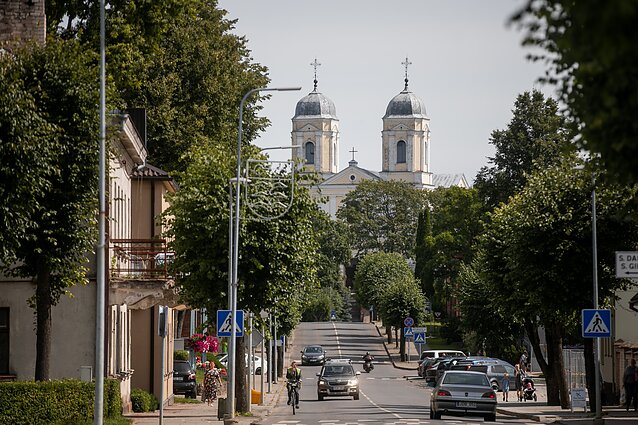
When the company built the technology centre in Molėtai, everyone knew that there would not be enough workers with the right skills.
“That’s why we set up the Teltonika Academy and started training people. We conducted interviews according to a recruitment plan. We took them to Vilnius for training. Now the new recruits are trained in Molėtai. It is easier for them not to have to travel to Vilnius. By the way, the time they spent on the road was counted as working hours with pay,” notes Rutkauskas.

As far as pay is concerned, workers with the same skills and responsibilities earn the same salary in Vilnius and Molėtai. It is up to them to choose where they want to live, says Rutkauskas.
Production in Molėtai is also a form of risk management, as it is safer to spread production in different locations.
“But the main reason was to help the region. The changes in Molėtai are very positive, there’s a new apartment block, the population is growing. People are returning from the big cities, from emigration,” summarises Rutkauskas.
The head of the Molėtai Technology Centre is himself from Vilnius, but will soon move to the town where he works.
“I’m already designing a house in Molėtai and my wife and I are looking forward to building a home, and planning to move. We are nature lovers,” he says.