












Moscow’s mouthpieces continue to spread propaganda and lies in the Baltic states, but a leaked hatch of reports suggests that their results have been quite limited. TikTok and Telegram are their channels of choice after most of their websites have been banned.
The LRT Investigation Team, together with Estonia’s Delfi and the independent Belarusian Media Bureau, analysed leaked Kremlin documents
“While the little kids from the Baltics are teasing Belarus, the West is cutting at Russia’s patience bit by bit,” Alexander Diukov, a self-identifying historian, opined last May. He went on to insist that a scenario of invading Belarus was being worked out in Lithuania. In the vanguard of this alleged invasion is supposed to be the Kalinowski Regiment, allowing to present the whole thing as a plot by the Belarusian opposition.
But it is not the Belarusian opposition, and not even Lithuania, that is actually behind it, says Diukov. “That’s the role that the Baltic countries play in the pan-European and Euro-Atlantic division of labour. Each country should have its own place. [...] The only thing the Baltics can do is to worsen the situation with Russia,” he claimed.
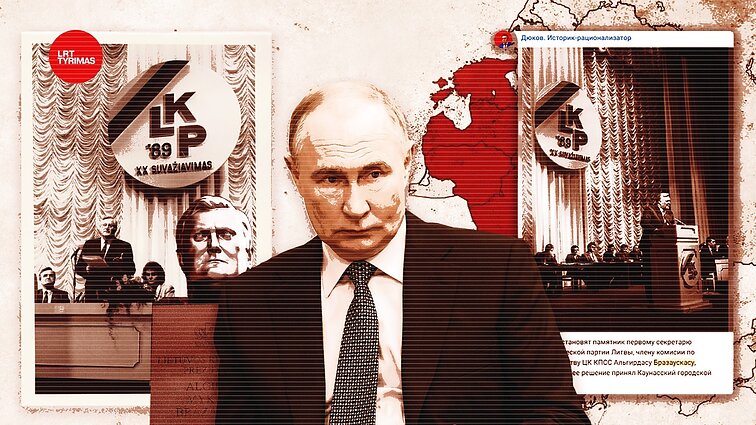
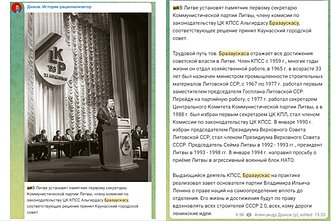
Nor does Diukov miss the opportunity to weigh in on the Kaunas mayor’s idea of building a monument to the late politician Algirdas Brazauskas who led the Lithuanian Communist Party but later successfully transitioned to be the country’s first president and social democratic prime minister. Diukov praises Brazauskas as a person who represents all the achievements of the Soviet government and who implemented Lenin’s idea of the self-determination of peoples. In today’s Lithuania, he argues, the policy of desovietisation and its methods show how “it is possible to rewrite the memory of individual events, to devalue the names and deeds of the heroes of the Soviet Union”.
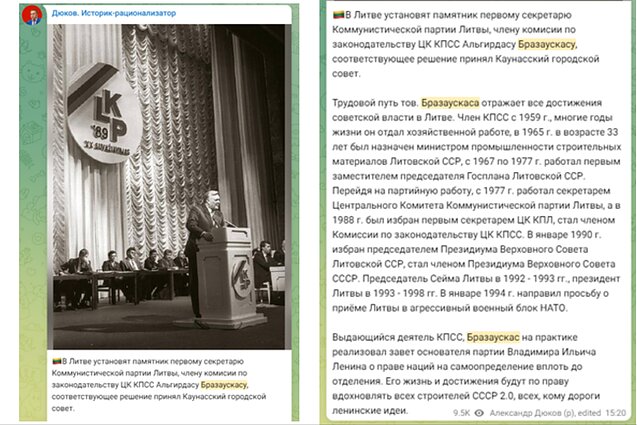
Diukov heads the Historical Memory Foundation in Russia, dedicated to whitewashing Soviet crimes, and has an extensive network of collaborators in the region, has published a scandalous book on the Holocaust. It seeks to justify the deportations and other Soviet repressions in 1941. Diukov has been under a travel ban in Lithuania since 2014 when he came to present his book.
However, the ban does not prevent Diukov from working against Lithuania and other countries in the region, especially Belarus, which is the second most important country for Moscow after Ukraine.
New faces of propaganda
Diukov’s comrade in his fight against the so-called “fascists” is Nikolai Mezhevich. He is the head of the Russian Association for Baltic Studies (RAPI), a professor at St Petersburg State University, and is best known in Russia as an expert on the Baltic states. As a result, he is regularly interviewed about the allegedly “unsuccessful” decisions of Estonia, Latvia and Lithuania regarding Russia, and calls Lithuania a “fascist” state.
Like Diukov, Mezhevich follows closely the developments in Lithuanian political life. Last spring, he was profusely sharing on his Telegram channel the statements of Eduardas Vaitkus, one of the candidates for the Lithuanian presidency. For example, Mezhevich enthusiastically agreed with Vaitkus’ claims that the Lithuanian authorities would try to “liquidate” him before the election, or that if “Lithuania tries to fight against Russia, it will be destroyed”. In May, Mezhevich congratulated Algirdas Paleckis – a former politician sentenced for spying for Moscow – on his birthday, calling him “the president of Lithuania” and “a prisoner of conscience”.

The Historical Memory Foundation and the Russian Association for Baltic Studies, the two structures headed by Diukov and Mezhevich, execute direct orders from the Moscow government. The LRT Investigation Team has gotten hold of documents that give a better understanding of their role in Russia’s propaganda machine geared towards the societies of the Baltic states, Belarus, and Moldova.
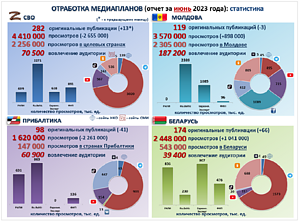
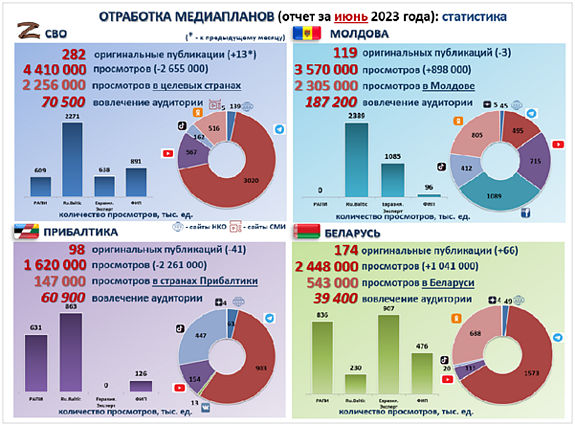
LRT has analysed documents, correspondence, and phone calls among the propagandists who report directly to the Kremlin administration. These documents include an action report submitted to Moscow in June 2023. The report describes the measures taken last year in the Baltic states, Moldova and Belarus and the results achieved.
According to sources from Western security agencies, the report was to be presented to the Russian Presidential Administration’s Directorate for Transnational Cooperation, an institution where almost all of the staff is exclusively from the Russian special services. Its long-time employee is Sergei Malenko who joined the presidential administration in 2015 and acted as Vladimir Putin’s adviser in the 2012 presidential election campaign.
Last year, journalists discovered that Malenko was responsible for developing a strategy for the Union State with Belarus, which detailed how Russia should control Belarus’ politics, economy and military by 2030.

However, the man in charge of propaganda in the former Soviet countries is currently Alexei Zhuravlev, who keeps a lower profile and has been working in Putin’s circle since 1997.
According to sources, his main tool is Diukov and the Historical Memory Foundation. However, Zhuravlev’s phone records obtained by journalists show that he also controls various shadowy organisations posing as independent research institutes or media outlets operating in foreign countries. Zhuravlev is in regular contact by phone both with Mezhevich’s son Alexei, who is in charge of advertising on his father’s Telegram channel, and with Alexander Nosovich, a representative of the online news outlet RuBaltic.
RuBaltic was founded by the Russian secret services and is a very active disseminator of Russian propaganda. Its chief editor Sergei Rekeda coordinates coverage directly with the Kremlin. And according to the June 2023 report, RuBaltic has generated more than 860,000 views in the Baltic countries, including Lithuania. Even today, it has a section dedicated to Lithuania that publishes threatening content, such as aggressive reminders that Russia has “gifted” Lithuania its independence by “allowing the use of Russian lands”.
Journalists tried to contact all the people mentioned above but only Diukov responded. He claimed to be unaware of the documents we have, of the periodic reports submitted to the Kremlin and of the communication with the Russian presidential administration.
“This is one of the latest attempts at discrediting. My colleagues and I have long faced persecution by the Baltic special services,” Diukov said by phone.
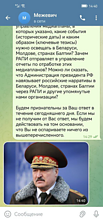
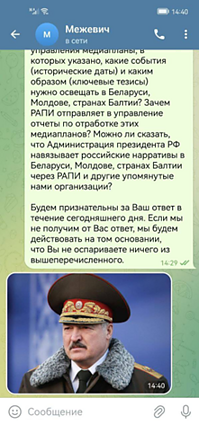
Mezhevich responded to our questions with a message containing nothing but a photo of Belarusian leader Alexander Lukashenko.
According to the State Security Department (VSD), Lithuania’s intelligence agency, the impact of these on the Lithuanian society is small but they contribute to creating a perception inside Russia that Lithuania and the other Baltic states are hostile countries.
In a written commentary, the VSD said that the Kremlin’s propaganda narratives are currently being disseminated in Lithuania by individuals acting alone. However, there is no record of their activities being financed by the Russian government.
However, according to the VSD, Russia is increasingly using pro-Russian Baltic nationals who have fled to Russia or Belarus to avoid prosecution. They get employed by Russian propaganda outlets or organisations implementing the Kremlin’s information and history policies.
Hundreds of posts for Lithuania
The leaked reports to the Kremlin show that, in 2023, campaigns organised in Lithuania and the neighbouring countries reached an audience of 150,000, with the most active social networks being TikTok and Telegram. On the latter, specially prepared content was posted 900 times over a single month last summer, while on TikTok some 450 videos were posted.
“The interesting thing is that we see the ecosystem changing. Since the Kremlin invaded Ukraine, many disinformation outlets have been blocked, in Lithuania and in the Baltics. And we can see that they are changing their strategy and that most of the disinformation last year was accessed via Telegram and TikTok,” Viktoras Daukšas, head of the thinktank Debunk.org, told LRT.
What matters, he said, is how the Kremlin measures the results, assesses the success of the assigned tasks, calculates the number of appearances in other media.
“We can see that the controls are quite strict because the reports are submitted every week with figures, so I think it is quite intense,” said Daukšas.
One example of success described in the reports is an interview of Mezhevich in June 2023 about the Baltic countries’ alleged intentions to strike at facilities in the Pskov Oblast, in Belarus, and to take over the control of Kaliningrad, all of which allegedly are already a subject of political discussions. His talks receive around 630,000 hits per month.

According to the report, the number of page views in the “target” countries increased by more than 40 percent last June but, it is pointed out, this is still not satisfactory.
The reports also note that “NGO representatives” like Mezhevich are invited to appear on Russia’s most popular political programmes, such as on Channel One and Vladimir Solovyov’s programmes. Mezhevich is quoted by Vedemosti, TASS, Pravda.ru and Ukraina.ru.
Every message controlled by the Kremlin
The propaganda zeal reports submitted to the Kremlin are just an outcome of the orders coming from Moscow to the experts and organisations it employs. For example, some of the leaked documents outline the themes that propaganda channels must disseminate.
The “Media Plan” for Moldova in June 2023 links the campaign to the NATO Summit in Vilnius last July. The plan states that the country’s President Maia Sandu, “in order to please the West and against the wishes of the majority of Moldovans, will try to abandon Moldova’s neutral status, dragging the country into NATO and turning it into another anti-Russian launching pad”.
Another message intended for the Moldovan population was that NATO, with the country’s help, was planning to open a “second front” against Russia, replacing Ukrainian soldiers on the battlefield with Moldovans. That is why, allegedly, the country is taking an active part in NATO exercises.

Ingrida Norkutė, an analyst at the Strategic Communications Department of the Lithuanian Armed Forces, told LRT that last year’s NATO summit in Vilnius saw the most intense information pressure in the whole year.
“Months before, they were saying that Lithuania is a failed state, it doesn’t pay for anything, so the NATO meeting will be a failure. As the summit approached, the messages changed, we saw more messages about the war in Ukraine, how the country was faring, and accusations that Ukraine was going to blow up the Zaporizhzhia nuclear power plant to have something to show to NATO before the summit,” said Norkutė.
In addition to the plan, the leaked documents contain a thematic report of Mezhevich’s association for the same period. It suggests that at least ten topics reached the Estonian, Latvian, and Lithuanian audiences in the first week of June last year. For example, a special campaign on the split of the Orthodox Church was prepared for Lithuania, which received at least 1,500 views per day.
“Developed in Ukraine: Lithuanian Orthodox Christians are being led to division” or “They don’t understand what they are doing: Lithuanian Orthodox Christians are at risk of splitting” are some of the messages that appeared on propaganda channels last summer, in line with the tasks set by Kremlin officials.

This was followed by Mezhevich’s own moralising about human rights violations in the Baltic states, which could only be overcome by Russia’s successful completion of a “special military operation”.
Moreover, the propaganda messages maintained that the three Baltic countries were profiting from support for Ukraine. RuBaltic.ru has also created a separate rubric on Russophobia, where the latest news story about Lithuania describes its efforts to erase videos by Russian performers from YouTube.
Mezhevich also had things to say on this topic. “[Lithuanian Foreign Minister] Gabrielius Landsbergis is a degenerate man. Lithuania is an absolutely fascist country, it has returned to its natural state, which it once was,” he declared in October 2023 to support his argument that Russia’s “special military operation” was also needed in the Baltic states.
“If decisions are taken in Lithuania that may support the Kremlin’s narrative, then it is disseminated through Kremlin-controlled channels, followed by comments from supposed experts or regime officials. Usually, the messages are first shared by very high-ranking officials and then go to news outlets, so the reach is not that small,” said Norkutė, an analyst at the Strategic Communications Department of the Lithuanian Armed Forces.

The documents show that the Kremlin is also targeting Baltic historical figures, linking them with the Red Army or the Soviet past. Diukov remains the most active player in this domain.
According to Daukšas, the head of Debunk.org, the leaked documents prove once again how the Kremlin uses its tools to spread discord and anger.
“World War Two themes are often used in memorial topics, and there was a surge in activity at that time. The split of the churches is a new theme, it happened after the Lithuanian Orthodox Christians decided to separate from Russia. It may not seem like big news, but the key insight is that they are investing billions in it,” Daukšas told LRT.
Mezhevich himself has recently taken an interest in historical memory. For example, on July 13, the day of the Soviet occupation of Vilnius in 1944, he proclaimed it to be the anniversary of the “liberation of Vilnius” and stressed that “today, Lithuania is once again a temporarily occupied territory, but as they say, change is just around the corner”. He consistently shares messages from the Telegram channel “Red Lithuania”.
The latter regularly shares messages from the Soviet occupation period, glorifying Lithuania’s communist past. The channel is also full of photos of meetings attended by the controversial politician Erika Švenčionienė and those involved in disinformation channels. Mezhevich calls them the real political opposition in Lithuania and stresses that they oppose NATO.

Sending troops to Ukraine
“It is not only Kyiv that has the task of recruiting as many people as possible into the army. In the Baltic countries, too, preparations are underway. The Lithuanian Seimas is trying to introduce universal conscription. At the moment, about 4,000 people a year are called up, and universal conscription will double this number,” Diukov writes on his Telegram account.
This message stands out among the historical content he usually shares on his channel. This could be linked to the Kremlin’s recent line that Lithuania will allegedly soon send troops to Ukraine. Lithuania’s plans to reintroduce universal military service supposedly proves this point.
These messages also find an audience in Lithuania. For example, last May, analysts from the Lithuanian Armed Forces documented an entire disinformation operation that started on Facebook with a photo purportedly shared by a military officer. The message with the photo says “we have been subjected to some very strange tests” and shows a sheet of paper with test questions and the name and symbols of the Lithuanian military’s Vytenis General Support Logistics Battalion. The test questions are designed to gauge the soldiers’ attitudes towards participation in military conflicts on foreign soil.
No such survey was conducted, LRT has found out. Moreover, the fragment of a soldier’s uniform seen in the photo is not of the colour of a modern Lithuanian soldier’s uniform. The profile of the person who shared the photo is full of military content, giving the impression of authenticity, but all the images shared are of officers from different countries. When contacted, the owner of the account did not respond to any questions.

The photo was shared in the Facebook group “Lithuanian military should defend Lithuania, not Ukraine”, which, according to Daukšas, is known as the group that tried to organise a protest during the NATO summit in Vilnius last year. And it is not only in Lithuania that attempts to spread lies about sending troops to Ukraine have been observed.
“Debunk.org has just analysed the information campaign in Côte d’Ivoire. A few months ago, Ukraine opened an embassy there, and the next day the information started to spread that the Ukrainian embassy was trying to recruit local citizens to fight in Ukraine,” the analyst said.
This, he said, involved the dissemination of forged documents. Examples of this can also be found in Lithuania. Another forged military document was circulated on Telegram in May. It purported to be a decree by the Lithuanian defence minister, authorising Lithuanian troops to participate in the armed conflict in Ukraine.
A few days later, similar fake documents found an audience in the Facebook group “Lithuanian military should defend Lithuania, not Ukraine”. Some of these documents have already been marked as fake and removed from Facebook, but there are still videos where supposedly Ukrainians with covered faces talk about President Volodymyr Zelensky’s petition inviting Lithuanian troops to fight in Ukraine. No such petition exists.
Mezhevich’s Telegram channel suggests that this campaign may have originated in Moscow. As soon as the false information about Lithuania sending troops to Ukraine began to circulate on social networks, he gave an interview to Sputnik on June 1, stating as a fact that Lithuania, Latvia and Estonia would send troops to Ukraine and that this was a NATO agenda.
“The role of Estonia, Lithuania and Latvia in NATO is a preliminary statement of programmatic theses, which will later be confirmed by the leading NATO countries, and especially by the USA,” said the propagandist Mezhevich.
A few days later, he once again shared news about the planned general conscription in Lithuania. “We understand where such unusual legislative innovations come from. We understand that the wind brought all this from Kyiv. We understand that every third able-bodied person has already left Lithuania. But this is just the beginning,” the Kremlin confidant shared his thoughts.

Newsletter
Every Friday morning.