







Lithuania’s outgoing government confronted multiple crises over its four years in power. Although many came naturally, other high-profile incidents were entirely of their own making.
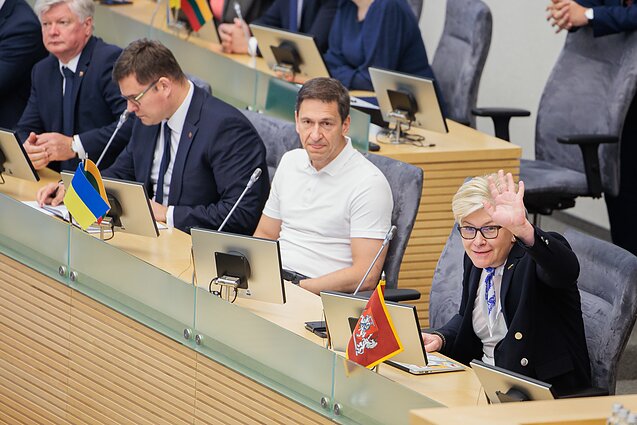
The government led by Prime Minister Ingrida Šimonytė came into power in late 2020. At the time, the country had already been fighting the Covid-19 pandemic for months. But as the number of cases climbed, the newly-elected government decided on a harsh quarantine in mid-December. This was followed by an extensive vaccination campaign and the introduction of a vaccine pass.
This provoked anger among a section of the population, particularly those against vaccination. The culmination came on August 10, 2021, when thousands of people rallied in front of the parliament, where a riot quickly broke out. Some 87 defendants are still on trial today.
Just a few months prior, in May 2021, the regime of Alexander Lukashenko diverted a plane frying from Athens to Minsk to arrest a Belarusian opposition activist, Roman Protasevich. Some 100 Lithuanian citizens were also onboard the plane. In response, the European Union adopted several sanction packages,
Angered by the decision, Lukashenko announced that he would no longer stop migrants trying to enter Lithuania. What followed was a new migration corridor, opened by the Minsk regime, for migrants from mostly the Middle East and Africa.

The Lithuanian government had to respond – firstly, what to do with those who had already entered the country, and secondly, how to secure the border amid what it called a “hybrid attack”.
According to Matas Baltrukevičius, an associate analyst at the Vilnius Policy Analysis Institute (VPAI), these global crises set the government apart from its predecessors.
“The context in which it had to act was probably the most unfavourable and the most difficult,” Baltrukevičius said.
Belarus sanctions nearly toppled the cabinet
However, many problems that dogged the outgoing government had been entirely of their making. When in the parliamentary opposition, Šimonytė claimed that corruption scandals and other incidents would have led to ministers losing their posts had they been in power. But once in government, these words proved hollow.
It was then that the Belarusian sanctions nearly toppled the government of Šimonytė. In December 2021, the United States imposed sanctions on Belaruskali, one of the world’s largest producers and exporters of potash fertiliser and a dominant source of foreign currency for the Lukashenko regime.
The day before the US sanctions came into force, Šimonytė said it wasn’t clear how they would be implemented in Lithuania. Soon, the government announced that the fertiliser cargo would continue to pass Lithuania by rail until January the following year, a month after the US sanctions came into force.

According to officials, this was because the Belarusian company had already paid the state-owned Lithuanian Railways for the cargo transit.
Observers and the political opposition then criticised the government for being one of the biggest flag-bearers of additional sanctions, yet failing to implement them once push came to shove. Foreign Minister Gabrielius Landsbergis acknowledged that the scandal was doing reputational damage to Lithuania.
As the outfall gathered momentum, Landsbergis said he was ready to resign, but was awaiting a decision from Šimonytė. Soon after, Minister of Transport and Communications Marius Skuodis also announced he was ready to take the fall.
Then, even the prime minister announced she was ready to resign. But days later, on December 14, 2021, she issued a statement saying that the cabinet would continue their work without any changes.
Corruption scandals
Another blow came in 2023 when Andrius Tapinas, a journalist and social activist, launched a campaign investigating the expenses of politicians in local administrations. The ensuing scandal focused predominantly on three ministers who had previously been members of the Kaunas City Council – Education Minister Jurgita Šiugždinienė, Finance Minister Gintarė Skaistė, and Culture Minister Simonas Kairys.
As calls grew for them to resign, Šimonytė defended her ministers, saying the scandal touched upon all parties and politicians, not only them.
Despite saying for weeks that she trusted the education minister, Šimonytė eventually accepted the resignation of Šiugždinienė. Meanwhile, Skaistė remained in her post after reimbursing the bloated expenses she had claimed during her work in the Kaunas Council.

In response, the head party of the ruling coalition, the Homeland Union (TS-LKD), decided to initiate early elections if the parliament did not approve the resignation of the government. Šimonytė also said she would resign if the Seimas voted against the government’s dissolution.
However, the parliament did exactly that – it rejected the proposal for the government to resign, as well as the idea of an early parliamentary election. After the vote, Šimonytė walked back her pledge to resign, saying she had reacted too emotionally.
Education takes a dive
Another scandal erupted after 35 percent of students failed their state mathematics exam. The Education Ministry scrambled for a lifeline, eventually introducing extra tutoring and interim inspections for pupils in the 11th grade.
But the first such tests earlier this year yielded mixed results. Some of the tasks in the physics and maths exams were flawed, while other technical problems stalked the Lithuanian language test.
The Director of the National Education Agency, Rūta Krasauskienė, had to resign, while the then Minister Gintautas Jakštas claimed the problems were due to financial mismanagement.
In April, Deputy Education Minister Ramūnas Skaudžius, who was responsible for general education, resigned, followed by Minister Jakštas.

Private flights
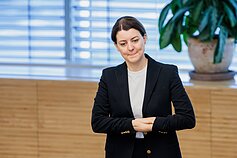
Subjectively, the largest scandal surrounded the resignation of Social Security and Labour Minister Monika Navickienė. For some time, questions were raised about the business connections of her husband, Mindaugas Navickas. However, the minister claimed she had no knowledge or relation to them and said it was up to the authorities to investigate.
But the real eruption happened when news leaked of the minister taking a free flight to Dubai on a private plane with Vilhelmas Germanas, a businessperson convicted of financial crimes.
She claimed the decision was a mistake and was made spontaneously. But the damage was done and she was ultimately forced to resign.
In all the cases, Šimonytė had been slow to demand resignations.
“I think that clinging to a team is not a good leadership trait,” said Baltrukevičius, the VPAI analyst. “The highlight was the famous demarche about the early elections. There was a real crisis here, which the government created itself.”
Sometimes, the political scandals were also caused by the complicated relations between the government and the president.
“There have been situations where ambition and grievances have gotten in the way. The last remaining serious challenge is the delegation of the European commissioner and the extremely complicated Lithuanian system, which is now revealing itself in all its glory," Baltrukevičius added.

Newsletter
Every Friday morning.