












Lithuania will raise the issues of Ukraine’s membership of the alliance, the place of the rotational air defence model in NATO’s plans, and the defence funding “floor” of 2.5 percent of GDP at the upcoming NATO summit in Washington.
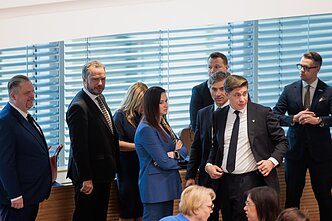
Lithuania’s preparations for the NATO summit in Washington in July were discussed on Friday at a joint meeting of the parliamentary Committees on Foreign Affairs and on National Security and Defence.
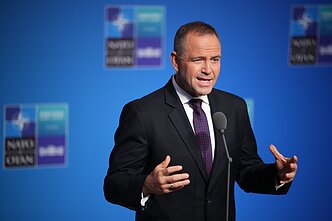
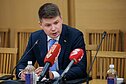
“We discussed the priorities for the upcoming summit – the issue of Ukraine’s membership, an invitation or at least a stronger language. We will stand firmly on Ukraine’s side in order to achieve something more than what we had in Vilnius [NATO summit of 2023],” Defence Minister Laurynas Kasčiūnas told reporters after the meeting.

The alliance stated at the Bucharest summit back in 2008 that Ukraine would become a NATO member in the future, but did not give a specific timeframe.
NATO leaders said at the Vilnius summit last July that an invitation to Ukraine to join NATO would be extended once the bloc’s members agreed and the country met the conditions.
It also decided to exempt Ukraine from the Membership Action Plan (MAP), to establish an Alliance-Ukraine Council and to approve a long-term support plan for Ukraine’s armed forces.
“Expectations may be slightly lower than last year because the partners are indicating very clearly that they are not ready to move strongly, but at least there is no change of mind, no retreat, no one thinks that the statements adopted last year were too strong,” Foreign Minister Gabrielius Landsbergis said.
“This gives hope that we are moving forward by constantly raising the issue,” he added.

Kasčiūnas said that at the Washington summit, Lithuania would also raise the issue of practical implementation of the regional defence plans adopted last year.
According to the minister, Lithuania will strive to ensure that the rotational air defence model in the Baltic states will become a necessity in NATO’s plans.
“We want this to become not only our field of action when we talk to countries to build systems here for training, but also to appear as a need in NATO’s overall plans,” Kasčiūnas said.
“So that this is not only a concern for our three countries, but also the implementation of the rotational air defence model appears in NATO’s plans,” he added.
NATO allies agreed in June last year that such a model would emerge, but it has not yet been implemented. The Baltic countries are currently in discussions with countries that could deploy air defence systems in the region.
According to Kasčiūnas, Lithuania also wants to start discussions on making it compulsory for alliance members to spend at least 2.5 percent of their GDP on defence.
“The discussion will probably remain a discussion, because not all countries have reached 2 percent yet,” Kasčiūnas said.
The NATO summit in Washington will take place July 9-11.

Newsletter
Every Friday morning.