












As Lithuania is in talks with German defence industry giant Rheinmetall over the artillery ammunition plant, experts say the state would also have to contribute financially.
Last week, Rheinmetall officially confirmed its plans to build a 155 mm artillery ammunition plant in Lithuania.
Further reading
The state would have to invest at least 250 million euros in the project, Vaidas Sabaliauskas, head of the Lithuanian Defence and Security Industry Association, estimates.
“The investment in the plant should be 250 million euros or more. I’m not familiar with the project and its scope. We have no information yet, but since we’ve talked to other manufacturers about them coming to Lithuania, this figure is not random,” he told BNS.
Prime Minister Ingrida Šimonytė said on Monday that Rheinmetall and Lithuanian authorities are currently holding working discussions, the results of which are expected in a few weeks. According to her, the main challenges are the financing of operations and the location of the plant in Lithuania.

Rheinmetall is unlikely to build the plant in Lithuania with only its own funds, Sabaliauskas believes. According to BNS sources, the establishment of a state-owned company is being considered for the project.
Aleksandras Nikonovas, head of the Finance Ministry-owned ammunition producer Giraitė, noted that setting up a state-owned company is one of the possible ways Lithuania could invest in the artillery ammunition plant.
“There are all sorts of examples in the world, both in the EU and in NATO countries. There can be all kinds of models: a mixed model, a listed company, a state-owned company. All models are possible,” Nikonovas told BNS.
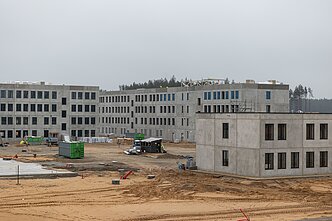
According to defence analyst Aleksandras Matonis, the future plant requires a “non-urbanised” area with well-developed transport, electricity, communications, and other infrastructure.
“The choice of the location would be a challenge because there are certain requirements for this kind of companies: distance from residential areas, preferably transport and energy infrastructure,” he explained.

Meanwhile, Nikonovas assured that there are places where the plant could be built, for example, in the central part of the country.
Involving local businesses
The production of artillery ammunition in Lithuania could start in three years at the latest, depending on the volume of investment, Matonis estimates.
“In this case, it would be a transfer of already known technology – the concrete construction of specific buildings, all this is simple and feasible. There would be no need for additional development, no need to rethink or improve. I think that the construction of such industrial projects can take one and a half to three years,” he said.
According to Sabaliauskas, such a plant in Lithuania would be a major boost for the local defence industry, shortening supply chains and creating business opportunities for Lithuanian logistics, metalworking, electronics, and other component manufacturing companies.
“Another level of Lithuanian security will also be achieved, as German capital will certainly provide greater security guarantees for Lithuania,” he noted.

head of the Lithuanian Defence and Security Industry Association also hopes that local businesses would be involved in the negotiations with Rheinmetall.
“We need to keep talking to the company to make sure it does not change its mind and to press them to move as much production as possible to Lithuania because the needs in Ukraine are inexhaustible at the moment,” Sabaliauskas said.
“This is a historic opportunity to attract such a manufacturer and to involve local business in the negotiations so that local business can offer its local competencies, premises, land plots, workforce, specialists,” he added.
In 2022, Rheinmetall and Krauss-Maffei Wegmann, another German defence industry company, set up a joint venture in Lithuania, named Lithuania Defence Services (LDS), for maintaining and repairing combat vehicles for NATO allies stationed in the Baltic Sea region and German-made military equipment sent to Ukraine.

Newsletter
Every Friday morning.