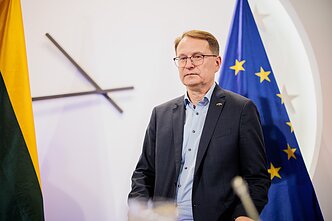


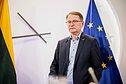

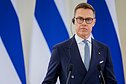




Prime Minister Ingrida Šimonytė has confirmed that Defence Minister Arvydas Anušauskas is stepping down from the post. The government wants to do “more and faster” for Lithuania’s security, while Aušauskas says he was offered to swap posts with another politician.
“It is about the expectation to do even more and faster during the government’s remaining term than has been done so far to make Lithuania feel secure,” the conservative prime minister posted on Facebook on Saturday, one day after information was leaked about Anušauskas’ resignation that sparked speculations.
“A lot has been done, but nine months is a short time and this session of the Seimas [parliament] is very important for taking decisions where maximum engagement is needed,” she added.
Anušauskas handed his resignation letter to the prime minister on Friday evening, but neither side has commented on the reasons for this so far.
According to Šimonytė, the resignation is not related to “any sudden change in the state of Lithuania’s national security or any negative news about the Defence Ministry’s performance.
“I regret that the leak of this information has given rise to various speculations […]. However, I would like to stress that the government is a political entity and therefore changes in the government take place when such changes are necessary,” the prime minister said.
Further reading
President’s office: decisions will be made next week
Anušauskas had a meeting with President Gitanas Nausėda on Saturday morning.
“The president stressed the need to ensure the functionality of the national defence system and the continuity and speed of the ongoing work,” the Nausėda’s senior adviser on national security Kęstutis Budrys told reporters after the meeting.
According to Budrys, the president will meet with Prime Minister Šimonyte on Monday and the necessary decisions on the change of ministers will be taken next week.

“The president, as commander-in-chief of the armed forces, has an interest in ensuring that the chain of command and leadership under him is clear, straight and functional,” the adviser said.
“The minister of defence plays an important role in peacetime and it is in the president’s interest that all decisions are taken in the shortest possible time,” he added.
Anušauskas: I was offered to swap places
Anušauskas himself commented on Saturday that he had received an offer from Prime Minister Šimonytė to swap posts with another politician, but refused to do so.
He also claimed that he had not heard any criticism from the prime minister about his performance so far.
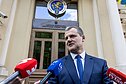
“At the end of the working day yesterday, I received an offer from the prime minister to give up the post of minister of national defence to another politician and to take his place as chairman of the committee in the Seimas. No reproaches have been made so far for any of the unimplemented items in the government programme. The offer was a bit unexpected for me and I turned it down,” the minister told reporters at the Presidential Palace.

He did not say whether he had been offered to swap positions with Laurynas Kasčiūnas, the chairman of the Committee on National Security and Defence.
Anušauskas said that he had asked the prime minister whether she really expected him to resign, but had received a positive answer and an offer to do so from next week.
He said that he had decided to resign “realising that in this difficult period, the decisions taken in the future work of the Ministry of National Defence and the strengthening of the armed forces in the face of the unabating threats require the political support of the prime minister”.
He insisted that he did not feel that he had made any mistakes that could have led the prime minister to dismiss him.
“What the public needs is not institutional battles, intrusive ranting about ‘end of the world’ geopolitics, but real action to strengthen our country’s defence power, the military,” Anušauskas said.
The politician also claimed that he “had to close the door on companies” that were trying to bribe national defence personnel in order to get lucrative contracts.
According to Anušauskas, these companies “found an open door to other politicians” and in some cases were investigated by the law enforcement. The minister said that PM Šimonytė supported all his anti-corruption activities, but he refused to name specific cases of bribery, companies, or politicians.
“I said what I wanted to say,” Anušauskas commented.
Ministers in Lithuania are appointed and dismissed by the president on the nomination of the prime minister.
The prime minister had originally planned to comment on the resignation of Anušauskas on Monday, a move that caused outrage among other politicians.

Newsletter
Every Friday morning.